
This guide covers six places on the walk from Republic Square to the old fortress: two cultural institutions on the square, a leafy park that used to be the city market, the Kalemegdan park and fortress, the Monument of Gratitude to France and the King's Gate deep inside the walls. Together they show the two sides of Belgrade, the 19th-century capital with its theatre and museum, and the much older fortress town on the cliff above the Sava and the Danube.
National Museum of Serbia
The National Museum is the oldest museum in Serbia, founded in May 1844. Since the 1950s it has filled a grand building on Republic Square that was built in 1902–1903 as the headquarters of a state financial institution, the Uprava Fondova, to a design by Andra Stevanović and Nikola Nestorović. In 2003 the museum closed for a reconstruction that dragged on for years, and it only reopened on 28 June 2018, Vidovdan, one of the most important dates in the Serbian calendar.
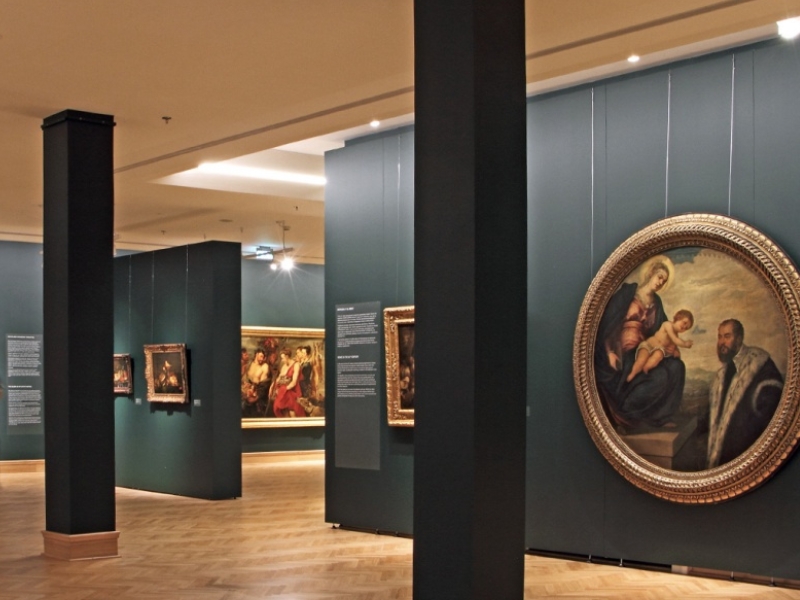
The collection runs from prehistory to modern art. Its best-known treasure is the Miroslav Gospel, an illuminated manuscript from around 1186 that is on UNESCO's Memory of the World register. The archaeology rooms show stone sculptures from Lepenski Vir on the Danube, from the 7th millennium BC, and clay figures from the Vinča culture. Upstairs there are Serbian and Yugoslav painters, and European works by artists such as Titian, Renoir and Van Gogh. The museum is one of the stops on our scavenger hunt.
- The main facade facing Republic Square, with its central dome and sculpted figures above the entrance.
- The equestrian statue of Prince Mihailo Obrenović in front of the museum, the usual meeting point in Belgrade, which locals simply call 'kod konja', at the horse.
National Theatre in Belgrade
Across the square stands the National Theatre, founded in 1868 by the writer Jovan Đorđević at the invitation of Prince Mihailo. The building, by the architect Aleksandar Bugarski, went up very fast: the foundation stone was laid in August 1868 and the theatre opened in November 1869. It stands beside the site of the old Stambol Gate, the city gate on the road to Istanbul, built by the Austrians in the 18th century and pulled down in 1866 on Prince Mihailo's orders.
The theatre has been rebuilt several times. Work started in 1911 was halted by the First World War and only finished in 1922. German bombs damaged the building on 6 April 1941, the first day of the attack on Yugoslavia, and it was repaired during the war. A big reconstruction followed from 1986 to 1989. Today it stages opera, ballet and drama, the large productions on the main stage and smaller plays on the Raša Plaović stage. The theatre is one of the stops on our scavenger hunt.
- The main entrance on the corner of Vasina and Francuska streets, and the long side facade facing Republic Square.
Studentski Park
A few streets north, Studentski Park (officially Akademski park) is a green square between the university faculties. Its past is less peaceful than it looks: under the Ottomans this was a Turkish cemetery, and from 1824 to 1926 the Great Market of Belgrade took up the space. Part of the park was laid out in the late 1880s and opened in 1897, and in 1927 the old market site was added and the present layout designed by Đorđe Kovalevski. It has been protected as a natural monument since 2007, and it is one of the stops on our scavenger hunt.
- Three monuments to Serbian scholars: the botanist Josif Pančić (1897), the writer and educator Dositej Obradović by Rudolf Valdec, first unveiled on Knez Mihailova in 1914 and moved here in 1930, and the geographer Jovan Cvijić (1994).
- The stone fence and wrought-iron gates from 1929, and the buildings around the park: the faculties of philosophy, philology and natural sciences, and the Kolarac concert hall.
Kalemegdan Park and the Belgrade Fortress
Kalemegdan takes its name from two Turkish words, kale (fortress) and meydan (square or field). It was the open ground in front of the walls, where the Ottoman army trained and gathered before battles. The fortress itself is far older: Celts and then Romans fortified this ridge above the meeting of the Sava and the Danube, and the walls you see today are mostly the work of Austrian and Ottoman engineers of the 18th century, built over Serbian, Byzantine and Roman remains.
After the Ottoman garrison left in 1867, the city began turning the empty field into a park in 1869, on an idea by the town planner Emilijan Josimović, and the biggest works came from 1890. Today Great Kalemegdan has formal promenades, the Military Museum and the long Sava Promenade along the ramparts, while Little Kalemegdan holds the zoo, opened in 1936, and the Cvijeta Zuzorić art pavilion of 1928.
- The Inner Stambol Gate, built during the Austrian reconstruction of 1717–1736, on the way from the park into the Upper Town.
- The Clock Tower gate from the mid-18th century, now the main entrance to the Upper Town; clock towers are rare in fortresses.
Monument of Gratitude to France
At the end of the main alley of the park, near Karađorđe's Gate, a bronze woman more than four metres tall strides forward with one arm stretched out. She is France, coming to Serbia's aid in the First World War. The monument was designed by Ivan Meštrović and unveiled on 11 November 1930, the anniversary of the armistice, in the presence of King Alexander and Queen Maria. Its drapery is shaped like wings, a clear echo of the Winged Victory of Samothrace. The monument is one of the stops on our scavenger hunt.
- The inscriptions on the stone pedestal: 'A la France' on the front and, on the back, 'We love France as she loved us 1914–1918', recarved during the restoration of 2018. Look also at the reliefs on the sides, carved from Meštrović's drawings.
The King's Gate
The King's Gate (Kralj kapija) is the southwestern gate of the innermost wall of the Upper Town, built around 1725 during the Austrian rule of Belgrade. It is easy to miss: you reach it down a short flight of steps that passes the Roman Well, and a bridge leads from it across the moat to the King's Ravelin, an outer defensive work. Standing in the passage you get a good sense of how many layers of walls an attacker had to cross. The King's Gate, listed on our route as the Royal Gate, is one of the stops on our scavenger hunt.
- The thickness of the walls in the gate passage, and the bridge to the ravelin, which shows how the defences were built as rings inside rings.
How to see them in one walk
Start on Republic Square, where the National Museum and the National Theatre face each other. Walk up Vasina street to Studentski trg and Studentski Park, then continue along Knez Mihailova to its end at the edge of Kalemegdan. Follow the main alley to the Monument of Gratitude to France, then go up through the Inner Stambol Gate and the Clock Tower gate into the Upper Town. Look for the steps down past the Roman Well to the King's Gate, and finish at the viewpoint over the rivers.
See Belgrade with World City Trail
Our Belgrade scavenger hunt turns the old centre into a game you play on your phone. The route links 10 stops, from Republic Square to the Victor. The National Museum, the National Theatre, Studentski Park, the Monument of Gratitude to France and the King's Gate are all stops, along with Republic Square, the University of Belgrade, the city's educational buildings, the place where the city keys were handed over in 1867 and the Victor. At each stop you solve a puzzle and learn a story, at your own pace.
There is also a self-guided walking tour and an outdoor escape game in Belgrade, for people who prefer a different format.
Play the Belgrade scavenger hunt →
Take the self-guided walking tour of Belgrade →
Play the outdoor escape game in Belgrade →
Facts checked in October 2026.