
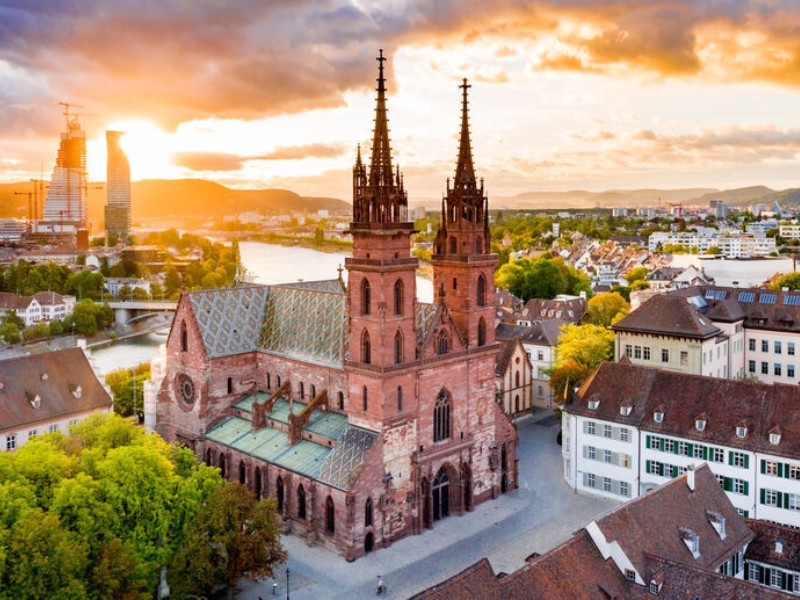
This guide follows five places in Basel from the railway station up into the old town: the Strasbourg Monument, the Offene Kirche Elisabethen, Basel Minster, the Natural History Museum and St Peter's Church. Four of them are about faith, learning and remembrance, and all five lie on the same route through Grossbasel, so you can see them in the order they come.
The Strasbourg Monument (Strassburger Denkmal)
In the small Elisabethenanlage park next to the main railway station stands a bronze group by Frédéric Auguste Bartholdi, the sculptor of the Statue of Liberty in New York, made in 1895. It thanks Switzerland for its help during the siege of Strasbourg in the Franco-Prussian War: in September 1870 a delegation from Basel, Bern and Zürich won permission to bring about 1,400 women, children and elderly people out of the besieged city. The monument was paid for by a French donor, Baron Hervé de Gruyer. It is the first stop of our scavenger hunt.
- The figures: a winged genius leads Alsatia, the figure of Alsace in traditional dress, with a weeping child, to Helvetia, who takes her hand and holds a shield over them.
- The reliefs on the base, which show the rescue and an older story of friendship between the cities: the trip of 1576, when men from Zürich travelled by boat to Strasbourg with a pot of millet porridge, which according to the story was still warm on arrival.
Offene Kirche Elisabethen
The Elisabethenkirche was built between 1857 and 1864 to designs by Ferdinand Stadler and was the first new church built in Basel since the Reformation. It was paid for by Christoph Merian, a wealthy landowner and one of the city's great benefactors, and his wife Margarethe Merian-Burckhardt. Merian died in 1858, just before the foundation stone was laid, and the couple are buried in marble sarcophagi in the crypt. Its neo-Gothic tower is taller than the towers of the Minster.
Since a full renovation between 1990 and 1994 the church has been run as an 'open church' (Offene Kirche), supported by the Reformed, Roman Catholic and Christian Catholic churches. It is one of the stops on our scavenger hunt.
- The stone pulpit, whose canopy is in fact made of wood painted to look like stone, a cost-saving trick that was mocked at the time as 'carpenter's Gothic'.
- The organ by the French builder Joseph Merklin, built at the same time as the church.
Basel Minster (Basler Münster)
The Minster, in red sandstone with a roof of coloured glazed tiles, stands on the hill above the Rhine where the bishops of Basel had their seat. A cathedral of Emperor Henry II was consecrated here in 1019, and the church is still linked with Henry and his wife Kunigunde. The late Romanesque building was finished around 1225. The earthquake of 1356 brought down five towers, the choir and several vaults, and the master builder Johannes Gmünd rebuilt it; the south tower, the Martinsturm, was completed on 23 July 1500. On 9 February 1529 the religious images were removed, the bishop's seat came to an end, and since then the Minster has been a Reformed Protestant church.
The humanist Erasmus of Rotterdam died in Basel in 1536 and was buried in the Minster, and his epitaph is one of its best-known memorials. In the cloisters is the gravestone of the mathematician Jacob Bernoulli, who asked for a logarithmic spiral with the motto 'Eadem mutata resurgo' (Changed, I rise again the same). The mason carved an Archimedean spiral instead, a different curve. The Minster is one of the stops on our scavenger hunt.
- On the west front, St George fighting the dragon on one tower and St Martin sharing his cloak with a beggar on the other, with figures of the founders Henry II and Kunigunde on the facade.
- The Galluspforte on the north side, a Romanesque portal from the late 12th century with Christ in judgement and the wise and foolish virgins.
- The small stone elephants on the outside of the choir at the eastern end.
- The Pfalz, the terrace behind the Minster, once the bishop's garden, with a wide view over the Rhine; on a clear day you can see the Black Forest and the Vosges.
Natural History Museum Basel
Basel's Natural History Museum opened in 1821, and since 1849 it has been on Augustinergasse, a few steps from the Minster, in a large neoclassical building by Melchior Berri, built from 1842 to 1849 as a museum and university building. Its oldest objects go back to the Amerbach Cabinet that the city bought in 1661, and today the collections hold more than 11 million objects, most of them fossils and invertebrates. The permanent exhibitions cover dinosaurs, the evolution of mammals, minerals, and the birds and mammals of Switzerland. The museum is one of the stops on our scavenger hunt. It is due to move to a new building in the St. Johann district, planned to open around 2028 or 2029, so check where it is before you go.
- Arnold Böcklin's three frescoes in the main staircase.
- The mummy of Anna Catharina Bischoff, an 18th-century Basel woman whose identity was traced by researchers.
St Peter's Church (Peterskirche)
St Peter's stands on the western side of the old town, above the valley of the Birsig. A church probably stood here as early as the 9th century, and the present building took shape after a chapter of canons was founded in 1230 to 1233; the tower was begun in 1270. After the University of Basel was founded in 1460, the canons' posts were turned into professorships, so the church was closely tied to the university. The 1356 earthquake damaged it badly, and since 1529 it has been a Reformed church. It is one of the stops on our scavenger hunt.
The church is known for its wall paintings from the 14th to the 16th century, many of them whitewashed after the Reformation and uncovered later. The most important is an Entombment of Christ from the late 14th century, counted among the finest Gothic paintings of the Upper Rhine.
- The Eberler Chapel, with an Annunciation painted around 1475.
- The gravestone of Johann Froben, the printer who published Erasmus, and epitaphs of the Bernoulli family of mathematicians.
How to see them in one walk
Start at the Strasbourg Monument outside the railway station and walk down Elisabethenstrasse to the Offene Kirche Elisabethen. Continue into the old town and up to the Münsterplatz for the Minster, its cloisters and the Pfalz terrace. The Natural History Museum is just around the corner on Augustinergasse. From there walk down to the Marktplatz and climb up to St Peter's Church on the other side of the Birsig valley. This is also the order in which the stops come on our scavenger hunt.
See Basel with World City Trail
Our Basel scavenger hunt turns the old town into a game you play on your phone. The route links 10 stops, from the Strasbourg Monument to the Rhine, and all five places in this guide are stops, along with the Kunstmuseum, the Town Hall, the Spalentor, the Mittlere Brücke and the Rhine itself. At each stop you solve a puzzle and learn a story, at your own pace.
There is also a self-guided walking tour and an outdoor escape game in Basel, for people who prefer a different format.
Play the Basel scavenger hunt →
Take the self-guided walking tour of Basel →
Play the outdoor escape game in Basel →
Facts checked in October 2026.