
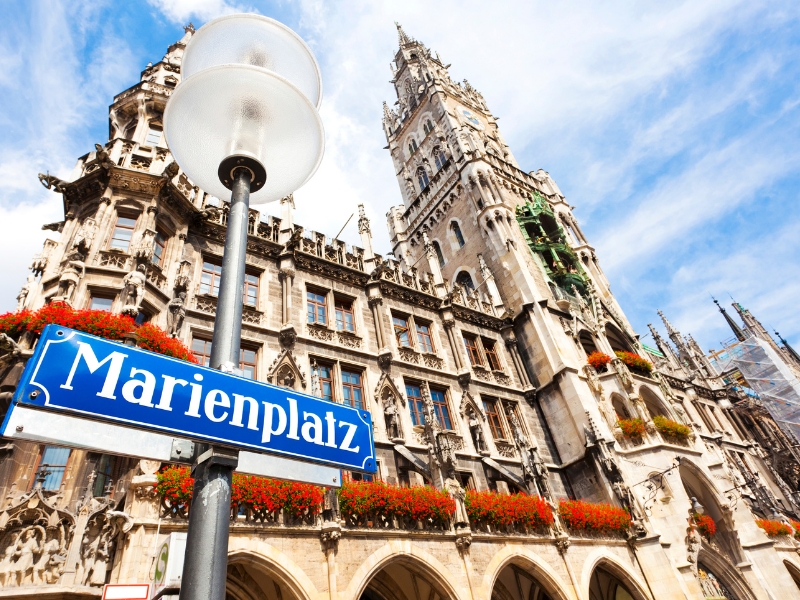
Munich's three busiest old-town sights lie within a few minutes of each other: the Jesuit church of St Michael on the shopping street, Marienplatz with its town halls, and the Viktualienmarkt food market behind them. This guide covers the three together, with their history and the details most people walk past, because one short walk links them and all three are stops on our scavenger hunt.
Marienplatz
Marienplatz has been Munich's main square since the city was founded in the 12th century. For centuries it was a market place where grain, salt and other goods were traded, and it only got its present name in 1854, after the Marian column in its centre. That column was put up in 1638 by Elector Maximilian I to give thanks that Munich had been spared destruction when the Swedish army occupied it during the Thirty Years' War.
The north side is filled by the New Town Hall, a neo-Gothic building put up between 1867 and 1908 to designs by Georg von Hauberrisser. Its tower holds the Glockenspiel, one of the largest in Europe. When it plays, two scenes turn above the square: the wedding of Duke Wilhelm V and Renata of Lorraine in 1568, complete with a joust, and the Schäfflertanz, the coopers' dance which, according to legend, the barrel makers first danced to bring people back into the streets after a plague. A lift inside the tower takes visitors up to a viewing platform high above the square.
At the east end of the square stands the Old Town Hall, with its Gothic hall and a gate tower that was rebuilt after the war. Between the two town halls, the Fish Fountain is the setting of an old custom: on Ash Wednesday the mayor and others come to wash their empty purses in it, which is supposed to bring them money in the year ahead.
- The Virgin on top of the Marian column and, at its base, four putti fighting a lion, a dragon, a basilisk and a serpent, symbols of war, hunger, plague and heresy.
- The figures of the Glockenspiel, including the Bavarian and Lorraine knights in the joust; in the version that plays today the Bavarian knight wins.
- The small Munich Kindl, the city's emblem of a child in a monk's habit, at the top of the New Town Hall tower.
- The dragon climbing the corner of the New Town Hall on the side of Weinstraße.
St Michael's Church
On Neuhauser Strasse, the pedestrian street leading west from Marienplatz, stands St Michael, the church built for the Jesuits by Duke Wilhelm V between 1583 and 1597. It was a statement of the Counter-Reformation in a Catholic duchy, and it is the largest Renaissance church north of the Alps. Its white interior has a wide barrel vault with no pillars, one of the largest of its time.
The construction was not smooth. In 1590 the tower collapsed onto the unfinished choir; the duke took it as a sign that the church was too small and had the choir rebuilt on a larger scale. The church was badly damaged in the Second World War and rebuilt afterwards.
Below the choir lies the crypt of the Wittelsbach family, the dynasty that ruled Bavaria for more than 700 years. More than 40 members are buried there, among them King Ludwig II, the builder of Neuschwanstein, whose coffin is usually decorated with flowers left by visitors.
- The bronze statue of the Archangel Michael fighting a demon between the two entrance portals, cast in the 1580s by Hubert Gerhard.
- The row of statues of Wittelsbach rulers on the facade, a family tree in stone.
- The great white vault seen from the back of the nave.
- The tomb of Ludwig II in the crypt.
The Viktualienmarkt
Just south-east of Marienplatz, the Viktualienmarkt is Munich's best-known food market. It began in 1807, when King Max I Joseph had the farmers' market moved off the overcrowded main square to this site. Since then it has grown into a permanent market of stalls and small shops selling fruit, vegetables, cheese, meat, fish, bread, flowers and ready-made food. The name comes from Viktualien, an old word for food supplies borrowed from Latin.
In the middle stands a beer garden which, unusually, serves beer from each of the big Munich breweries in turn. Around the market are fountains with statues of Munich comedians and folk singers, among them Karl Valentin and Liesl Karlstadt, which locals often decorate with fresh flowers.
The market sits between two old churches: the Heilig-Geist-Kirche, on the north-east side, and St Peter's, Munich's oldest parish church, whose tower gives one of the best views over the square and the market.
- The tall blue-and-white maypole decorated with figures of the trades and crafts of Munich.
- The Karl Valentin fountain, with the comedian's bronze figure and his famous lean frame.
- The stalls selling Bavarian specialities such as Weisswurst, pretzels and Obatzda cheese spread.
- The view of the market and the old town from the tower of St Peter's next door.
How to see them in one walk
Start at St Michael's on Neuhauser Strasse and walk east along the pedestrian street to Marienplatz; on the way you pass close to the Frauenkirche with its two domed towers. Spend some time on the square, ideally when the Glockenspiel plays, then walk past the Old Town Hall and St Peter's to the Viktualienmarkt and finish with lunch at the stalls. From there it is a short walk to the Isartor or the Asamkirche on Sendlinger Strasse.
See Munich with World City Trail
Our Munich scavenger hunt turns the city centre into a game you play on your phone. The route links 10 stops, from Königsplatz to the Isartor. All three places in this guide are stops, along with Karolinenplatz, Odeonsplatz, Max-Joseph-Platz, the Frauenkirche and the Asamkirche.
If you prefer a different format, there is also a self-guided walking tour and an outdoor escape game in Munich.
Play the Munich scavenger hunt →
Take the self-guided walking tour of Munich →
Play the outdoor escape game in Munich →
Facts checked in October 2026.