
Most visitors to Nuremberg arrive at the main station and walk into the old town from the south. This guide follows that line: from the Opera House outside the walls, through the Handwerkerhof crafts courtyard at the Königstor, past St Lorenz and the Fountain of Virtue, to the provocative Ehekarussell fountain and finally up to Albrecht Dürer's House below the castle. Together they show five sides of the city: theatre, crafts, Gothic art, modern sculpture and its most famous painter.
The Opera House
Nuremberg's opera house stands on the Frauentorgraben, just outside the old town walls. It was built between 1901 and 1905 to designs by the Berlin theatre architect Heinrich Seeling and opened on 1 September 1905; its facades mix Neo-Renaissance and Neo-Baroque forms with touches of Art Nouveau. In 1935 the interior was hastily remodelled by Paul Schultze-Naumburg to strip out the Art Nouveau decoration, because Hitler wanted a Wagner opera to open that year's Nazi party rally. Damaged in 1945, the house was rebuilt after the war and is home to the Staatstheater Nürnberg. A long general renovation has been planned for years, with the Kongresshalle on the former party rally grounds chosen as the interim venue, so check what is on before you go.
- From the outside, look at the mix of styles on the facades, then compare it with the old town walls across the moat: the opera house was built just outside the medieval fortifications.
The Handwerkerhof
Right inside the Königstor, in the walled yard of the old Frauentor fortifications, is the Handwerkerhof, the Craftsmen's Courtyard. It opened on 1 April 1971, the year of Albrecht Dürer's 500th birthday, with new half-timbered houses built inside the former Waffenhof, the armoury yard of the city's last fortifications. It is unashamedly made for visitors, but it is a pleasant first stop when you come from the station: small workshops where you can watch Lebkuchen bakers, potters and goldsmiths at work, and stalls selling Nuremberg sausages, Franconian beer and wine, and wooden and tin toys.
- The setting: look up at the massive city wall and the towers of the Frauentor and Königstor around the courtyard, part of the late-medieval defences that still ring most of the old town.
St Lorenz (St Lawrence's Church)
St Lorenz is the great Gothic church of the southern old town, the Lorenz side of the river. Work on the three-aisled basilica began around 1250 and was largely complete by about 1390. Between 1439 and 1477 the city added the soaring hall choir that makes the east end so light, and the twin towers reach about 81 metres. Air raids in 1943 and 1945 and the final battle for the city in April 1945 badly damaged the roof and vaults; rebuilding began in 1949 and the first service in the restored church was held on St Lawrence's Day in 1952.
On the square in front of the church stands the Fountain of Virtue (Tugendbrunnen), a bronze fountain with allegorical figures of the virtues that Benedikt Wurzelbauer designed and cast between 1585 and 1589. It is a good place to stand back and take in the west front of St Lorenz.
- The Angelic Salutation (Englischer Gruß) hanging in the choir, a carved Annunciation that the patrician Anton Tucher commissioned from Veit Stoss in 1517–1518.
- The tabernacle by Adam Kraft, made between 1493 and 1496, a stone tower of Gothic tracery that climbs towards the vault.
- The two west towers of about 81 metres, best seen from the square beside the Fountain of Virtue, and the contrast between the older basilica nave and the brighter hall choir.
The Ehekarussell (Marriage Merry-go-round)
In front of the Weißer Turm (White Tower) stands the fountain officially called the Hans-Sachs-Brunnen but known to everyone as the Ehekarussell. The city commissioned it from the Braunschweig sculptor Jürgen Weber, who designed it between 1977 and 1981, and it was installed in 1984. Six larger-than-life bronze groups show the stages of married life, from passionate first love through quarrels to death, based on the poem "Das bittersüße eh'lich' Leben" (The Bittersweet Married Life) by the Nuremberg poet Hans Sachs, who sits on a pedestal above them. Many locals found the figures crude when it was unveiled, and the budget overrun added to the row.
- Walk all the way round: the scenes only make sense in sequence, and the details, from the young lovers to the end of the couple's life, are meant to be looked at up close.
Albrecht Dürer's House
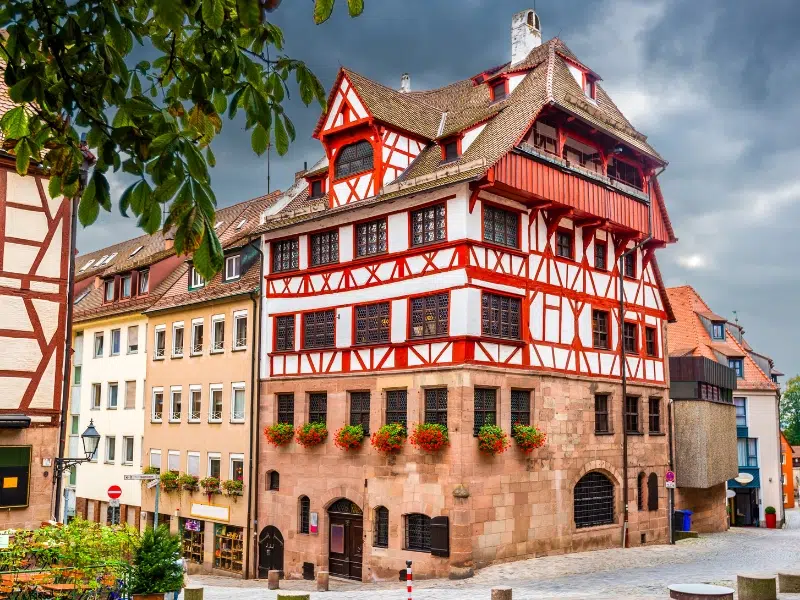
The corner house at the Tiergärtnertorplatz, just below the castle, was built around 1420; beams from it have been dated to 1418. Albrecht Dürer bought it in 1509 and lived and worked here until his death in 1528. The city bought the house in 1826, and it has been run as a museum since 1871. It was seriously damaged in the Second World War but survived far better than most of the old town, and it reopened to the public as early as 1949.
Inside, the house shows how a successful artist lived and worked around 1500. Costumed tours led by "Agnes Dürer", the painter's wife, tell stories about everyday life in the household, and an audio guide is also available.
- The workshop on the second upper floor, possibly Dürer's own, with the tools and materials for drawing, engraving and woodcuts, and a working replica of a printing press based on a Dürer drawing.
- The largely original kitchen on the first floor, and outside, the Tiergärtnertorplatz square in front of the house, with the castle walls rising behind it.
How to see them in one walk
Start at the Opera House and cross into the old town at the Königstor, where the Handwerkerhof is right inside the gate. Follow the main street north to St Lorenz and the Fountain of Virtue, then turn west to the Weißer Turm and the Ehekarussell. From there, cross the Pegnitz and head uphill through the northern old town to Albrecht Dürer's House at the foot of the castle.
See Nuremberg with World City Trail
Our Nuremberg scavenger hunt turns the old town into a game you play on your phone. The route links 10 stops and starts at the Opera House, and five of them are in this guide: the Opera House, the Handwerkerhof, St Lorenz, the Ehekarussell and Albrecht Dürer's House. It also takes in the Fleischbrücke, the Hauptmarkt, the Schöner Brunnen and St Sebald's Church before finishing at the Imperial Castle.
If you prefer a different format, there is also a self-guided walking tour and an outdoor escape game in Nuremberg.
Play the Nuremberg scavenger hunt →
Take the self-guided walking tour of Nuremberg →
Play the outdoor escape game in Nuremberg →
Facts checked in October 2026.