
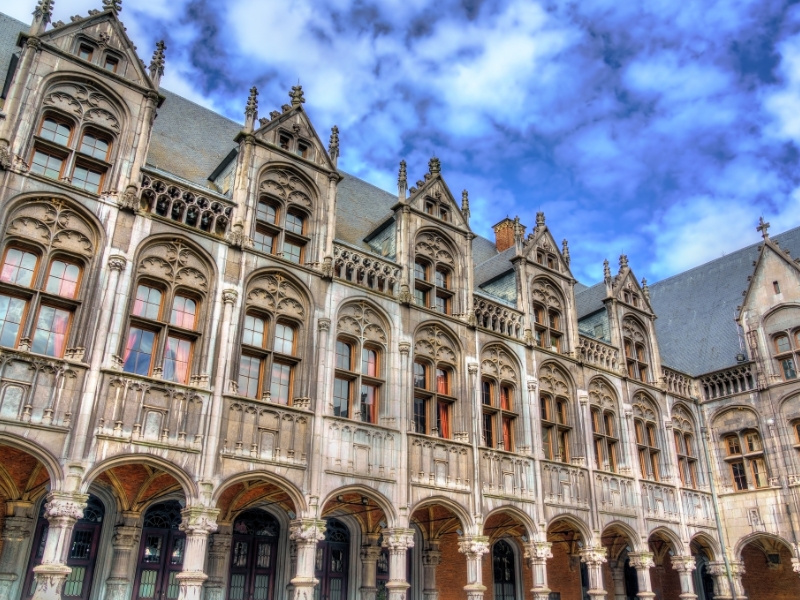
For about eight centuries Liège was ruled by prince-bishops, and the churches they and their abbeys left behind are still the best way to read the city's past. This guide covers three of them, St Paul's Cathedral, the Church of Saint-Jacques and the domed Church of Saint-André, together with the bronze Charlemagne on the Boulevard d'Avroy, a reminder of the emperor Liège likes to claim as its own. All four are close together in the city centre and can be seen on one walk.
St Paul's Cathedral
Liège's cathedral was not built as one. Bishop Éracle founded a church dedicated to St Paul in 967, and he died before it was finished; his successor Notger completed it. For centuries it was a collegiate church, run by a chapter of canons, while the cathedral of the prince-bishops was the huge church of Saint-Lambert on the square of the same name. When Saint-Lambert was demolished after the Liège Revolution, from 1795 on, St Paul's took over its role and became the cathedral in 1802.
The building you see is Gothic. Rebuilding started in 1289; the choir, transept and nave date from the 13th century and the apse from the 14th, and the church was finished only in 1557. The tower was raised by a storey in 1811 and 1812, at Napoleon's request, and it carries the carillon that once rang in Saint-Lambert. The cathedral is one of the stops on our scavenger hunt, and the route starts here.
- The painted vaults of the nave from 1528 and 1529, attributed in an old manuscript to Lambert Lombard and his pupils.
- The 16th-century stained-glass windows, including one given by Léon d'Oultres in 1530, beside 20th-century glass by Max Ingrand.
- The white marble Christ lying in the tomb, carved by Jean Del Cour in 1696, and the cloister, whose west wing houses the cathedral treasury with the reliquary bust of Saint Lambert.
Church of Saint-Jacques
Saint-Jacques was founded in 1015 by Prince-Bishop Baldéric II as a Benedictine abbey dedicated to St James the Less. Of the Romanesque abbey church only the west block survives, with one of its three towers; look for it at the western end, where its plain stone contrasts with the rest. The Gothic church that replaced it was built under Abbot Jean de Coromeuse, who led the abbey from 1507 to 1525, and was completed in 1538. In 1558 a Renaissance portal was added, attributed to the Liège artist Lambert Lombard.
Inside, the reason to come is the ceiling. The vaults of the nave are covered in painted decoration from the same period and have more than 150 keystones, so it pays to bring binoculars or simply sit and look up. The abbey buildings were pulled down after the French Revolution, and their cloister became the public park beside the church. The church itself was returned to worship in 1803 and is still a parish church. It is one of the scavenger hunt stops.
- The choir windows, made between 1525 and 1531 and counted among the finest Renaissance stained glass in Belgium.
- The 1558 Renaissance portal, whose classical forms stand out against the Gothic walls.
Church of Saint-André
The Church of Saint-André stands on the Place du Marché, the old market square of Liège, and is easy to spot by its dome. Its origins are unknown, but it was a parish church by the 13th century; in 1250 Beatrix de Vottem gave it a large gift of land. Until the late 18th century it belonged to the Teutonic Order, and it was the church of the order's commandery of Saint-André. The present building was begun in 1765 and consecrated in 1772, as a Latin inscription above the portal records.
Its later life shows how Liège treated its churches after the revolution. Saint-André became a grain exchange, then a labour exchange, and later a hall for exhibitions and city events. In 2011 it was closed because asbestos was found, and a renovation, including a new dome, began in late 2017; check whether the inside is open before you plan a visit. Even from outside, the dome and the old market square around it make the stop worthwhile. Saint-André is a stop on the scavenger hunt.
The Charlemagne statue
The bronze Charlemagne on horseback on the Boulevard d'Avroy was unveiled on 26 July 1868. The project was proposed to the city in 1855 by Louis Jéhotte, a professor of sculpture at the Brussels academy. It was first planned for the Place Saint-Lambert, but ended up on the boulevard, where it still stands at the edge of the centre.
Why Charlemagne in Liège? Tradition places his birth between Jupille and Herstal, today part of greater Liège, and that has made him a major figure in local folklore; no source settles where he was really born, so treat this as a local tradition rather than a fact. A well-known local piece even has him in conversation with Tchantchès, the city's folk hero. The statue is one of the stops on our scavenger hunt.
- The six niches of the stone pedestal, with figures of Charlemagne's ancestors: Saint Begga, Pepin of Herstal, Charles Martel, Bertrada, Pepin of Landen and Pepin the Short.
- The way the bronze rider sits high above his ancestors, so the whole monument reads like a family tree in stone and metal.
How to see them in one walk
Start at St Paul's Cathedral and walk south to the Church of Saint-Jacques, then go west to the Boulevard d'Avroy and the Charlemagne statue. From there head north through the centre, across the Place Saint-Lambert, to the Place du Marché and the Church of Saint-André. Allow time inside the cathedral and Saint-Jacques, where most of the details are, and keep in mind that services take priority over visits.
See Liège with World City Trail
Our Liège scavenger hunt turns the city centre into a game you play on your phone. The route links 10 stops, from the cathedral to the Grand Curtius, and all four places in this guide are stops: the cathedral, Saint-Jacques, the Charlemagne statue and Saint-André, along with the Aquarium-Museum, the Théâtre de Liège, the Royal Opera of Wallonia, the Place Saint-Lambert and Saint-Barthélemy. At each stop you solve a puzzle and learn a story, at your own pace.
If you prefer a different format, there is also a self-guided walking tour and an outdoor escape game in Liège.
Play the Liège scavenger hunt →
Take the self-guided walking tour of Liège →
Play the outdoor escape game in Liège →
Facts checked in October 2026.