
Salzburg packs a lot into a small space, and this guide links six of its best-known places in one line across the river: a neo-Gothic church on the new-town side, the two houses where the Mozart family lived, the great Baroque square of the prince-archbishops, the cathedral and the fortress above it all. Together they tell the story of a city ruled for centuries by its archbishops, and of the musician it is most proud of. All six are stops on our Salzburg scavenger hunt.
St. Andrew's Church (Andräkirche)
St. Andrew's Church stands on the eastern part of Mirabellplatz, opposite Mirabell Palace. Its predecessor, in Linzer Gasse, had already been pulled down in 1861. The new neo-Gothic church was built from 1892 to plans by Josef Wessicken, with the city master builder Jakob Ceconi in charge, and consecrated in 1898; it went up behind the former court stables, which were demolished once it was finished. The church was badly damaged in the air raids on Salzburg in November 1944 and April 1945, and when it was rebuilt its much taller pointed spires were replaced by the present pyramid-shaped roofs. Its original appearance was not restored, either then or in the conversion of 1969 to 1972.
- The towers with their low pyramid roofs, which make the church easy to recognise; old photographs show how much taller the spires once were.
Mozart Residence (Mozart-Wohnhaus)
Across Makartplatz, at number 8, is the Tanzmeisterhaus, the dancing master's house. It was first recorded in 1617, and in 1711 the court dancing master Johann Lorenz Spöckner was allowed to teach dancing to the nobility here. His son Franz Gottlieb Spöckner, who bought the house in 1739, was a witness at Leopold Mozart's wedding in 1747. In 1773, six years after Franz Gottlieb's death, the Mozart family moved into an apartment in the building. Bombs destroyed about two thirds of the house in 1944; the dancing master's hall, with its late 18th-century stucco, was restored in 1956 and 1957, and the museum today shows instruments and documents from the years Wolfgang Amadeus lived here, from 1773 to 1780.
- The small Magic Flute house (Zauberflötenhäuschen) in the courtyard, where Mozart is said to have composed parts of the opera; it came from Vienna, stood on the Kapuzinerberg and later at the Mozarteum, and was rebuilt here after 2022.
Mozart's Birthplace
On the other side of the Salzach, at Getreidegasse 9, is the house where Wolfgang Amadeus Mozart was born on 27 January 1756. The family lived on the third floor from 1747 to 1773, renting from Johann Lorenz Hagenauer, whose family had owned the house since 1703. It has been a museum since 1880, and its rooms cover Mozart's childhood, his first instruments, his friends and his love of opera.
- Mozart's childhood violin.
- The clavichord on which he composed The Magic Flute.
Residenzplatz
Residenzplatz is the great square of the prince-archbishops. Prince-Archbishop Wolf Dietrich von Raitenau had it laid out from 1587, clearing a former cemetery and demolishing many houses to make room, and it was first called simply the main square. On its west side is the Residenz, the archbishops' palace, which Wolf Dietrich transformed in the Renaissance style between 1587 and 1612 and which now holds the Residenzgalerie, a gallery of 16th- to 18th-century paintings opened in 1923. On the east side is the Neue Residenz, begun in 1588, with its bell tower. Today the square hosts Salzburg's Christmas market in Advent, an open-air cinema showing Salzburg Festival recordings in July and August, and the Rupertikirtag fair on 24 September, the feast of Saint Rupert.
- The Residenz Fountain in the middle, built between 1656 and 1661 to a design by Tommaso di Garona in Untersberg limestone, with a Triton on top; it is often called one of the largest Baroque fountains in Central Europe.
- The bell tower of the Neue Residenz on the east side of the square.
Salzburg Cathedral
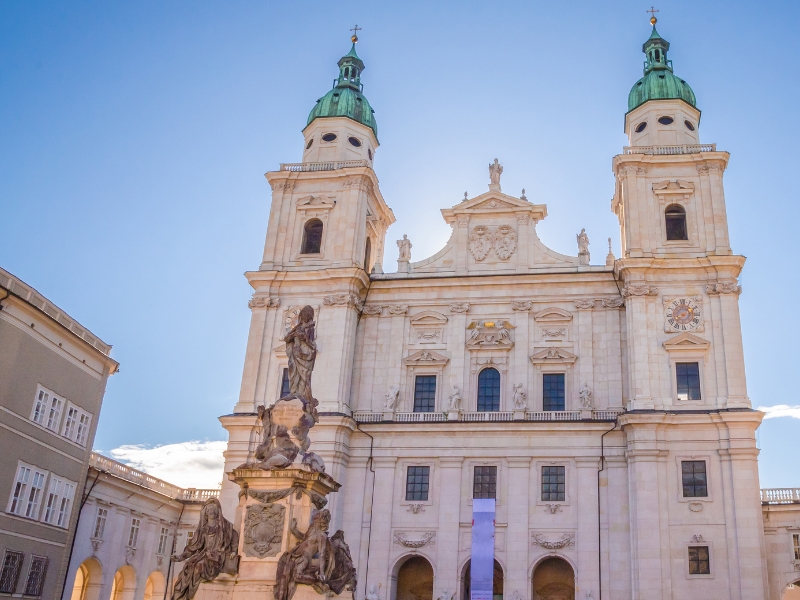
Salzburg Cathedral, dedicated to Saints Rupert and Vergilius, stands on the site of a church founded by Saint Vergilius in 774. After the old basilica was badly damaged in 1598, Wolf Dietrich had it demolished, and in 1614 Archbishop Markus Sittich von Hohenems began the present Baroque cathedral to a design by Santino Solari. It was consecrated on 24 September 1628.
Mozart was baptised here on 28 January 1756, the day after his birth, in a 14th-century Gothic font that is still in the cathedral. In 1944 a bomb hit the central dome, and the restoration was completed in 1959. In front of the cathedral, Domplatz is dominated by the Marian column, the Maria Immaculata, built between 1766 and 1771.
- The facade statues of Saints Rupert and Vergilius, Saints Peter and Paul and the evangelists, and the three bronze doors of 1957 and 1958, which stand for faith, hope and love.
Hohensalzburg Fortress
Above the old town rises Hohensalzburg Fortress. Work began in 1077 under Archbishop Gebhard, with a simple bailey and a wooden wall, and the fortress grew over the centuries to about 250 by 150 metres, which makes it one of the largest medieval castles in Europe. Prince-Archbishop Leonhard von Keutschach, who ruled from 1495 to 1519, expanded it and had the princely apartments fitted out from 1498. The fortress was besieged only once, in the German Peasants' War of 1525, without success; in 1800, French troops under General Moreau took it without a fight.
Inside, the Golden Chamber is the most lavish of the princely rooms, with benches carved with vines, grapes and animals. The Reisszug, a goods funicular described in 1515, still carries supplies up to the upper courtyard in modernised form and is probably the oldest working railway in the world.
- The Salzburger Stier, an organ of more than 200 pipes in the Krautturm, built for Leonhard von Keutschach in 1502 and still played at set times in season.
- The view over the domes and roofs of the old town and across the Salzach to the new town, the reward for the climb.
How to see them in one walk
Start at St. Andrew's Church on Mirabellplatz, then walk the few steps to the Mozart Residence on Makartplatz. Cross the Salzach on the Marko-Feingold-Steg footbridge into the old town and head to Mozart's Birthplace on Getreidegasse. From there, walk through the old town to Residenzplatz and on to the cathedral and Domplatz. Finish with the climb up to Hohensalzburg Fortress. Getreidegasse is busiest in the middle of the day, so go early or late if you want to see the birthplace without crowds.
See Salzburg with World City Trail
Our Salzburg scavenger hunt turns the city into a game you play on your phone. The route links 10 stops, from St. Andrew's Church to Hohensalzburg Fortress, and all six places in this guide are stops, along with the Marko-Feingold-Steg, the Pferdeschwemme horse fountain, St. Peter's Abbey and the Kapitelschwemme. At each stop you solve a puzzle and learn a story, at your own pace.
There is also a self-guided walking tour and an outdoor escape game in Salzburg, for people who prefer a different format.
Play the Salzburg scavenger hunt →
Take the self-guided walking tour of Salzburg →
Play the outdoor escape game in Salzburg →
Facts checked in October 2026.