
This guide follows seven places across the centre of Venice, from the Frari church in San Polo over the Rialto Bridge to La Fenice, St Mark's Square, St Mark's Basilica, the Doge's Palace and the Greek Orthodox church of San Giorgio dei Greci. They make one natural line through the city on foot, and between them they show what the Republic built for its faith, its trade, its government and its music. All seven are stops on our Venice scavenger hunt.
The Frari
The Basilica di Santa Maria Gloriosa dei Frari is the great Franciscan church of Venice. The site was given to the friars in 1231; a first church was finished in 1338, and work on the much larger present building began soon after and took more than a century. The facade was completed in 1440 and the church was consecrated on 27 May 1492. Its brick bell tower, completed in 1396, is the second tallest in the city after St Mark's.
The Frari is also a burial place of artists. Titian, the leading Venetian painter of the 16th century, died in 1576 and is buried here. The church also holds the monument to the sculptor Antonio Canova, built by his pupils from a design he had made for an unbuilt tomb of Titian; only Canova's heart lies inside.
- Titian's Assumption of the Virgin on the high altar, the painting that draws your eye down the whole length of the church.
- Titian's Pesaro Madonna on the north side of the nave, and Giovanni Bellini's Madonna and Child with Saints Nicholas, Peter, Mark and Benedict.
The Rialto Bridge
For centuries this was the only way across the Grand Canal on foot. A pontoon bridge was replaced in 1255 by a wooden bridge whose middle could be raised to let tall ships through, and shops built along it paid for its upkeep. The wooden bridge was partly burned in the revolt of Bajamonte Tiepolo in 1310, collapsed in 1444 under a crowd watching a wedding procession, and fell again in 1524. Famous architects, among them Sansovino, Palladio and Vignola, put forward designs for a stone bridge, but their classical, many-arched plans were turned down.
The bridge you cross today was built between 1588 and 1591 by Antonio da Ponte as a single stone arch with a span of about 32 metres. The design was so bold that the architect Vincenzo Scamozzi predicted it would one day collapse. It has stood ever since.
- The two ramps that rise to the portico at the top, with rows of shops on the covered ramps on either side.
Teatro La Fenice
La Fenice means the phoenix, and the name has proved apt. The opera house designed by Giannantonio Selva opened on 16 May 1792. Fire destroyed it in December 1836, and it reopened a year later; on 29 January 1996 an arson attack destroyed it again, and two electricians were later convicted of setting the fire. The theatre was rebuilt as it was, where it was, to a design by Aldo Rossi, and reopened with a concert on 14 December 2003. Rossini's Tancredi and Bellini's I Capuleti e i Montecchi had their premieres here, and Verdi's long link with the house began with Ernani in 1844 and went on with Attila, Rigoletto, La traviata and Simon Boccanegra.
- The facade on Campo San Fantin, and inside, if you visit or come for a performance, the auditorium with its 1,126 seats.
St Mark's Square
The long arcaded buildings on its sides are the Procuratie Vecchie on the north, from the early 16th century, and the Procuratie Nuove on the south, largely finished by 1640; the Napoleonic Wing closing the west end was built between 1810 and 1813. The remark that the square is the drawing room of Europe is usually attributed to Napoleon, without proof. Caffè Florian, under the Procuratie Nuove, opened in 1720.
- The campanile, which collapsed on 14 July 1902 and was rebuilt in its old form and place by 1912, and the clock tower of 1499, whose archway leads into the Merceria towards the Rialto.
- On the Piazzetta towards the lagoon, the two granite columns with Saint Theodore and the winged lion of Saint Mark, probably raised around 1268.
St Mark's Basilica
According to medieval chronicles, two Venetian merchants carried the body of Saint Mark away from Alexandria in 828 or 829, and the city built a church for it next to the Doge's residence. The present basilica was probably begun in 1063 and was dedicated on 8 October 1094, when the relics were placed in the new crypt. Until the fall of the Republic in 1797 it was the Doge's chapel, not the cathedral; it became the seat of the Patriarch only in 1807.
The mosaics that cover the domes and vaults span about eight centuries of styles, and only around a third of them are considered original. On the balcony over the central door stand copies of the four bronze horses; the originals have been kept inside since 1974.
- The Pala d'Oro behind the high altar, a screen of Byzantine enamels on gilded silver, ordered from Constantinople in 1102.
- The Pentecost dome over the western arm: an empty throne with a book and a dove, and rays falling on the apostles, each with a flame on his head.
The Doge's Palace
The seat of the Doge and the government of the Republic has stood on this spot since the 9th century, though nothing of that first building survives. The Gothic palace you see dates from work begun around 1340. Its ceremonial entrance is the Porta della Carta, built in 1438–1442 by Giovanni and Bartolomeo Bon, and inside the courtyard the Giants' Staircase has been guarded since 1567 by Sansovino's statues of Mars and Neptune, symbols of Venetian power on land and sea.
A fire in 1577 destroyed the Great Council Chamber, which was rebuilt in the same Gothic style. Behind the Doge's throne hangs Tintoretto's Paradise, one of the largest canvas paintings in the world. The Bridge of Sighs, built in 1614, links the palace with the New Prisons across the canal. The palace has been run as a museum by the city since 1923.
- From the Ponte della Paglia on the waterfront, the view of the Bridge of Sighs between the palace and the prisons.
San Giorgio dei Greci
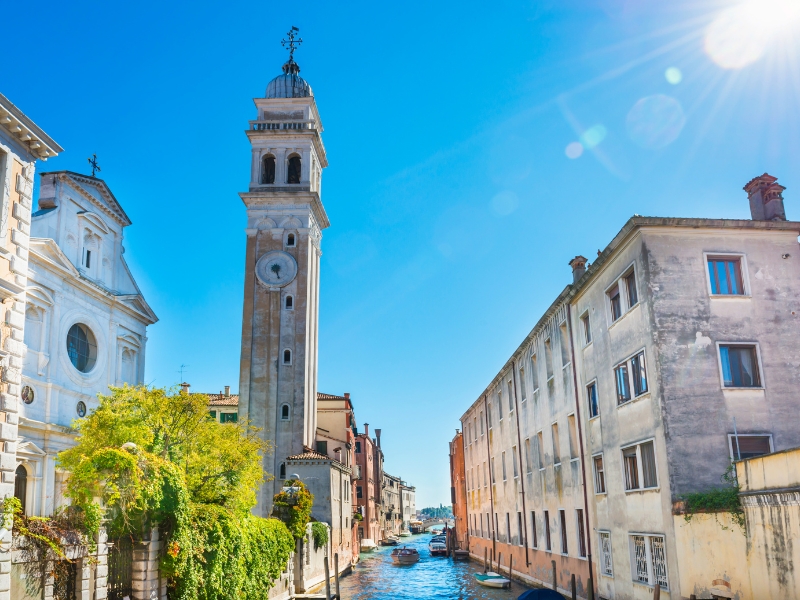
A short walk east of St Mark's, beyond the church of San Zaccaria, stands the church of the Greek community of Venice. The Greeks received permission in 1498 to found their confraternity, the Scuola di San Nicolò dei Greci, and the church was paid for by a tax on ships coming from the Orthodox world. Building began in 1539 under Sante Lombardo, continued from 1548 under Giannantonio Chiona, and the church was completed in 1573. The bell tower followed in 1592.
- The iconostasis with its eighteen icons by Michael Damaskinos, among them the Archangel Michael.
- The Last Judgement in the dome, painted by Giovanni Kyprios in 1589–1593. Next door, the former Flanginian School houses the Hellenic Institute of Byzantine and Post-Byzantine Studies.
How to see them in one walk
Start at the Frari in San Polo and walk east through Campo San Polo to the Rialto Bridge. Cross it and follow the lanes south past the church of San Salvador to Campo San Fantin and La Fenice. From there it is a short way to St Mark's Square, the basilica and the Doge's Palace. Finish by walking along the waterfront and inland past San Zaccaria to San Giorgio dei Greci.
See Venice with World City Trail
Our Venice scavenger hunt turns the city centre into a game you play on your phone. The route links 10 stops, from the Frari to San Giorgio dei Greci, and all seven places in this guide are among them, together with Campo San Polo, the church of San Salvador and the church of San Zaccaria.
There is also a self-guided walking tour and an outdoor escape game in Venice, for people who prefer a different format.
Play the Venice scavenger hunt →
Take the self-guided walking tour of Venice →
Play the outdoor escape game in Venice →
Facts checked in October 2026.