
This guide covers six places along one line through Dubrovnik, from the western land gate to the old harbour: the Pile Gate, Fort Bokar and Fort Lovrijenac that guarded it, Onofrio's Large Fountain just inside, the Rector's Palace, and the Porporela pier by St John's Fortress. Together they show how the Republic of Ragusa protected itself, supplied itself with water and governed itself. The old city, including much of its walls, has been on the UNESCO World Heritage List since 1979.
Pile Gate
The Pile Gate is the main entrance to the old town from the west, and it was built as a well-defended complex with more than one door rather than a single opening. You first pass an outer gate, then cross a stone bridge between two Gothic arches, designed by the architect Paskoje Miličević in 1471, and reach a wooden drawbridge that could be pulled up. In the days of the Republic it was raised every night in a ceremony. Beyond it a Gothic inner gateway leads into the town.
The moat in front of the walls and Fort Bokar beside the gate completed the defence. Near the gate you will also find a chart that marks every artillery hit on the old town during the siege of 1991–1992, when the city sustained 650 hits; the damage was repaired in the original style, mostly between 1995 and 1999.
- The statue of Saint Blaise, the city's patron, above the main arch, holding a model of the Renaissance city.
- From the bridge, the view down to the moat and across to Fort Lovrijenac on its rock outside the walls.
Fort Bokar
Fort Bokar sits on the western corner of the walls, right by the Pile Gate. It was built between 1461 and 1463 by the Florentine architect Michelozzo as a two-storey casemate fortress projecting from the older medieval wall. It was the key point of the defence of the Pile entrance and is considered one of the finest examples of practical fortification architecture of its time. The walls around the old town run for about 1,940 metres and reach a height of about 25 metres, and you can see Bokar from the wall walk or from the shore below.
- The way the fort juts out from the line of the medieval wall, best seen from outside the walls near the Pile Gate.
Fort Lovrijenac
Fort Lovrijenac, the fortress of St Lawrence, stands outside the western walls on a rock 37 metres above the sea, and it is often called the Gibraltar of Dubrovnik. According to the old Chronicles of Ragusa it was built in just three months. A story tells that the Venetians wanted to build a fort on the same spot, but the people of Dubrovnik got there first and the Venetian ships with the building material had to sail home; treat it as a legend.
The walls facing the sea and any attacker are up to 12 metres thick, while the wall facing the city is only about 60 centimetres thick. Inside, the courtyard is used as a stage, and Shakespeare's Hamlet performed here has become the symbol of the Dubrovnik Summer Festival.
- The inscription above the gate, Non bene pro toto libertas venditur auro: freedom is not to be sold for all the gold in the world.
Onofrio's Large Fountain
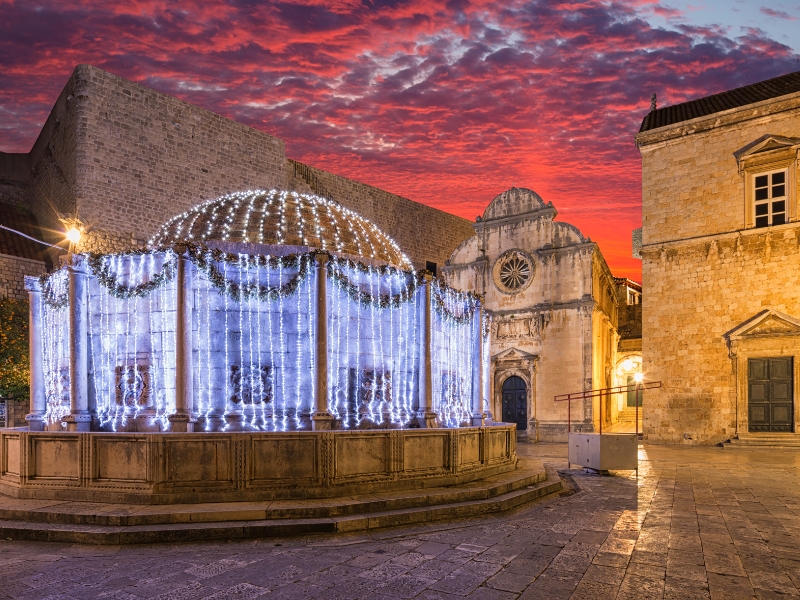
Just inside the Pile Gate, in the middle of a small square at the start of the main street, stands the Large Onofrio Fountain. In 1438 the city built a long aqueduct instead of relying on cisterns, designed by the Neapolitan architect and engineer Onofrio della Cava, and he ended it with two public fountains: this one, and the Little Onofrio Fountain at the other end of the main street, which supplied the market at Luža Square. The large fountain's shape may have been inspired by the former Romanesque baptistery of the old cathedral. Its sculptural decoration was lost in the earthquake of 1667, which destroyed most of the city.
- The sixteen carved masks (mascarons) around the fountain, with water running from each mouth.
The Rector's Palace
From the 14th century until 1808 the palace was the seat of the Rector of the Republic of Ragusa, and it also held the Minor Council, the state offices, an armoury, a powder store, a guard house and a prison. A fire destroyed the earlier building in 1435, and the Neapolitan Onofrio della Cava, the builder of the fountain, was given the job of rebuilding it. A gunpowder explosion damaged it again in 1463. The Florentine Michelozzo then proposed new plans, but they were rejected in 1464 as too Renaissance in style, and Salvi di Michele of Florence continued the work from 1467.
After damage in the earthquakes of 1520 and 1667 parts were rebuilt in Baroque style, so the palace now mixes Gothic, Renaissance and Baroque. The Milanese sculptor Pietro di Martino carved ornaments here. The palace has housed the history department of the Dubrovnik Museums since 1872, and its facade appeared on the back of the Croatian 50 kuna banknote.
- The finely carved capitals, the ornate staircase in the courtyard, and the monument to the merchant Miho Pracat, set up by the Senate in 1638 and made by Pietro Giacometti of Recanati.
Porporela
Porporela is a pier built in 1873 next to St John's Fortress, at the south-eastern edge of the old harbour. The harbour itself was laid out in the late 15th century by the engineer Paskoje Miličević, who also designed the Kaše breakwater of 1485 to shelter it from south-easterly winds and waves. St John's Fortress, first built in the mid 14th century and altered many times, controlled the harbour entrance; today it houses an aquarium of Adriatic fish on the ground floor and the maritime and ethnographic museums above. The harbour and Porporela are now promenades.
- The view from the end of the pier back to the walls and St John's Fortress, and out to the Kaše breakwater.
How to see them in one walk
Start outside the walls at Pile and look up at Fort Lovrijenac. Back at the gate, look out for Fort Bokar on the corner of the walls, then cross the bridge and pass through the Pile Gate to Onofrio's Fountain. Walk the full length of the main street to the Luža Square and the Rector's Palace, then go through to the old harbour and finish on Porporela by St John's Fortress.
See Dubrovnik with World City Trail
Our Dubrovnik scavenger hunt turns the old town into a game you play on your phone. The route links 10 stops, from the Pile Gate to Fort Bokar, and five of the places in this guide are among them: the Pile Gate, Onofrio's Fountain, the Rector's Palace, Porporela and Fort Bokar. Other stops include the Clock Tower, St Blaise's Church and the cathedral; Fort Lovrijenac is not on the route.
There is also a self-guided walking tour and an outdoor escape game in Dubrovnik, for people who prefer a different format.
Play the Dubrovnik scavenger hunt →
Take the self-guided walking tour of Dubrovnik →
Play the outdoor escape game in Dubrovnik →
Facts checked in October 2026.