
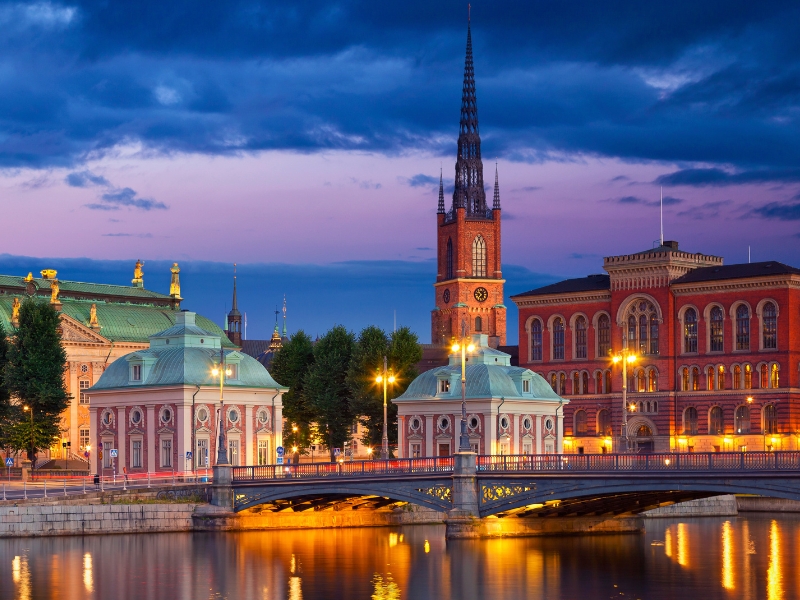
This guide follows a line of six places from Riddarholmen, the small island next to Gamla Stan, across the water to Blasieholmen and Skeppsholmen: Riddarholm Church, the Normalhöjdpunkten marker, the Nobel Prize Museum, St. Jacob's Church, the Nationalmuseum and the gilded crowns on the Skeppsholm Bridge. They mix royal burials, science prizes, church history and art, and all six are stops on our scavenger hunt.
Riddarholm Church
Riddarholm Church (Riddarholmskyrkan) began in the late 13th century as the church of a Franciscan friary, the Greyfriars, and is one of the oldest buildings in Stockholm. After the Reformation the friary was closed and the church became Lutheran; its congregation was dissolved in 1807, and since then it has been used only for burials and commemorations. It is run today by the Swedish state and the Royal Court.
This is where most Swedish monarchs lie, from Gustavus Adolphus in the 17th century to Gustaf V in the 20th, as well as the earlier kings Magnus Ladulås and Charles VIII; Queen Christina, buried in Rome, is the best known exception. Royal burials have since moved to the Royal Cemetery at Haga. The church's tall openwork spire is in cast iron: the earlier spire by Willem Boy was destroyed by lightning on 28 July 1835 and replaced.
- The coats of arms of deceased knights of the Royal Order of the Seraphim on the walls. When a knight is buried, the church bells ring without pause from noon to one o'clock.
- The Bernadotte Chapel, with the sarcophagi of King Charles XIV John, the French marshal who founded the present royal dynasty, and his queen Desideria.
- Outside, the statue of Birger Jarl, the medieval ruler linked to Stockholm's founding, on a column in front of the Bonde Palace, which houses the Supreme Court.
Normalhöjdpunkten
Between City Hall and Riddarholmen, our route stops at Normalhöjdpunkten. The Swedish name means "the normal height point": as the name suggests, it is a fixed point of the kind surveyors use as a reference for measuring heights in a city. It is small and easy to walk past, which is exactly why it makes a good stop in a game: finding it is part of the challenge.
Nobel Prize Museum
The Nobel Prize Museum opened in spring 2001, for the 100th anniversary of the Nobel Prize, and took its present name in 2019 (before that it was the Nobel Museum). It is run by the Nobel Foundation and fills part of the Stock Exchange Building on the north side of Stortorget, the main square of Gamla Stan and the scene of the Stockholm Bloodbath of 1520.
The building itself was designed by Erik Palmstedt and built in 1773-1778 for the Stockholm Stock Exchange, which moved out completely in 1998. Since 1914 it has also been the seat of the Swedish Academy, and it is here that the Academy chooses and announces the winner of the Nobel Prize in Literature. The Nobel Library is in the same building.
- In the museum bistro, turn a chair over: Nobel laureates have signed the undersides of the seats.
- The facade of the Stock Exchange Building closing the north side of the square, with the old well in front.
St. Jacob's Church
St. Jacob's Church (Sankt Jacobs kyrka) stands on the western side of the Kungsträdgården park, near the Royal Opera. An older church on the site was pulled down under Gustav Vasa; John III ordered a new one in 1580, and building started in 1588 under the master builder Heinrich van Huwen. It took so long that the church mixes late Gothic, Renaissance and baroque, and when it was inaugurated on 26 November 1643, in the presence of Queen Christina, the interior was only partly finished.
A fire in 1723 destroyed the roof, and the central tower by Göran Josuae Adelcrantz was inaugurated in 1739. The church was repainted in the 1770s, given a new copper roof in 1910, and its rather bare interior today comes from a restoration in 1932-37. Its parish was merged with the Stockholm Cathedral parish in 1989.
- The southern portal, begun in 1644 by Heinrich Blume.
- The bust of the tenor Jussi Björling outside the church, close to the opera house where he sang.
Nationalmuseum
Sweden's national museum of art and design began in 1792 as the Royal Museum, with King Gustav III among its founders. Its present building on Blasieholmen, by the German architect Friedrich August Stüler, was built between 1844 and 1866, when it opened and took the name Nationalmuseum. In 2013 it closed for a full renovation and reopened on 13 October 2018 with restored windows and skylights, a new sculpture courtyard and almost three times as many works on show.
The collection counts about 700,000 objects, including some 500,000 drawings and the world's largest collection of portrait miniatures. Highlights include Rembrandt's Simeon's Song of Praise, Watteau's The Love Lesson and Chardin's Rabbit and Copper Pot.
- The Dutch 17th-century rooms with the Rembrandts.
- The new sculpture courtyard inside the building.
The gilded crowns on Skeppsholmsbron
From the museum the Skeppsholm Bridge leads to the island of Skeppsholmen. A wooden bridge first crossed here in 1638-40, when the navy moved to the island; the present bridge of five arches was made by Motala Verkstad and opened in 1861. At its midpoint sit two gilded crowns, symbols of Sweden and the royal family. This is the last stop of our scavenger hunt.
How to see them in one walk
Start at City Hall and look for Normalhöjdpunkten on the way to Riddarholmen and Riddarholm Church. Cross into Gamla Stan to Stortorget and the Nobel Prize Museum, then pass Gustav III's Obelisk and the Royal Palace and cross the bridge to Gustav Adolfs torg. From there it is a short walk to St. Jacob's Church at Kungsträdgården, then along the water to the Nationalmuseum and over the Skeppsholm Bridge to the crowns.
See Stockholm with World City Trail
Our Stockholm scavenger hunt turns the old town and its waterfront into a game you play on your phone. The route links 10 stops, from Stockholm City Hall to the gilded crown on the Skeppsholm Bridge, and all six places in this guide are stops, along with City Hall, Gustav III's Obelisk, the Royal Palace and Gustav Adolfs torg. At each stop you solve a puzzle and learn a story, at your own pace.
There is also a self-guided walking tour and an outdoor escape game in Stockholm, for people who prefer a different format.
Play the Stockholm scavenger hunt →
Take the self-guided walking tour of Stockholm →
Play the outdoor escape game in Stockholm →
Facts checked in October 2026.