
This guide links six places in central Ljubljana that tell the story of how Slovenes made the city their own: the main building of the University of Ljubljana, the Vodnik Monument, Prešeren Square, the Franciscan Church of the Annunciation, the Dragon Bridge and the Butchers' Bridge. Most of what you see here was rebuilt or newly built after the earthquake of 1895, and every one of these places is a stop on our scavenger hunt.
University of Ljubljana
The University of Ljubljana is Slovenia's oldest university. Ljubljana had Jesuit colleges in the 17th century and a short-lived university under French rule, founded in 1810 and closed in 1813 when Austria took the city back. The present university was created by a law passed on 2 July 1919, after the end of Austria-Hungary, and the first lectures were held on 3 December that year in five faculties: law, philosophy, technology, theology and medicine.
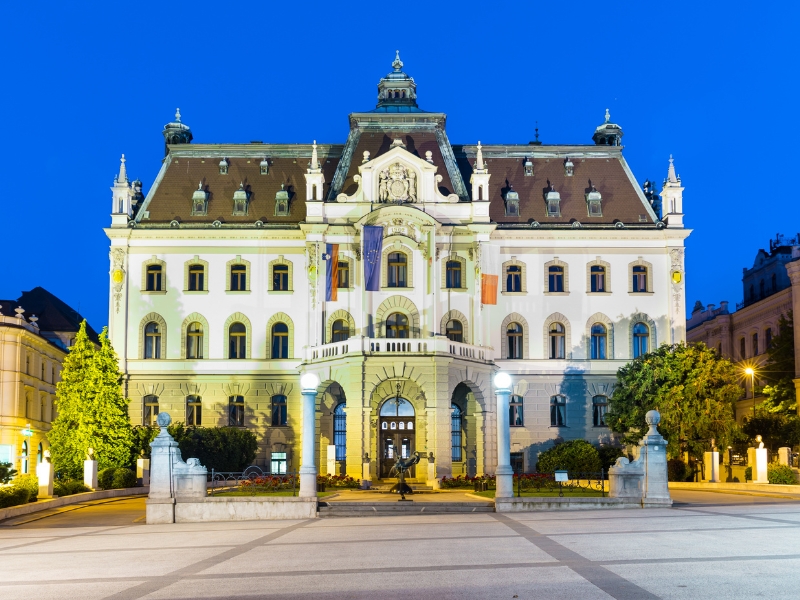
Its seat is on Congress Square (Kongresni trg), in a palace built in 1902 to a design by Jan Vladimír Hráský as the mansion of the provincial government of Carniola; it was later remodelled by Josip Hudetz. Today the university has about 38,000 students, 23 faculties and three art academies, spread across the city.
- The palace front on Congress Square, facing the park in the middle of the square.
- A few streets south, the National and University Library by Jože Plečnik, completed in 1941, with its patterned walls of brick and stone.
Vodnik Monument
On Vodnik Square, next to the Central Market, stands the bronze statue of Valentin Vodnik (1758-1819), a priest, poet and journalist and one of the leading figures of the Slovene national awakening. He was an open supporter of the Illyrian Provinces, the short Napoleonic state that had Ljubljana as its capital.
The statue was cast in Vienna between 1887 and 1889 by the young sculptor Alojz Gangl and unveiled on 30 June 1889 with a three-day celebration. It was the first public Slovene national monument. In 1929 France gave a bronze decoration for the pedestal to mark the 120th anniversary of the Illyrian Provinces.
- The single word VODNIK on the front of the pedestal, and on the back the last verse of his poem Moj spomenik (My Monument), written in 1806.
Prešeren Square
Prešeren Square (Prešernov trg) is the main meeting point of Ljubljana, where the old town meets the 19th-century city across the Ljubljanica. It took its present shape after the 1895 earthquake, when the architect Max Fabiani planned it as a junction of four streets and new palaces replaced the damaged medieval houses. It has been closed to cars since 2007, and the square and its monument are protected as cultural monuments of national importance.
The square is named after France Prešeren (1800-1849), Slovenia's national poet, whose poem Zdravljica (A Toast) became the national anthem in 1989; the anniversary of his death, 8 February, is a cultural holiday. His bronze monument, with a muse above him, was put up in 1905, designed by the sculptor Ivan Zajec on a pedestal by Fabiani.
- The Hauptmann House on the corner, built in 1873 and given its colourful Secession facade in 1904 by Ciril Metod Koch.
- The Triple Bridge on the river side of the square, the poplars beside it planted following a plan by Jože Plečnik.
Franciscan Church of the Annunciation
The red-faced baroque church on the north side of the square was built between 1646 and 1660 by Francesco Olivieri and Francesco Rosina, on a site where older churches had stood; its bell towers followed around 1720. The red colour, a symbol of the Franciscan order, dates from a redesign in 1858; before that the facade was white. Inside, the high altar is mostly by the baroque sculptor Francesco Robba, from 1736.
- The copper statue of the Madonna and Child on top of the facade, by Matej Schreiner.
- The ceiling frescoes by Matej Sternen, painted in 1935-36 to replace those damaged in the 1895 earthquake.
Dragon Bridge
The Dragon Bridge crosses the Ljubljanica a short walk downstream from the market. It was built in 1900-01, opened on 4 October 1901, and replaced an oak bridge from 1819 that had been damaged in the earthquake. It was one of the earliest reinforced concrete bridges in Europe, built with the system patented by Josef Melan, while the architect Jurij Zaninović designed its Vienna Secession look, from the balustrades to the copper dragons.
It first carried the name Jubilee Bridge of Emperor Franz Joseph I, for the 40th year of his reign, and was renamed the Dragon Bridge in 1919. The dragon is the symbol of Ljubljana, linked to the legend of Jason and the Argonauts, who are said to have killed a dragon here. Another local legend, told with a smile, says the dragons wag their tails whenever a virgin crosses the bridge.
- The four large dragons on pedestals at the corners, and the sixteen smaller ones along the bridge.
Butchers' Bridge
The Butchers' Bridge (Mesarski most) is a footbridge opened on 10 July 2010 between the Central Market and the Petkovšek Embankment. Jože Plečnik had planned a covered bridge here in the late 1930s as part of his market, but the Second World War stopped it, and for more than fifty years the gap stayed empty. The bridge that was finally built, designed by Jurij Kobe, is much simpler, with glass strips along its sides and steel wire railings, which couples soon began to cover with padlocks.
- The bronze sculptures by Jakov Brdar: Adam and Eve, a satyr and Prometheus.
- The small frogs and shellfish sitting on top of the railings.
How to see them in one walk
Start at Congress Square in front of the university building, then cross the river to the Town Hall and the cathedral and come out on Vodnik Square by the market. Walk to the Dragon Bridge, come back along the market colonnade to the Butchers' Bridge, and cross it to reach Prešeren Square, where the Franciscan Church stands at the head of the Triple Bridge. The Central Market is busiest in the morning, a good time to see Vodnik Square in use.
See Ljubljana with World City Trail
Our Ljubljana scavenger hunt turns the old town into a game you play on your phone. The route links 10 stops, from the Ursuline Church of the Holy Trinity to the Triple Bridge, and all six places in this guide are stops, along with the Ursuline Church, the Town Hall, Ljubljana Cathedral and the Triple Bridge. At each stop you solve a puzzle and learn a story, at your own pace.
There is also a self-guided walking tour and an outdoor escape game in Ljubljana, for people who prefer a different format.
Play the Ljubljana scavenger hunt →
Take the self-guided walking tour of Ljubljana →
Play the outdoor escape game in Ljubljana →
Facts checked in October 2026.