
Toledo packs Christian, Muslim and Jewish history into one hilltop old town, and this guide covers five places that show its layers: the cathedral, the City Hall facing it, the Jesuit church of San Ildefonso, the El Greco Museum with the painter's monument nearby, and the small mosque of Cristo de la Luz. They run from a mosque of the year 999 to the 18th century, and from the religious and civic centre of the city to the old Jewish quarter where El Greco worked.
Catedral Primada de Toledo
Toledo's cathedral is called the Primate Cathedral of Spain: in 1088 Pope Urban II recognised its archbishop as primate over the other bishops of the kingdom. The present Gothic building was promoted by Archbishop Rodrigo Ximénez de Rada; work began in the mid-1220s, and King Ferdinand III attended the laying of the first stone in 1226 or 1227. The building took more than two and a half centuries: the last Gothic vaults of the nave were closed in 1493.
The bell tower, begun in 1425 by Alvar Martínez and finished with an octagonal upper section by Hannequin of Brussels, rises about 92 metres over the old town. The sacristy is a picture gallery in its own right, with fifteen paintings by El Greco; his Disrobing of Christ (El Expolio) hangs over its altar.
- The Puerta del Perdón, the main portal of the 15th century, begun in 1418; it is usually kept closed and opened only for great occasions, such as the arrival of a new archbishop.
- In the sacristy, El Greco's El Expolio, the large canvas of Christ about to be stripped of his garments.
- The Transparente, the Baroque altar behind the main chapel.
Toledo City Hall
Across the square from the cathedral stands the City Hall (Ayuntamiento), and the square between them takes its name. Its history is a roll call of Spanish architects. The first designs, by Nicolás de Vergara the Elder, were never used; work only started in 1575 on new plans by Juan de Herrera, the architect of El Escorial. Jorge Manuel Theotocópuli, El Greco's son, took over later and drew the towers in 1612 and the staircase in 1614, and Teodoro Ardemans finished the building in 1703, raising the towers and crowning them with slate spires.
- The classical main facade, which was designed to answer the Gothic cathedral across the square.
- The two towers with their slate spires, added when Ardemans finished the building.
Iglesia de San Ildefonso (the Jesuit church)
The Baroque church of San Ildefonso, usually called the Jesuit church (Iglesia de los Jesuitas), is dedicated to Saint Ildefonsus, patron saint of Toledo, and by tradition it stands on the site of the house where he was born. Building began in 1629 to a design credited to Juan Bautista Monegro and went on for more than a century; the church was consecrated in 1718 while still unfinished and only completed in 1765. Its towers can be climbed, and together with the dome they are among the highest points of the old town.
- The view from the towers over the roofs of Toledo to the cathedral and the Alcázar.
- The relief over the main door, showing the Virgin coming down to Saint Ildefonsus, by Diego Rodríguez de Luna, and the coat of arms of the Manrique de Castilla family on the facade.
Museo del Greco
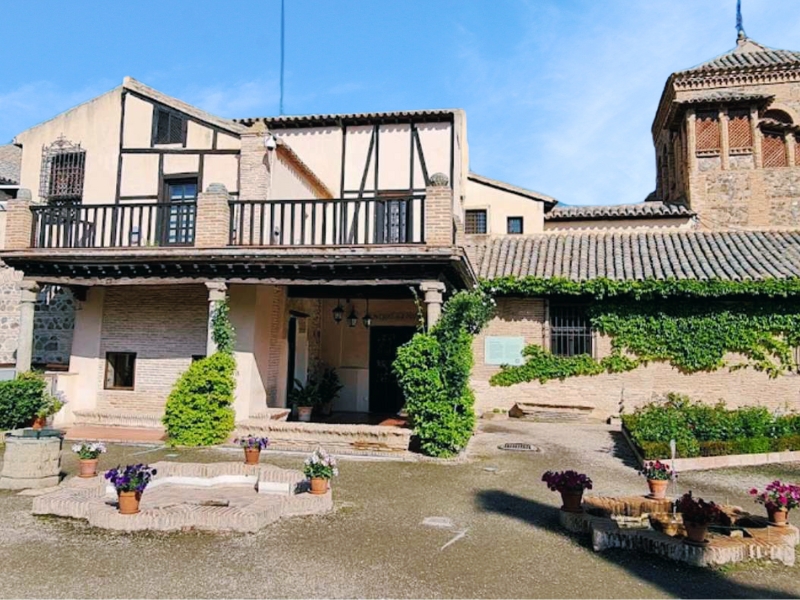
The El Greco Museum is in the old Jewish quarter, on the foundations of a 16th-century house and a Renaissance palace. It was created by the Marquis of Vega-Inclán and opened in 1910 as a recreation of the kind of house and studio the Cretan painter Domenikos Theotokopoulos, El Greco, would have used; it is not the house he actually lived in, which was probably on a nearby plot owned by the Marquis of Villena. After a long renovation it reopened in 2011.
- View and Plan of Toledo, perhaps the most important work in the collection, with the city laid out as El Greco saw it.
- The series of the Apostles (Apostolado), considered the finest of the sets of this subject that survive. A short walk away stands the monument to El Greco, another stop on our scavenger hunt.
Mezquita del Cristo de la Luz
This small building was the mosque of Bab al-Mardum, an oratory beside one of the gates of Muslim Toledo, and it probably stands on the site of an earlier Visigothic church. An inscription on the facade dates it to December 999 and names its patron, Ahmad ibn Hadidi, and its builder, Musa ibn Ali. Inside, four columns with reused Visigothic capitals divide the almost square room into nine bays, and each bay has a different dome. After the Christian conquest it became a church, and around 1187 a Romanesque-Mudéjar apse was added, one of the earliest examples of Mudéjar art.
According to legend, the king's horse knelt in front of the building when the Christian army entered Toledo, and when the wall was opened a crucifix was found beside a lamp that was still burning, which gave the church its name, Christ of the Light. In front of it, excavations uncovered a stretch of Roman road paved with large granite slabs. The mosque is not a stop on our scavenger hunt, but it is a short walk from Plaza Zocodover.
- The facade with its decorative arches and the inscription that dates the building to 999.
- The nine small domes, each with its own design.
How to see them in one walk
Start in Plaza Zocodover and walk down to the cathedral and the City Hall facing each other across the Plaza del Ayuntamiento. Climb up to the Jesuit church of San Ildefonso and its towers, then head west through the old town past the church of Santo Tomé to the El Greco Museum and the El Greco monument in the Jewish quarter. From there you can continue to the synagogue of Santa María la Blanca and the monastery of San Juan de los Reyes. Keep the Cristo de la Luz for the start or the end of the day, as it lies a short walk from Zocodover, away from the rest of this route. Toledo's streets are steep and narrow, so wear good shoes.
See Toledo with World City Trail
Our Toledo scavenger hunt turns the old town into a game you play on your phone. The route links 10 stops, from Plaza Zocodover to the monument to Isabella I of Castile, and the cathedral, the City Hall, the Jesuit church, the El Greco Museum and the El Greco monument are all stops, along with the church of Santo Tomé, the synagogue of Santa María la Blanca and the monastery of San Juan de los Reyes. At each stop you solve a puzzle and learn a story, at your own pace.
There is also a self-guided walking tour and an outdoor escape game in Toledo, for people who prefer a different format.
Play the Toledo scavenger hunt →
Take the self-guided walking tour of Toledo →
Play the outdoor escape game in Toledo →
Facts checked in October 2026.