
This guide follows the south side of central Seville, from the river to the city's great park: the Híspalis Fountain at Puerta de Jerez, the Torre del Oro, the bullring of the Real Maestranza, the cathedral, the Plaza de España and two quiet corners of the Parque de María Luisa, the Glorieta de San Diego and the Lotus Pond. Together they span eight centuries, from an Almohad watchtower to the buildings of the 1929 Ibero-American Exposition, and every one of them is a stop on our scavenger hunt.
Híspalis Fountain
The fountain in the middle of the Puerta de Jerez roundabout is named after Hispalis, the Roman name of Seville. The square itself takes its name from a gate in the old city walls that faced towards Jerez de la Frontera. The city council commissioned the fountain in 1928 and it was installed in 1929, the year of the Ibero-American Exposition. It was designed by Juan Bautista Míguez Roca and carved by the sculptor Manuel Delgado Brackenbury. A robed woman, the figure of the city, sits on large leaves held up by children standing on giant tortoises.
- The symbols around her: a cogwheel for industry, a caduceus for trade and leaves for agriculture. The four children with conch shells on the rim are copies, put back in 2015; the originals had been removed in 1939.
Torre del Oro
The Torre del Oro stands on the bank of the Guadalquivir. It was built in 1220–1221, in the last decades of Almohad rule, as a tower on the river at the edge of the walled city. It has three parts: the Almohad base, a second Mudéjar section usually dated to the reign of Pedro I in the 14th century, and the top section with its small dome, added in 1760 after the Lisbon earthquake of 1755 had damaged the tower. Since 1944 it has housed a naval museum run by the Spanish Navy.
The name, "Tower of Gold", has several explanations. A restoration in 2005 found that the walls had once been coated with lime and straw that gave them a golden shine. The popular idea that the gold of the Americas was kept here is not true: that was stored in the Casa de la Contratación.
- The change in shape and stone between the three levels, which shows the three building periods clearly.
- The view along the river from the quay at its foot, with the bullring a short walk upstream.
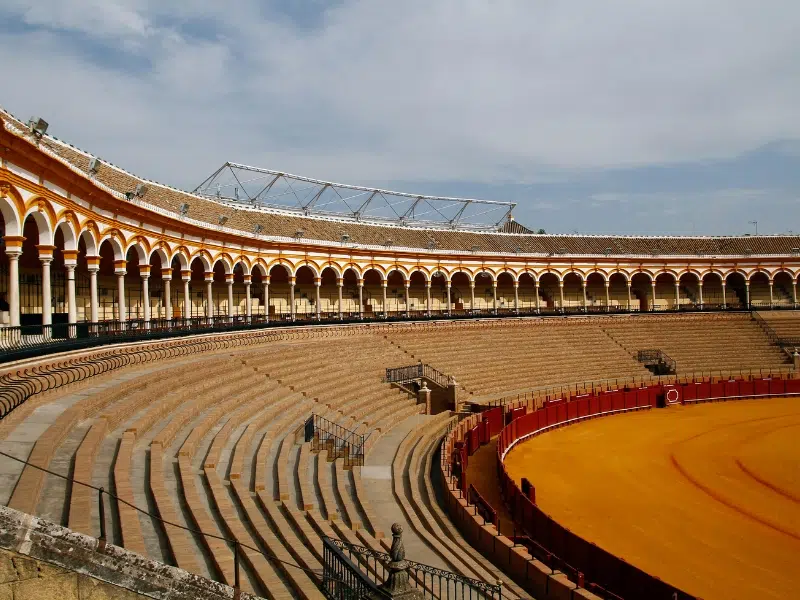
Plaza de Toros de la Real Maestranza
The bullring of the Real Maestranza de Caballería, a noble riding society, took more than a century to build: work on a circular ring began in 1760 and was only finished in 1881. It looks round but is in fact slightly oval, and it holds about 12,000 to 13,000 spectators. For people who follow bullfighting it is one of the most important rings in Spain, especially during the April Fair (Feria de Abril). A bullfighting museum, the Museo Taurino, opened under the stands in 1989.
- The Puerta del Príncipe, the most famous gate, through which a matador is carried out on the shoulders of the crowd after an outstanding afternoon.
- The Prince's Box (Palco del Príncipe), built for Infante Felipe de Borbón and crowned with a sculpture group by the Portuguese sculptor Cayetano de Acosta.
Catedral de Sevilla
In 1401 the cathedral chapter decided to replace the old Almohad mosque with a new church; documented work began in 1433 and the last stone was set in 1506. In 1988 Guinness certified it as the cathedral with the largest surface area in the world. Two parts of the mosque survived: the Patio de los Naranjos, its old ablutions courtyard planted with orange trees, and the minaret, built from 1184 and turned into the bell tower known as the Giralda. Hernán Ruiz added the Renaissance bell chamber in the 16th century, and the bronze weather vane, the Giraldillo, was put on top in 1568.
Inside are the tomb of Christopher Columbus, near the Puerta de San Cristóbal, and the main altarpiece, begun in 1482 by Pedro Dancart and finished by Juan Bautista Vázquez the Elder, described as the largest in Christendom. The cathedral, together with the Alcázar and the Archivo de Indias, has been a UNESCO World Heritage Site since 1987.
- The Puerta del Perdón, the old entrance to the mosque courtyard, with terracotta decoration added in the early 16th century.
- The Giraldillo turning in the wind on top of the Giralda, best seen from the Plaza Virgen de los Reyes.
Plaza de España
The Plaza de España was built for the Ibero-American Exposition of 1929. The architect Aníbal González designed it, and work ran from 1914 to 1929; the result is a huge half circle of brick and tile, with a central building and two towers about 70 metres high. Along the curved wall run 48 tiled benches, one for each of Spain's provinces at the time, each with a map and a scene from local history. A canal follows the curve, crossed by four bridges named after the old kingdoms of Aragon, Castile, León and Navarre, and you can hire a rowing boat on it.
- The provincial benches: look for a province you know and read the scene on its tiles.
- The square as a film set: it appears in Lawrence of Arabia (1962) as British headquarters in Cairo and in Star Wars: Episode II (2002) as a palace on the planet Naboo.
Parque de María Luisa: Glorieta de San Diego and the Lotus Pond
The Plaza de España sits on the edge of the Parque de María Luisa, whose land was given to the city in 1893 by the Infanta María Luisa Fernanda de Borbón. The French landscape architect Jean-Claude Nicolas Forestier redesigned it in the years before the exposition, with avenues, small squares (glorietas), fountains and ponds; the layout you walk through today is close to the one of 1929. The Glorieta de San Diego, one of these small squares, dates from 1929, the year of the exposition. On the park's main axis Forestier placed the Lions' Fountain, the Frogs' Fountain (Fuente de las Ranas, 1914) and the Estanque de los Lotos, the Lotus Pond, where our scavenger hunt ends.
- The Lions' Fountain and the Frogs' Fountain, which share the park's main axis with the Lotus Pond.
How to see them in one walk
Start at the Híspalis Fountain on the Puerta de Jerez and walk down to the river for the Torre del Oro. Follow the Paseo de Colón upstream to the Maestranza bullring, then turn inland through the Plaza del Cabildo to the cathedral and the Giralda. From the cathedral pass the Puerta del León of the Alcázar and walk south past the old Royal Tobacco Factory, now part of the university, to the Glorieta de San Diego. Finish with the Plaza de España and the paths of the Parque de María Luisa down to the Lotus Pond. In summer, do the walk early in the morning or late in the afternoon and keep the park for the hottest part.
See Seville with World City Trail
Our Seville scavenger hunt turns the city into a game you play on your phone. The route links 10 stops, from the Híspalis Fountain to the Lotus Pond, and all the places in this guide are stops: the fountain, the Torre del Oro, the bullring, the cathedral, the fountain of the Glorieta de San Diego, the Plaza de España and the Lotus Pond, along with the Plaza del Cabildo, the Puerta del León and the Royal Tobacco Factory. At each stop you solve a puzzle and learn a story, at your own pace.
There is also a self-guided walking tour and an outdoor escape game in Seville, for people who prefer a different format.
Play the Seville scavenger hunt →
Take the self-guided walking tour of Seville →
Play the outdoor escape game in Seville →
Facts checked in October 2026.