
This guide brings together six places in Trento: Piazza Dante, the Buonconsiglio Castle, Palazzo Thun, the church of Santa Maria Maggiore, Piazza del Duomo and the MUSE science museum. Five of them sit in the compact old town that hosted the Council of Trent in the 16th century, when the city's prince-bishops turned it into a stage for the whole Catholic world; the sixth, the MUSE, shows the modern Trento that has grown up on its southern edge.
Piazza Dante
Most visitors arrive at Piazza Dante, the garden square in front of the railway station. Its centrepiece is the monument to Dante Alighieri, unveiled in 1896 to a design by the Florentine sculptor Cesare Zocchi. At the time Trento belonged to Austria-Hungary, and putting the greatest Italian poet on a tall pedestal here, facing north towards the German-speaking world, was a clear statement of the town's Italian identity. Today the square is a shady park with a pond, flanked by the seat of the autonomous province.
Castello del Buonconsiglio
For about five centuries, until 1803, the Buonconsiglio Castle was the residence of the prince-bishops who ruled Trento. It is not one building but a group: the medieval Castelvecchio with its round tower, the Renaissance Magno Palazzo built for Prince-Bishop Bernardo Cles in the 1520s and 1530s, and the later Giunta Albertiana that links them. Cles brought in leading painters of his day, among them Girolamo Romanino and the brothers Dosso and Battista Dossi, to decorate his new rooms. Today the whole complex is a museum of art and local history.
The castle also has a darker chapter. In July 1916, during the First World War, the Austrian authorities executed the irredentists Cesare Battisti and Fabio Filzi in its moat; the spot is now a memorial known as the Fossa dei Martiri.
- The Cycle of the Months in the Torre Aquila, frescoes painted around 1400 that show courtly life and farm work month by month; the tower is usually seen on a guided visit.
- The Loggia of Romanino in the Magno Palazzo, with Renaissance frescoes by Girolamo Romanino.
- The views over the rooftops from the castle gardens and loggias, with the mountains behind.
Palazzo Thun
Halfway along Via Belenzani, Trento's grandest street, stands Palazzo Thun, the town hall. It grew out of several medieval houses and was owned for about four centuries by the noble Thun family, who rebuilt it in the 15th and 16th centuries; during the Council of Trent, cardinals stayed here. The city bought it in 1873 and has had its seat here ever since. The inner courtyard is normally open, and it keeps a surprise: the original stone statue of Neptune from the fountain in Piazza del Duomo, carved by Stefano Salterio and moved here in 1939 to protect it.
Santa Maria Maggiore
A short walk west, the church of Santa Maria Maggiore was rebuilt in Renaissance style in the 1520s for Bernardo Cles, the same prince-bishop who enlarged the castle. During the Council of Trent, several sessions of the council were held in this church, which made it one of the places where the Counter-Reformation was shaped. Look for the tall bell tower, the side portal with its Renaissance carving and, inside, the light, wide nave that was large enough for the council's assemblies.
Piazza del Duomo
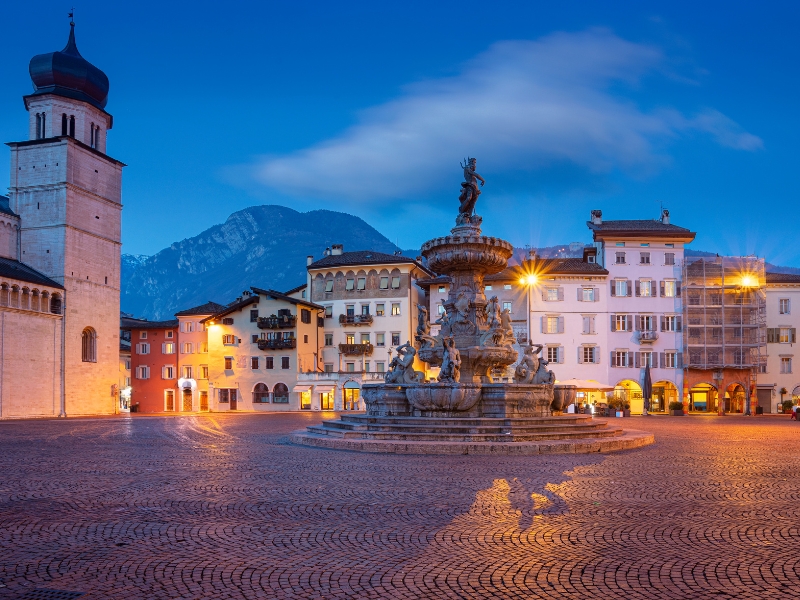
Piazza del Duomo is the main square of Trento and the setting for most of the city's events. On one side rises the Romanesque cathedral of San Vigilio, begun in 1212 by the master builder Adamo d'Arogno, where the Council of Trent opened in December 1545. Next to it stand the Palazzo Pretorio, the old bishops' palace that now houses the Diocesan Museum, and the Torre Civica.
In the middle of the square, the Neptune Fountain was built between 1767 and 1769 by Francesco Antonio Giongo. The Neptune you see on top is a bronze copy made in 1942 and placed there in 1945; the stone original is the one in the courtyard of Palazzo Thun.
- The painted façades of the Case Cazuffi-Rella on the north side, covered in 16th-century Renaissance frescoes.
- The rose window on the cathedral's north transept, carved as a Wheel of Fortune with figures rising and falling around it.
- The tritons and sea horses around the fountain basin.
MUSE
The MUSE, Trento's science museum, opened in 2013 in the new Le Albere district, south of the old town near the Adige river. It was designed by Renzo Piano, and its jagged roofline is meant to echo the shapes of the surrounding mountains. Inside, the museum is organised by altitude, from the glaciers at the top to the Alpine valleys at the bottom, and stuffed animals and skeletons seem to float in the tall central space. It is a good place for families and for a rainy day. Close by stands the Palazzo delle Albere, a 16th-century villa with corner towers built for the Madruzzo family of prince-bishops, which is another stop on our route.
How to see them in one walk
Start at Piazza Dante and walk into the old town to Santa Maria Maggiore, then continue to Piazza del Duomo for the cathedral, the fountain and the painted houses. From the square, walk up Via Belenzani past Palazzo Thun, and continue along Via Manci and Via San Marco to the Buonconsiglio Castle at the eastern edge of the centre. Finish with a longer walk south through the town to the MUSE and the Le Albere district, or save the museum for another day.
See Trento with World City Trail
Our Trento scavenger hunt turns the old town into a game you play on your phone. The route links 10 stops, and all six places in this guide are among them, from Piazza Dante and the Buonconsiglio Castle to Piazza del Duomo and the MUSE. The route also takes in the Port'Aquila gate, Piazza Venezia, the cathedral and the Palazzo delle Albere.
If you prefer a different format, there is also a self-guided walking tour and an outdoor escape game in Trento.
Play the Trento scavenger hunt →
Take the self-guided walking tour of Trento →
Play the outdoor escape game in Trento →
Facts checked in October 2026.