
This guide covers three places in the upper town of Luxembourg City that each say something about how the country sees itself: the Grand Ducal Palace, where the head of state works; the monument to the poets Dicks and Lentz, who gave Luxembourgish its first great literature and the words of the national anthem; and the Kaddish monument, the national memorial to the Jews of Luxembourg murdered in the Holocaust. All three lie within a few minutes' walk of each other, between the Place d'Armes and the edge of the old fortress.
Grand Ducal Palace
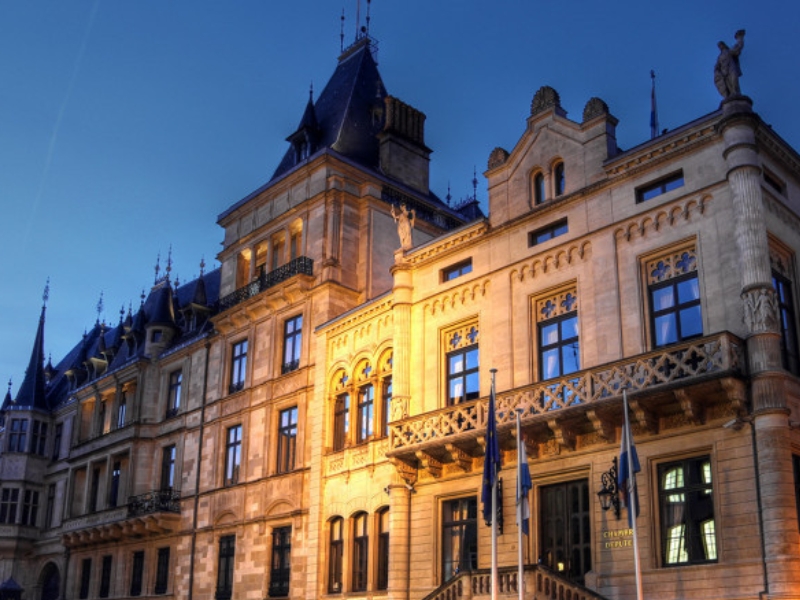
The Palais Grand-Ducal stands on the Rue du Marché-aux-Herbes, in the old centre of the upper town. It began life as the city's town hall: the earlier town hall was destroyed in 1554, when lightning set off a store of gunpowder and the blast wrecked much of the town, and the present building went up in 1572. Its richly carved façade, with its small turrets and patterned stonework, is usually described as Spanish Renaissance, a reminder of the long period when Luxembourg belonged to the Spanish Habsburgs.
After the French Revolution the building served as the seat of the regional government, and in 1890 it became the residence of the grand dukes, when the House of Nassau-Weilburg came to the throne; it was extended and restored in the years that followed. Today it is the official workplace of the Grand Duke, used for audiences, state visits and official receptions, while the grand-ducal family lives at Berg Castle outside the capital. Next door, in a 19th-century building linked to the palace, sits the Chamber of Deputies, Luxembourg's parliament.
- The sentry who marches up and down in front of the main door, a duty of the Luxembourg Army; the changing of the guard is a small ceremony worth catching.
- The flag on the roof: when it flies, the Grand Duke is in the country.
- The carved window frames and the two small corner turrets on the 16th-century front, very different in style from the plainer extension to the right.
- Guided tours of the interior are offered in summer only, while the palace is not in official use; check the dates and book ahead.
Monument Dicks-Lentz
In Square Jan Palach, a small corner of the Place d'Armes, stands a stone monument to Luxembourg's two national poets. Edmond de la Fontaine, known by his pen name Dicks (1823–1891), wrote the first plays in the Luxembourgish language and is seen as the father of its theatre. Michel Lentz (1820–1893) wrote the words of the national anthem, Ons Heemecht, and the patriotic song De Feierwon, written for the opening of the country's first railway.
The monument, by the sculptor Pierre Federspiel, dates from the early 20th century, a time when Luxembourgish was still widely seen as a dialect rather than a language. Putting two Luxembourgish-language writers on a public monument in the main square was a statement in itself. Today the language is the national language of the country, and the monument is one of the few places in the city where you will see a line of it carved in stone.
- The lion at the top, the heraldic animal of the Grand Duchy, also seen on the national coat of arms.
- The figure of a blacksmith, a nod to the iron and steel industry that made the country rich.
- The motto carved on the pillar, Mir wëlle bleiwe wat mir sinn (We want to remain what we are), taken from De Feierwon and still quoted as the national motto.
Kaddish Monument
On Boulevard Roosevelt, near the edge of the old fortress and a short walk from the cathedral, stands the Kaddish monument, Luxembourg's national memorial to the victims of the Shoah. It was inaugurated on 17 June 2018, 75 years after the last transport of Jews left Luxembourg for the East. The site was chosen because the city's first synagogue, opened in 1823, stood here.
The memorial is a block of grey-pink granite carved by Shelomo Selinger, a Franco-Israeli sculptor born in Poland in 1928 who survived nine concentration camps and two death marches. He named it after the Kaddish, the Jewish prayer for the dead. In May 1940 about 4,000 Jews lived in Luxembourg, many of them refugees from Germany, Austria and Eastern Europe; most were forced to flee or were deported, and only a small number survived in the country.
- The surface of the stone itself: Selinger chiselled and hammered his own prayer into the granite as he worked on it.
- The inscription in French: Pour les Juifs du Luxembourg assassinés par les Nazis 1940-1945 (For the Jews of Luxembourg murdered by the Nazis, 1940-1945).
- This is a place of remembrance: keep your voice down, and don't climb or sit on the stone.
How to see them in one walk
Start at the Place d'Armes, the square lined with café terraces, and find the Dicks-Lentz monument in its Square Jan Palach corner. Walk through to the Place Guillaume II, known locally as the Knuedler, with its equestrian statue of William II, King of the Netherlands and Grand Duke of Luxembourg, and on to the Rue du Marché-aux-Herbes for the Grand Ducal Palace. From there, continue towards the Notre-Dame cathedral and the Place de la Constitution, and follow Boulevard Roosevelt to the Kaddish monument, where the upper town meets the old fortress walls above the Pétrusse valley.
See Luxembourg City with World City Trail
Our Luxembourg City scavenger hunt turns the upper town into a game you play on your phone. The route links 10 stops, and all three places in this guide are among them: it starts at the Dicks-Lentz monument and also includes the Grand Ducal Palace and the Kaddish monument, along with the Place d'Armes, the Place Guillaume II, the Bock Casemates, Saint Michael's Church, the cathedral, the Monument of Remembrance and the Chemin de la Corniche.
If you prefer a different format, there is also a self-guided walking tour and an outdoor escape game in Luxembourg City.
Play the Luxembourg City scavenger hunt →
Take the self-guided walking tour of Luxembourg City →
Play the outdoor escape game in Luxembourg City →
Facts checked in October 2026.