
This guide follows seven Prague landmarks along one line through the city: the Municipal House, the Týn Church, the Astronomical Clock, the Church of St Nicholas on Old Town Square, the Spanish Synagogue, Charles Bridge and St Vitus Cathedral. Together they span six centuries, from the Gothic city of Emperor Charles IV to the Art Nouveau Prague of the early 1900s, and they line the old royal route that kings once followed from the Old Town across the river to the castle.
Municipal House (Obecní dům)
The Municipal House stands next to the Gothic Powder Tower, on the site of the old royal court where Bohemian kings lived in the 15th century. It was built between 1905 and 1912 to designs by Antonín Balšánek and Osvald Polívka, and nearly every leading Czech artist of the time worked on its interior, including Alfons Mucha, who decorated the Mayor's Hall. It was here, on 28 October 1918, that the independence of Czechoslovakia was proclaimed. Today it houses Smetana Hall, a concert venue, as well as a café and a restaurant with their original Art Nouveau fittings.
- The large mosaic above the main entrance, Homage to Prague, by Karel Špillar.
- The sculptural groups on either side of the entrance, which represent the Humiliation and the Resurrection of the Czech nation.
- The ironwork, glass and lamps of the ground-floor café, which you can see without a ticket.
Church of Our Lady before Týn
The twin spires of the Týn Church rise behind the houses on the east side of Old Town Square. The church was built from the 14th century onwards and was for a long time the main church of the Hussites, the followers of the reformer Jan Hus. Its towers are not identical: the south one is slightly wider and is sometimes called Adam, the north one Eve. Inside lies the Danish astronomer Tycho Brahe, who worked at the court of Emperor Rudolf II and died in Prague in 1601.
- The way the church hides behind the Týn School: you enter through a narrow passage under the arcades of the houses in front.
- Tycho Brahe's tombstone near the high altar, showing him in armour.
Astronomical Clock (Orloj)
On the south side of the Old Town Hall hangs the Astronomical Clock, made in 1410 by the clockmaker Mikuláš of Kadaň with the astronomer Jan Šindel. It is the oldest astronomical clock in the world that still works. The upper dial shows the position of the sun and moon in the sky, the lower dial is a calendar with the signs of the zodiac and scenes of rural life. Every hour, from morning until late evening, figures of the apostles parade past two small windows above the dials while a skeleton rings its bell. A legend says the town councillors had the clockmaker blinded so he could never build a finer clock elsewhere; it is only a legend, and it is usually told of a later Master Hanuš.
- The skeleton representing Death, flanked by a vain man with a mirror, a miser with his purse and a Turk with a lute.
- The calendar dial, painted in the 1860s by Josef Mánes; the one on the tower today is a copy and the original is in the City of Prague Museum.
- The golden rooster in the window above the apostles, which crows at the end of the show.
Church of St Nicholas (Old Town)
On the north-west corner of Old Town Square stands the white Baroque Church of St Nicholas, built in 1732–1737 by Kilian Ignaz Dientzenhofer, one of the great architects of Prague's Baroque. It is not to be confused with the larger St Nicholas Church in the Lesser Town. Since 1920 it has belonged to the Czechoslovak Hussite Church, and it is used today for services and for classical concerts, which are a good way to see its domed interior and large crystal chandelier.
Spanish Synagogue
In Josefov, the old Jewish quarter, the Spanish Synagogue was built in 1868 on the site of the Old School, the oldest synagogue in Prague. Its name comes from its Moorish Revival style, inspired by the Alhambra in Granada: the interior is covered with gilded and painted arabesques from top to bottom. Today it is part of the Jewish Museum in Prague and shows the history of the Jews of Bohemia and Moravia from the 19th century onwards, and it is also used for concerts.
- Outside, the bronze statue of Franz Kafka by Jaroslav Róna, unveiled in 2003, showing the writer riding on the shoulders of an empty suit.
Charles Bridge
Charles Bridge was begun in 1357 under Emperor Charles IV, to replace an earlier bridge swept away by floods, and was built by the workshop of Peter Parler. For centuries it was the only bridge across the Vltava in Prague, and it was simply called the Stone Bridge; the name Charles Bridge dates only from 1870. The 30 statues and statue groups along its sides were mostly added in the Baroque period, and many of those you see today are copies, with the originals in the Lapidarium of the National Museum. A popular legend says that eggs were mixed into the mortar to make it stronger.
- The statue of St John of Nepomuk, the oldest on the bridge (1683), with bronze reliefs polished bright by people who touch them for luck.
- The Old Town Bridge Tower at the eastern end, one of the finest Gothic towers in Europe.
- The view of the castle and St Vitus Cathedral from the middle of the bridge, best early in the morning before the crowds.
St Vitus Cathedral
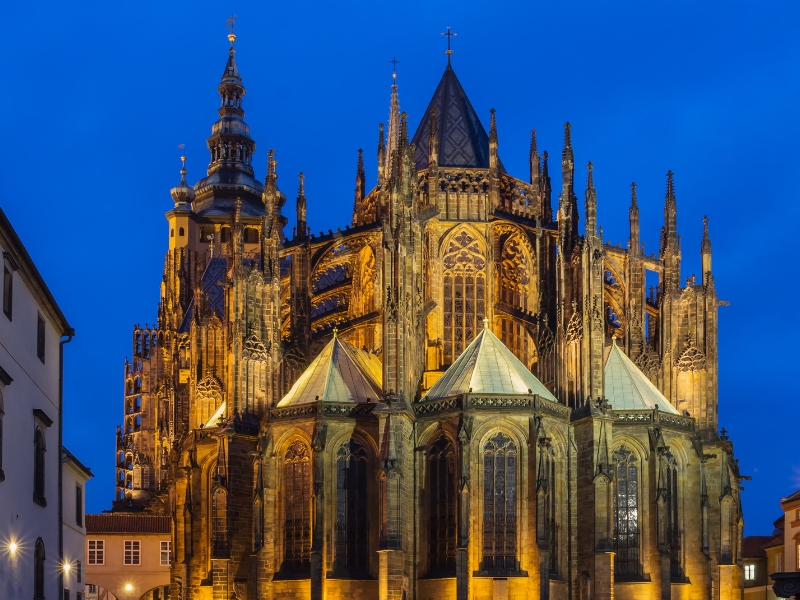
The cathedral of St Vitus, inside the Prague Castle complex, is the largest church in the country and the place where Bohemian kings were crowned. Construction began in 1344 under Matthias of Arras and was continued by Peter Parler, but the building was completed only in 1929, so the Gothic east end and the neo-Gothic west front are almost six centuries apart. It holds the tombs of kings and saints, and above the St Wenceslas Chapel is the chamber where the Bohemian crown jewels are kept.
- The St Wenceslas Chapel, its walls set with semi-precious stones and painted scenes.
- The stained-glass window by Alfons Mucha in the New Archbishop's Chapel, made in the early 1930s.
- The silver tomb of St John of Nepomuk and, outside on the south side, the Golden Gate with its 14th-century mosaic of the Last Judgement.
How to see them in one walk
Start at the Municipal House by the Powder Tower and follow Celetná Street to Old Town Square, where the Týn Church, the Astronomical Clock and the Church of St Nicholas all face the same square. Take a short detour north into Josefov for the Spanish Synagogue, then return through the Old Town lanes to Charles Bridge. Cross the river into the Lesser Town and climb up to the castle, where St Vitus Cathedral stands in the third courtyard. This is roughly the old coronation route of the Bohemian kings, walked in the same direction.
See Prague with World City Trail
Our Prague scavenger hunt turns the city into a game you play on your phone. The route links 10 stops, and all seven places in this guide are among them, from the Municipal House and the Astronomical Clock to Charles Bridge and St Vitus Cathedral. It also passes Henry's Tower, the monument to Charles IV by the bridge and the Holy Trinity Column in the Lesser Town.
If you prefer a different format, there is also a self-guided walking tour and an outdoor escape game in Prague.
Play the Prague scavenger hunt →
Take the self-guided walking tour of Prague →
Play the outdoor escape game in Prague →
Facts checked in October 2026.