
The 10 stops of our Graz scavenger hunt, from the cathedral to the Uhrturm, already have their own guide. This post covers eight other places in and around the old town that are worth your time: a Gothic staircase, the hill the clock tower stands on, a façade full of gods, the largest preserved historic armoury in the world, the Franciscan church, two buildings from 2003 on the river Mur and a Baroque palace on the western edge of town. Most of them lie inside the area UNESCO lists as a World Heritage Site, and all but the palace fit into one walk.
The double spiral staircase in the Burg
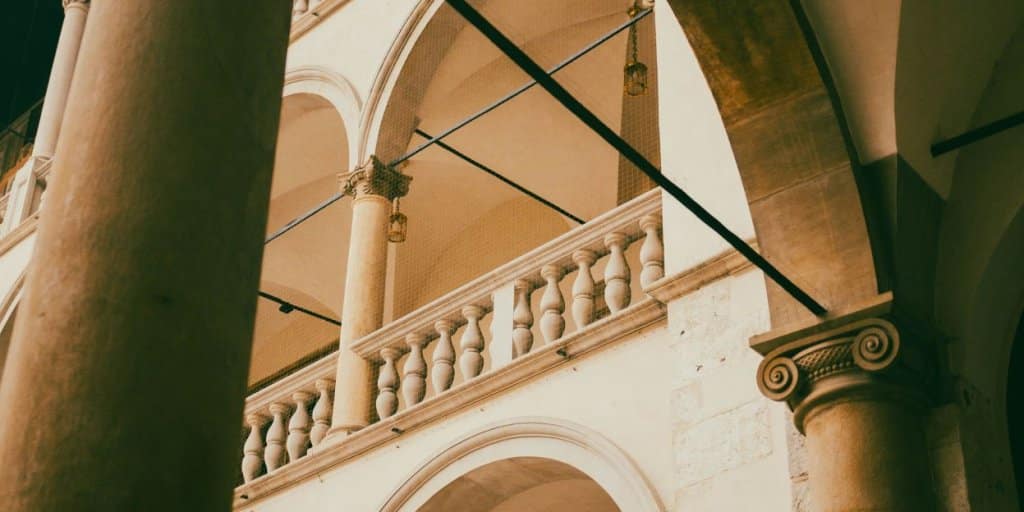
The Burg, a few steps from Graz Cathedral, was the Habsburgs' residence in Graz. Frederick III began building it in 1438 and his son Maximilian I extended it around 1500. Today it is the seat of the Styrian provincial government, so most of it is offices, but you can walk into the courtyards. The thing to find is the double spiral staircase from 1499: two stone stairways that wind up a tower around each other, meet on a landing on each floor and separate again. Nobody knows who designed it. People in Graz call it the staircase of reconciliation, after a local saying that two people who go up on different flights will always meet again.
- The landings where the two flights join for a moment and then part; stand at the bottom and look up to see how they twist.
- The Burg's entrance on Hofgasse, the lane that also leads to the cathedral and the Mausoleum of Ferdinand II.
The Schlossberg: funicular, lift, stairs and tunnels
The Uhrturm is a stop on our route, but the hill under it has a story of its own. The Schlossberg was a fortress for centuries and was never taken by force. In 1809, under the Treaty of Schönbrunn, Napoleon's troops demolished most of it; the people of Graz paid to save the clock tower and the bell tower, whose bell, Liesl, is the heaviest in the city. The rest of the old fortress is now a park of ruins, paths and viewpoints over the red roofs, and there are several ways up.
- The Schlossbergbahn, a funicular opened in 1894, which climbs from the riverside on a track with a gradient of about 60 percent.
- The Kriegssteig from Schlossbergplatz: 260 steps in five flights zigzagging up the rock face, begun in 1914 and opened in 1918. Next to it a short tunnel leads to the Schlossberg lift and to a long indoor slide that winds around the lift shaft.
- The Kasematten, the cellar of a ruined bastion that is now an open-air stage with a retractable roof, and the tunnels dug under the hill in the Second World War as air-raid shelters, some of which you can still walk through.
The Painted House on Herrengasse
Herrengasse runs from the Hauptplatz, the main square with the City Hall, towards the Landhaus. At number 3 stands the Gemaltes Haus, the Painted House, also called the Herzogshof. It is first mentioned in 1360, and until the Burg was finished the Habsburgs, as dukes of Styria, did official business here. Giovanni Pietro de Pomis painted the first façade around 1600, but nothing of his work survives: what you see is by the Baroque painter Johann Mayer, who repainted it in 1742 for the owner of the time, a money changer. The frescoes cover the whole front, more than 220 square metres.
- The gods in tiers: Bacchus, Vulcan and Vesta at the bottom; Apollo, Jupiter and Pluto in the middle; Mercury, Mars, Minerva and Aesculapius at the top.
- Heroes from Greek and Roman myth alongside the gods. For a long time nobody knew who the figures were; they were identified as the classical gods only in recent years.
The Landeszeughaus (Styrian Armoury)
A little further along Herrengasse, right next to the Landhaus, is the Landeszeughaus, the largest preserved historic armoury in the world. From the late 15th century the Styrian estates stockpiled weapons in Graz to defend the region against the Ottomans, and in 1642 Antonio Solar began this building to hold them. At one time it stored up to 190,000 weapons. When Empress Maria Theresa wanted to centralise defence and close it, the Styrians asked to keep it, and their request was granted. About 32,000 objects survive, from suits of armour and helmets to swords, pikes and firearms, displayed across four floors.
- The Baroque statues of Mars and Minerva by Giovanni Mamolo on the façade.
- The Landhaus next door, one of the stops on our route, with its arcaded courtyard; the armoury itself is not a stop.
The Franciscan Church and its quarter
West of the Hauptplatz, towards the Mur, the Franziskanerkirche stands on one of the oldest church sites in Graz: Franciscan friars settled here in the 13th century, and the order still runs the monastery. Its tall west tower was built between 1636 and 1643 as part of the city defences and got its onion dome around 1740. A bomb hit the church in 1945, and the windows in the choir date from the decades after the war. The lanes around it, known as the Franziskanerviertel, are full of small shops and places to eat.
- The Jakobikapelle (St James Chapel) in the east wing, an early Gothic space from the 13th century, and what remains of the old cloister, with gravestones set into its walls.
The Murinsel
From the Franciscan church it is a short walk to the river and the Murinsel, a floating platform anchored in the Mur. The New York artist Vito Acconci designed it for 2003, when Graz was European Capital of Culture. Shaped like a giant shell about 47 metres long, it is linked to both banks by footbridges, so you can use it to cross the river. Inside there is a café under a twisted dome, a small amphitheatre and a children's play area. From its walkways you see the old town on one side and the Kunsthaus on the other.
Kunsthaus Graz
On the west bank, in the Lend district, the Kunsthaus is the other big building from 2003. Peter Cook and Colin Fournier designed a blue, bulging shape that Fournier nicknamed the Friendly Alien. It is joined to the Eisernes Haus, a cast-iron department store from 1846 to 1848 whose listed façade was kept. The Kunsthaus has no permanent collection: it shows changing exhibitions of contemporary art and is run by the Universalmuseum Joanneum.
- The skin of blue acrylic panels and, after dark, the BIX media façade: 930 fluorescent lamps behind the panels whose brightness can be set one by one to show images and text.
Schloss Eggenberg
The one place here that needs a tram ride is Schloss Eggenberg, on the western edge of the city. Hans Ulrich von Eggenberg, a leading minister of Emperor Ferdinand II, had the Baroque palace built from 1625 around an older family house, to plans by Giovanni Pietro de Pomis, the same court artist who first painted the Gemaltes Haus. The building works like a calendar: it has 365 exterior windows, one for each day of the year, and 24 state rooms for the hours of the day. In 2010 UNESCO added it to the Graz World Heritage Site.
- The Planetensaal (Planetary Room), the main hall, painted by Hans Adam Weissenkircher in the 1680s with the four elements, the twelve signs of the zodiac and the seven classical planets.
- The park with its peacocks, and the museums of the Universalmuseum Joanneum inside, including the Alte Galerie and the archaeology museum with the Cult Wagon of Strettweg.
How to see them in one walk
Start at the Burg on Hofgasse and look for the double staircase. Walk down to Schlossbergplatz and climb the Kriegssteig, or take the lift; explore the hill, then come down on the funicular or by the paths towards Sporgasse. From there it is a few minutes to the Hauptplatz and into Herrengasse for the Painted House and, further on, the Landeszeughaus beside the Landhaus. Head west through the Franciscan quarter to the church, go down to the Mur, cross the river on the Murinsel and finish at the Kunsthaus. Keep Schloss Eggenberg for the afternoon or another day: it deserves a few hours, and a tram from the centre takes you there.
See Graz with World City Trail
Our Graz scavenger hunt turns the old town into a game you play on your phone. Its route covers 10 other landmarks, among them Graz Cathedral, the Mausoleum of Ferdinand II, the Landhaus and the Uhrturm, so the places in this post are good to add before or after the game. Several of them are close to the route, but none of them is a stop.
If you prefer a different format, there is also a self-guided walking tour and an outdoor escape game in Graz.
Play the Graz scavenger hunt →
Take the self-guided walking tour of Graz →
Play the outdoor escape game in Graz →
Facts checked in November 2026.