
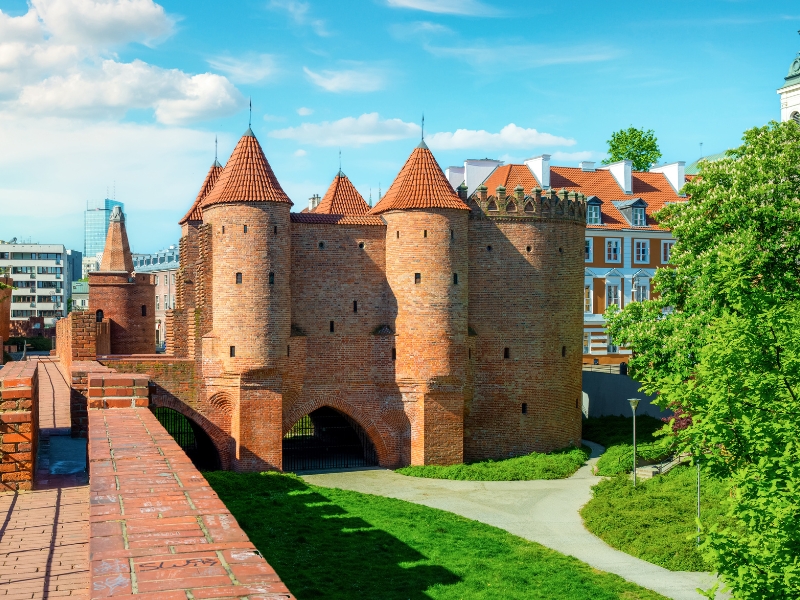
The Warsaw Barbican (Barbakan) is the round red-brick gate tower that stands on the old city walls between the Old Town and the New Town. It was built in the 1540s to guard the road out of the city, saw real fighting only once, and what you see today is mostly a 1950s reconstruction, made partly with old bricks brought from Nysa and Wrocław.
The Warsaw Barbican at a glance
- Where: on Nowomiejska Street, the walk from the Old Town Market Square to the New Town, on the line of the old city walls.
- Built: around the 1540s; rebuilt in 1952–1954 after its destruction in the Second World War.
- By: designed by Jan Baptysta of Venice, an Italian architect working in Mazovia; the post-war reconstruction was led by Wacław Podlewski.
- What it is today: a gateway you walk through on the way between the two old towns, part of the UNESCO-listed Old Town, with a seasonal exhibition of the Museum of Warsaw on the city walls.
- Time needed: 15–30 minutes, including a walk along the walls.
A gate that was out of date at once
The barbican was built in front of the New Town Gate to protect the entrance to Old Warsaw and to cover the neighbouring walls. It is a semicircular brick bastion that projects beyond the moat, with gun ports on the lower level and a covered gallery with round loopholes above. Firearms were developing so fast that it was outdated almost as soon as it was finished. It saw action only once, on 30 June 1656, when the army of King John II Casimir took it back from the Swedes during the Deluge.
In the 18th century the barbican was partly pulled down to make room for traffic, and in the 19th century its remains were built into tenement houses. A first partial reconstruction of the walls was carried out in 1937–1938 under Jan Zachwatowicz. The Old Town was then destroyed in the siege of 1939 and the Warsaw Uprising of 1944. After the war, planners decided not to rebuild the houses along the walls but to uncover the walls and reconstruct the barbican. The work, in 1952–1954, followed 17th-century engravings and used bricks from demolished Gothic houses in Nysa and Wrocław.
What to look for
- The round loopholes in the upper gallery, from which defenders could fire in both directions.
- The gun ports at the lower level and the Renaissance-style attic crowning the walls.
- The bridge over the dry moat: walk across it and look down at the ditch that once surrounded the city walls.
- The sandstone plaque on the inner wall, unveiled in 1956 for the 300th anniversary of the recapture from the Swedes.
- The bricks themselves: much of the masonry is older than the reconstruction, reused from buildings in other Polish cities.
The second-largest barbican in Poland
Barbicans were once common in front of European city gates, but few survive. Warsaw's is usually described as the second largest in Poland, after the much bigger Barbican in Kraków. Unlike Kraków's, which survived the war, Warsaw's is mainly a careful post-war rebuild, which makes it a good example of how the whole Old Town was brought back from ruins using old drawings and paintings.
Tips for your visit
- Come early in the morning, before tour groups arrive, to walk through the gate and along the walls in peace.
- For the best photo, stand on the New Town side of the moat and frame the whole round bastion with the Old Town behind it.
- In summer, look for the Museum of Warsaw exhibition inside, which tells the story of the city walls.
- Combine it with a walk from the Old Town Market Square through the barbican and along Freta Street to the New Town Market Square.
Nearby
- Old Town Market Square: the rebuilt main square with its colourful houses and the Mermaid statue, a few minutes' walk away.
- Little Insurgent Monument: a small statue of a boy soldier of the 1944 Uprising, by the walls close to the barbican.
- Marie Skłodowska-Curie Museum: in the house on Freta Street where the scientist was born.
- New Town Market Square: a quieter square with an old well and the Church of St Casimir.
See Warsaw with World City Trail
Our Warsaw scavenger hunt turns the old town into a game you play on your phone. The route links 10 stops and takes around 3 hours, with about 47 minutes of walking, and includes places such as the Church of the Visitation, the New Town Market Square and the Krasiński Garden. You can play in English, German, French, Italian, Spanish or Polish.
If you prefer a different format, there is also a self-guided walking tour and an outdoor escape game in Warsaw.
Play the Warsaw scavenger hunt →
Take the self-guided walking tour of Warsaw →
Play the outdoor escape game in Warsaw →
Facts checked in October 2026.