
Dublin began as a Viking harbour, spent seven centuries as the seat of English and then British rule, and became the capital of an independent Ireland in 1922. Two medieval cathedrals and a castle sit within a few minutes' walk of each other, and almost every street has a writer attached to it. Here are the facts and stories behind the city.
10 spannende Fakten über Dublin
- Ein Name von einem schwarzen Teich: Dublin kommt vom irischen Dubh Linn, schwarzer Teich, nach einem dunklen Gezeitenbecken, wo der Fluss Poddle in die Liffey mündete. 841 gründeten Wikinger hier eine Siedlung.
- A Viking king's cathedral: Christ Church Cathedral was founded around 1030 by the Norse king Sitric Silkbeard. Its crypt is one of the largest medieval crypts in Britain and Ireland.
- Katze und Ratte, erstarrt in der Jagd: In der Krypta von Christ Church liegen die mumifizierten Körper einer Katze und einer Ratte, die angeblich in einer Orgelpfeife steckten. James Joyce erwähnt die beiden in Finnegans Wake.
- Gulliver's dean: St Patrick's Cathedral was founded in 1191. Jonathan Swift, author of Gulliver's Travels, was its dean from 1713 until his death in 1745 and is buried inside, next to his companion Stella.
- Sieben Jahrhunderte Macht: König Johann ließ 1204 in Dublin eine Burg errichten. Am 16. Januar 1922 wurde Dublin Castle an Michael Collins und die Provisorische Regierung des neuen irischen Staates übergeben.
- Justice with her back to the people: the statue of Justice above the castle's main gate faces into the castle yard, turning her back on the city, and unusually she wears no blindfold.
- A very long lease: in 1759 Arthur Guinness signed a 9,000-year lease on a small brewery at St James's Gate.
- A bridge named after its toll: the cast-iron Ha'penny Bridge opened in 1816. Its nickname comes from the halfpenny toll once charged to cross the Liffey.
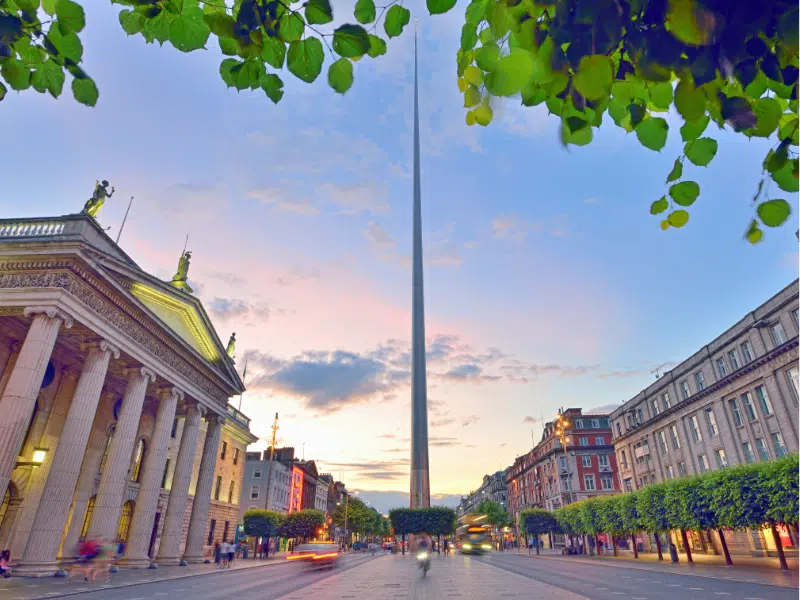
- A spire where a pillar stood: the Spire on O'Connell Street, completed in 2003, is 120 metres tall. It stands on the site of Nelson's Pillar, which was blown up in 1966.
- Eine Stadt der Schriftsteller: Dublin wurde 2010 UNESCO-Literaturstadt. Jedes Jahr am 16. Juni feiern Fans den Bloomsday, den Tag im Jahr 1904, an dem Joyce seinen Roman Ulysses spielen lässt.
Die Tür der Versöhnung
In 1492 two powerful Irish families, the Butlers of Ormond and the FitzGeralds of Kildare, were feuding over who would hold the office of Lord Deputy. After a skirmish outside the city walls, the Butlers fled into the chapter house of St Patrick's Cathedral and barred the door. Gerald FitzGerald, Earl of Kildare, followed and called on them to come out and make peace, but they feared a trap. To prove his good faith, he had a hole cut in the door and pushed his arm through it, offering his hand. Instead they shook it, came out, and the families made peace. The battered old door now stands in the cathedral, and the story is the origin of the Irish expression to chance your arm.
Dublin Castle kurz erklärt
For about 700 years Dublin Castle was the centre of English and later British government in Ireland. Little of the medieval fortress survives above ground apart from the Record Tower; most of what you see is Georgian. Irish presidents are inaugurated in its St Patrick's Hall. Behind it, the Dubh Linn Garden lies roughly where the original black pool was, and the Chester Beatty library and museum stands in the castle grounds.
Was man in Dublin essen sollte
- Dublin coddle: a slow-cooked stew of sausages, bacon, potatoes and onions, the city's own comfort food.
- Irish Stew: Lamm oder Hammel mit Kartoffeln, Zwiebeln und Karotten, in vielen Pubs rund um die Kathedralen zu haben.
- Guinness: the stout has been brewed at St James's Gate since 1759. The Gravity Bar at the top of the Guinness Storehouse has views across the city.
- Braunes Sodabrot: ein dichtes, leicht säuerliches Brot aus Buttermilch und Natron statt Hefe.
- Seafood Chowder: eine cremige Suppe mit Fisch und Meeresfrüchten aus der Irischen See, oft mit Sodabrot serviert.
Gut zu wissen vor dem Besuch
- Für das Book of Kells am Trinity College buchst du am besten vorab ein Zeitfensterticket. Die Old Library mit ihrem Long Room soll Ende 2027 für die Restaurierung schließen.
- St Patrick's and Christ Church charge an entry fee for sightseeing. Services are free.
- Die Höfe von Dublin Castle kannst du kostenlos durchqueren; für die State Apartments brauchst du ein Ticket, und sie können bei offiziellen Anlässen schließen.
- Für einen Tag am Meer nimm die DART-Bahn nach Norden bis Howth mit Klippenweg und Fischerhafen oder nach Süden bis Dún Laoghaire mit seinen langen Molen.
Dublin mit World City Trail entdecken
Our Dublin scavenger hunt turns these sights into a game you play on your phone. The route links 10 stops and takes around three hours, with about 59 minutes of walking. Along the way you visit St Patrick's Cathedral, Christ Church Cathedral and Dublin Castle.
An jeder Station löst du ein Rätsel und hörst eine kurze Geschichte, in deinem eigenen Tempo. Du kannst starten, wann du willst.
Die Schnitzeljagd in Dublin spielen →
Fakten geprüft im Oktober 2026.