
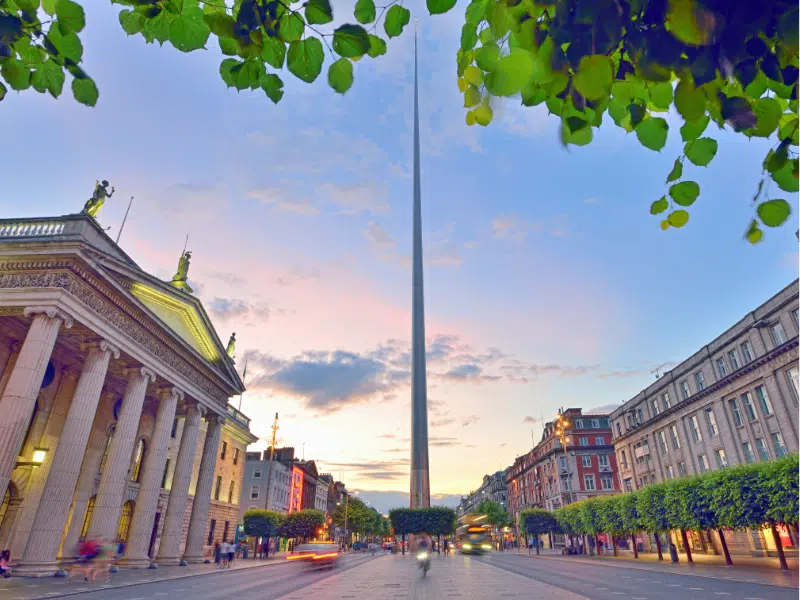
Dublin began as a Viking harbour, spent seven centuries as the seat of English and then British rule, and became the capital of an independent Ireland in 1922. Two medieval cathedrals and a castle sit within a few minutes' walk of each other, and almost every street has a writer attached to it. Here are the facts and stories behind the city.
10 curiosità su Dublino
- Un nome da uno stagno nero: Dublino viene dall’irlandese Dubh Linn, stagno nero, da una pozza scura dove il fiume Poddle incontrava il Liffey. I vichinghi vi fondarono un insediamento nell’841.
- A Viking king's cathedral: Christ Church Cathedral was founded around 1030 by the Norse king Sitric Silkbeard. Its crypt is one of the largest medieval crypts in Britain and Ireland.
- Un gatto e un topo fermi nell’inseguimento: nella cripta di Christ Church sono esposti i corpi mummificati di un gatto e di un topo che sarebbero stati trovati incastrati in una canna d’organo. James Joyce li cita in Finnegans Wake.
- Gulliver's dean: St Patrick's Cathedral was founded in 1191. Jonathan Swift, author of Gulliver's Travels, was its dean from 1713 until his death in 1745 and is buried inside, next to his companion Stella.
- Sette secoli di potere: re Giovanni ordinò di costruire un castello a Dublino nel 1204. Il 16 gennaio 1922 il Castello di Dublino fu consegnato a Michael Collins e al Governo provvisorio del nuovo Stato irlandese.
- Justice with her back to the people: the statue of Justice above the castle's main gate faces into the castle yard, turning her back on the city, and unusually she wears no blindfold.
- A very long lease: in 1759 Arthur Guinness signed a 9,000-year lease on a small brewery at St James's Gate.
- A bridge named after its toll: the cast-iron Ha'penny Bridge opened in 1816. Its nickname comes from the halfpenny toll once charged to cross the Liffey.
- A spire where a pillar stood: the Spire on O'Connell Street, completed in 2003, is 120 metres tall. It stands on the site of Nelson's Pillar, which was blown up in 1966.
- Una città di scrittori: Dublino è diventata Città della letteratura UNESCO nel 2010. Ogni 16 giugno gli appassionati festeggiano il Bloomsday, il giorno del 1904 in cui Joyce ambientò il romanzo Ulisse.
La porta della Riconciliazione
In 1492 two powerful Irish families, the Butlers of Ormond and the FitzGeralds of Kildare, were feuding over who would hold the office of Lord Deputy. After a skirmish outside the city walls, the Butlers fled into the chapter house of St Patrick's Cathedral and barred the door. Gerald FitzGerald, Earl of Kildare, followed and called on them to come out and make peace, but they feared a trap. To prove his good faith, he had a hole cut in the door and pushed his arm through it, offering his hand. Instead they shook it, came out, and the families made peace. The battered old door now stands in the cathedral, and the story is the origin of the Irish expression to chance your arm.
Il Castello di Dublino in breve
For about 700 years Dublin Castle was the centre of English and later British government in Ireland. Little of the medieval fortress survives above ground apart from the Record Tower; most of what you see is Georgian. Irish presidents are inaugurated in its St Patrick's Hall. Behind it, the Dubh Linn Garden lies roughly where the original black pool was, and the Chester Beatty library and museum stands in the castle grounds.
Cosa mangiare a Dublino
- Dublin coddle: a slow-cooked stew of sausages, bacon, potatoes and onions, the city's own comfort food.
- Irish stew: agnello o montone con patate, cipolle e carote, servito in molti pub intorno alle cattedrali.
- Guinness: the stout has been brewed at St James's Gate since 1759. The Gravity Bar at the top of the Guinness Storehouse has views across the city.
- Pane bruno al bicarbonato: un pane compatto e leggermente acidulo fatto con latticello e bicarbonato invece del lievito.
- Seafood chowder: una zuppa cremosa di pesce e frutti di mare del Mare d’Irlanda, spesso servita con pane bruno.
Da sapere prima di partire
- Per vedere il Libro di Kells al Trinity College prenota in anticipo un biglietto a orario. La Old Library con la sua Long Room dovrebbe chiudere per restauro alla fine del 2027.
- St Patrick's and Christ Church charge an entry fee for sightseeing. Services are free.
- I cortili del Castello di Dublino si attraversano liberamente; gli State Apartments richiedono un biglietto e possono chiudere per eventi ufficiali.
- Per una giornata al mare, prendi il treno DART verso nord fino a Howth, con il sentiero sulle scogliere e il porto dei pescatori, o verso sud fino a Dún Laoghaire, con i suoi lunghi moli.
Scopri Dublino con World City Trail
Our Dublin scavenger hunt turns these sights into a game you play on your phone. The route links 10 stops and takes around three hours, with about 59 minutes of walking. Along the way you visit St Patrick's Cathedral, Christ Church Cathedral and Dublin Castle.
A ogni tappa risolvi un enigma e ascolti una breve storia, al tuo ritmo. Puoi iniziare quando vuoi.
Gioca alla caccia al tesoro di Dublino →
Fatti verificati a ottobre 2026.