
Dublin began as a Viking harbour, spent seven centuries as the seat of English and then British rule, and became the capital of an independent Ireland in 1922. Two medieval cathedrals and a castle sit within a few minutes' walk of each other, and almost every street has a writer attached to it. Here are the facts and stories behind the city.
10 curiosidades sobre Dublin
- Um nome vindo de um charco negro: Dublin vem do irlandês Dubh Linn, charco negro, por causa de uma poça escura onde o rio Poddle se juntava ao Liffey. Os vikings fundaram aqui um povoado em 841.
- A Viking king's cathedral: Christ Church Cathedral was founded around 1030 by the Norse king Sitric Silkbeard. Its crypt is one of the largest medieval crypts in Britain and Ireland.
- Um gato e um rato parados a meio da perseguição: na cripta de Christ Church estão expostos os corpos mumificados de um gato e de um rato que terão sido encontrados presos num tubo de órgão. James Joyce menciona-os em Finnegans Wake.
- Gulliver's dean: St Patrick's Cathedral was founded in 1191. Jonathan Swift, author of Gulliver's Travels, was its dean from 1713 until his death in 1745 and is buried inside, next to his companion Stella.
- Sete séculos de poder: o rei João Sem Terra mandou construir um castelo em Dublin em 1204. A 16 de janeiro de 1922 o Castelo de Dublin foi entregue a Michael Collins e ao Governo Provisório do novo Estado irlandês.
- Justice with her back to the people: the statue of Justice above the castle's main gate faces into the castle yard, turning her back on the city, and unusually she wears no blindfold.
- A very long lease: in 1759 Arthur Guinness signed a 9,000-year lease on a small brewery at St James's Gate.
- A bridge named after its toll: the cast-iron Ha'penny Bridge opened in 1816. Its nickname comes from the halfpenny toll once charged to cross the Liffey.
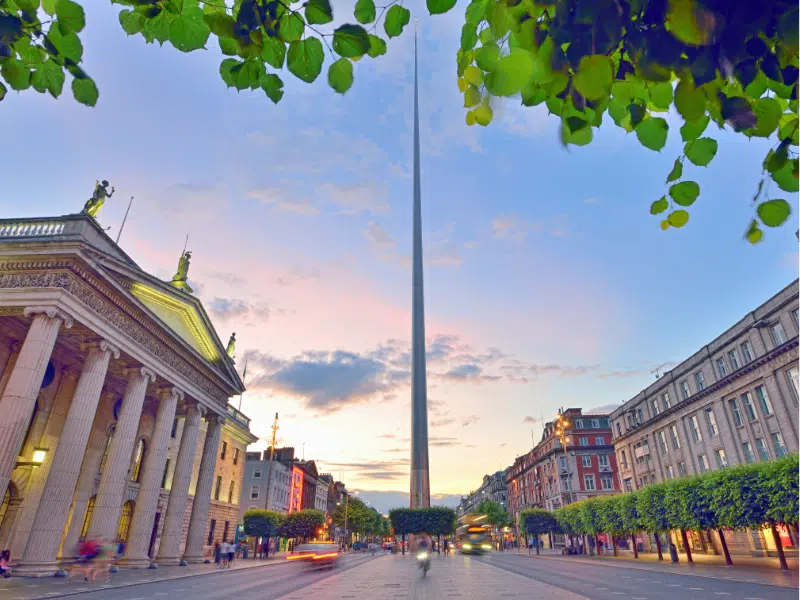
- A spire where a pillar stood: the Spire on O'Connell Street, completed in 2003, is 120 metres tall. It stands on the site of Nelson's Pillar, which was blown up in 1966.
- Uma cidade de escritores: Dublin tornou-se Cidade da Literatura da UNESCO em 2010. Todos os anos, a 16 de junho, os fãs celebram o Bloomsday, o dia de 1904 em que Joyce situou o romance Ulisses.
A Porta da Reconciliação
In 1492 two powerful Irish families, the Butlers of Ormond and the FitzGeralds of Kildare, were feuding over who would hold the office of Lord Deputy. After a skirmish outside the city walls, the Butlers fled into the chapter house of St Patrick's Cathedral and barred the door. Gerald FitzGerald, Earl of Kildare, followed and called on them to come out and make peace, but they feared a trap. To prove his good faith, he had a hole cut in the door and pushed his arm through it, offering his hand. Instead they shook it, came out, and the families made peace. The battered old door now stands in the cathedral, and the story is the origin of the Irish expression to chance your arm.
O Castelo de Dublin, explicado
For about 700 years Dublin Castle was the centre of English and later British government in Ireland. Little of the medieval fortress survives above ground apart from the Record Tower; most of what you see is Georgian. Irish presidents are inaugurated in its St Patrick's Hall. Behind it, the Dubh Linn Garden lies roughly where the original black pool was, and the Chester Beatty library and museum stands in the castle grounds.
O que comer em Dublin
- Dublin coddle: a slow-cooked stew of sausages, bacon, potatoes and onions, the city's own comfort food.
- Irish stew: borrego ou carneiro com batatas, cebola e cenoura, servido em muitos pubs perto das catedrais.
- Guinness: the stout has been brewed at St James's Gate since 1759. The Gravity Bar at the top of the Guinness Storehouse has views across the city.
- Pão escuro de soda: um pão denso e ligeiramente ácido feito com leitelho e bicarbonato em vez de fermento.
- Seafood chowder: uma sopa cremosa de peixe e marisco do mar da Irlanda, muitas vezes com pão escuro.
Antes de ires
- Para veres o Livro de Kells no Trinity College, reserva com antecedência um bilhete com hora marcada. A Old Library e a Long Room deverão fechar para restauro no fim de 2027.
- St Patrick's and Christ Church charge an entry fee for sightseeing. Services are free.
- Os pátios do Castelo de Dublin atravessam-se gratuitamente; os State Apartments precisam de bilhete e podem fechar em eventos oficiais.
- Para um dia à beira-mar, apanha o comboio DART para norte até Howth, com o trilho das falésias e o porto de pesca, ou para sul até Dún Laoghaire e os seus longos molhes.
Descobre Dublin com a World City Trail
Our Dublin scavenger hunt turns these sights into a game you play on your phone. The route links 10 stops and takes around three hours, with about 59 minutes of walking. Along the way you visit St Patrick's Cathedral, Christ Church Cathedral and Dublin Castle.
Em cada paragem resolves um enigma e ouves uma pequena história, ao teu ritmo. Podes começar quando quiseres.
Jogar a caça ao tesouro de Dublin →
Factos verificados em outubro de 2026.