
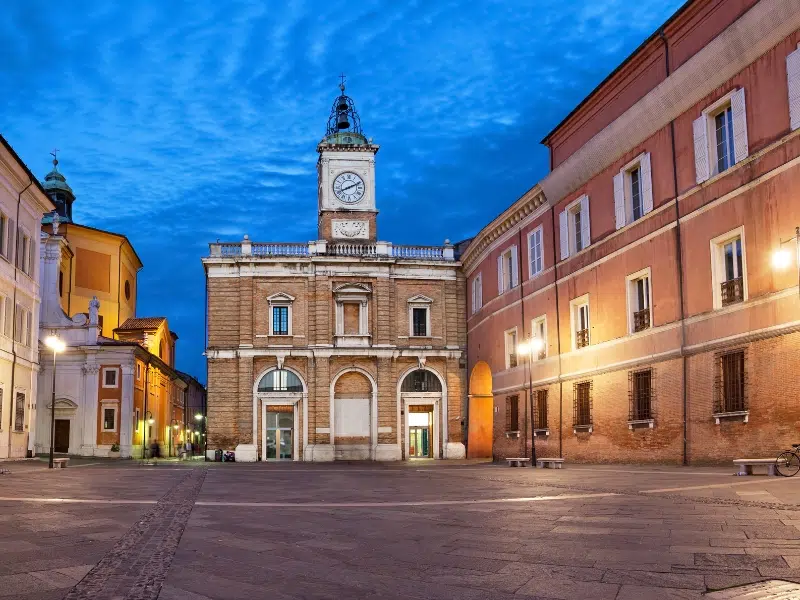
Ravenna war Hauptstadt des Weströmischen Reichs, dann des Ostgotenkönigs Theoderich, dann des byzantinischen Italiens, und jeder dieser Herrscher hinterließ Kirchen voller Mosaiken. Von außen sind sie schlichter Backstein, innen leuchten sie in Gold, Blau und Grün. Auch Dante ist hier begraben. Hier sind die Fakten und Geschichten, die die Stadt besonders machen.
10 spannende Fakten über Ravenna
- Eine kaiserliche Hauptstadt: 402 verlegte Kaiser Honorius die Hauptstadt des Weströmischen Reichs nach Ravenna, geschützt von Sümpfen und nah am Meer. Sie blieb Hauptstadt, bis das Reich 476 unterging.
- Eight monuments, one World Heritage Site: since 1996 UNESCO has listed eight early Christian monuments in Ravenna, including San Vitale, the two baptisteries and the two basilicas of Sant'Apollinare.
- Ein Himmel voller Sterne: Das kleine Mausoleum der Galla Placidia aus dem 5. Jahrhundert hat eine Kuppel aus tiefblauem Mosaik mit goldenen Sternen um ein zentrales Kreuz. Galla Placidia, die Schwester des Honorius, regierte jahrelang das Westreich für ihren jungen Sohn.
- Ein Kaiser, der nie kam: San Vitale, 547 geweiht, zeigt Kaiser Justinian und Kaiserin Theodora mit ihrem Hof auf zwei berühmten Mosaiktafeln, obwohl keiner von beiden je Ravenna besuchte.
- A roof made of one stone: the Mausoleum of Theodoric, built around 520 as the king's future tomb, is topped by a single block of Istrian stone about 10 metres across and weighing around 230 tonnes.
- Hands without bodies: in Sant'Apollinare Nuovo, built by Theodoric, the new Byzantine rulers had his court removed from the mosaic of his palace. Look closely at the columns and you can still see a few hands left behind.
- A port that lost its sea: Classe, south of the city, was the base of a Roman fleet in the time of Augustus. The coast has since silted up and moved away, and the basilica of Sant'Apollinare in Classe now stands among fields.
- Dante's last home: the poet died in Ravenna on 14 September 1321, in exile from Florence. His small neoclassical tomb by Camillo Morigia was completed in 1781, and every year Florence sends oil for the lamp that burns inside.
- Ein verliebter Dichter: Lord Byron lebte von 1819 bis 1821 in Ravenna, aus Liebe zur Gräfin Teresa Guiccioli.
- Musik in den Basiliken: Seit 1990 bringt das Ravenna Festival jeden Sommer Konzerte, Oper und Tanz in die Stadt, manchmal in dieselben Kirchen, die die Mosaiken bergen.
Die Gebeine Dantes
For centuries Florence wanted back the poet it had exiled. In 1519, Pope Leo X, himself a Medici from Florence, allowed a delegation to collect Dante's remains, with Michelangelo among those who supported the request. When the sarcophagus in Ravenna was opened, it was empty. The Franciscan friars who looked after the tomb had taken the bones out through a hole in the wall and hidden them in their monastery. They were moved into the new tomb in 1781, then hidden again when Napoleon closed the religious orders, and forgotten. In 1865, during work for the 600th anniversary of Dante's birth, a builder found a wooden box in a walled-up doorway with an inscription saying it held Dante's bones. They were reburied in the tomb, where they remain. During the Second World War they were buried in a garden nearby for safety.
Was man in Ravenna essen sollte
- Piadina romagnola: ein dünnes Fladenbrot, auf einer Platte gebacken und um die Füllung geklappt. Seit 2014 ist es EU-geschützt.
- Squacquerone di Romagna: ein weicher, frischer, leicht säuerlicher Käse, klassisch in der Piadina mit Rucola.
- Cappelletti: kleine hutförmige Nudeln mit Käsefüllung, in Brühe serviert, besonders um Weihnachten.
- Passatelli: dicke Stränge aus Semmelbröseln, Parmigiano, Eiern und Muskat, in Brühe gegart.
- Sangiovese di Romagna: the region's everyday red wine; for white, try the local Albana.
Gut zu wissen vor dem Besuch
- Mehrere Mosaikmonumente teilen sich ein Kombiticket, und für das Mausoleum der Galla Placidia braucht man in der Hochsaison mitunter ein gebuchtes Zeitfenster. Schau vorher auf den offiziellen Seiten nach.
- Sant'Apollinare in Classe is outside the centre but easy to reach by bus or local train.
- Ravenna ist flach und sehr fahrradfreundlich, und viele Hotels verleihen oder vermieten Räder.
- Die Adriastrände von Marina di Ravenna und Punta Marina sind im Sommer eine kurze Busfahrt entfernt.
Ravenna mit World City Trail entdecken
Our Ravenna scavenger hunt turns these sights into a game you play on your phone. The route links 10 stops and takes around two hours, with about 38 minutes of walking, and includes a stop at the Giardini Pubblici, the city's public gardens.
An jeder Station löst du ein Rätsel und hörst eine kurze Geschichte, in deinem eigenen Tempo. Du kannst starten, wann du willst, und auf Deutsch, Englisch, Französisch, Italienisch, Spanisch oder Niederländisch spielen.
Die Schnitzeljagd in Ravenna spielen →
Fakten geprüft im Oktober 2026.