
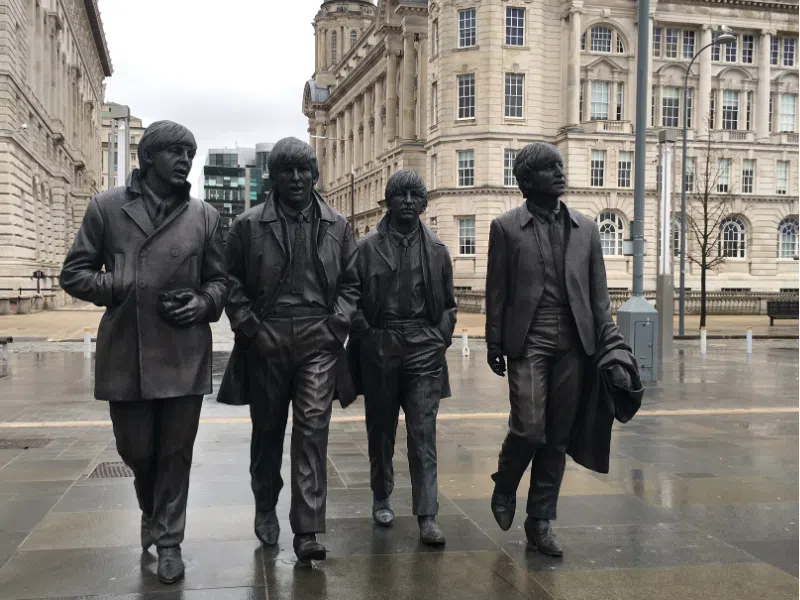
Liverpool se hizo rica junto al río Mersey, y su frente marítimo todavía lo demuestra: en el siglo XIX era uno de los puertos con más tráfico del mundo. También es la ciudad de los Beatles y de un acento y un guiso que se llaman igual: Scouse. Estos son los datos y las historias que hay detrás.
10 curiosidades sobre Liverpool
- The world's first commercial wet dock: the Old Dock opened in 1715, letting ships load and unload whatever the tide was doing. Its remains were rediscovered and now lie beneath the Liverpool ONE shopping district.
- Dos pájaros que mantienen viva la ciudad: en lo alto del Royal Liver Building, terminado en 1911, hay dos Liver Birds de cobre. Uno mira al mar y el otro a la ciudad, y la leyenda dice que si algún día salieran volando, Liverpool dejaría de existir.
- Clocks bigger than Big Ben's: the clock faces on the Royal Liver Building are larger than those of the Great Clock at Westminster, which makes them the largest in Britain.
- Britain's largest cathedral: Liverpool Cathedral, built between 1904 and 1978, is the biggest cathedral in the UK. Its architect, Giles Gilbert Scott, was only 22 when he won the competition, and he later designed the classic red telephone box.
- Two cathedrals, one street: Hope Street links the Anglican cathedral with the Catholic Metropolitan Cathedral, consecrated in 1967 and nicknamed Paddy's Wigwam.
- Un hito ferroviario: el Liverpool and Manchester Railway, inaugurado en 1830, fue la primera línea interurbana con trenes de pasajeros con horario fijo arrastrados por locomotoras de vapor.
- Casi 300 conciertos en un sótano: los Beatles tocaron en el Cavern Club de Mathew Street unas 290 veces entre 1961 y 1963. El sótano original se rellenó en los años setenta, y el club que visitas hoy es una reconstrucción casi en el mismo sitio.
- A floor that is rarely seen: the Great Hall of St George's Hall, opened in 1854, has a floor of more than 30,000 Minton tiles. It is kept covered most of the time and is only revealed on special occasions.
- Un Patrimonio Mundial que perdió el título: la UNESCO inscribió el frente marítimo en 2004 como Liverpool – Puerto mercantil marítimo y lo retiró de la lista en 2021 por las nuevas construcciones en los muelles.
- One of Europe's oldest Chinese communities: Chinese seamen settled near the docks in the 19th century. The ornate arch on Nelson Street, put up in 2000, was made by craftsmen from Shanghai, Liverpool's twin city.
De pueblo pesquero a puerto mundial
Liverpool empezó como un pequeño burgo: el rey Juan sin Tierra le concedió su carta en 1207 porque quería un puerto para navegar a Irlanda. En el siglo XVIII, gran parte de su riqueza vino de la trata de esclavos: los barcos de Liverpool llevaron a más de un millón de africanos esclavizados a través del Atlántico, una historia que hoy cuenta el International Slavery Museum en el Royal Albert Dock. En el siglo XIX, millones de emigrantes salieron de Europa por Liverpool rumbo a América y Australia. El Royal Liver Building, el Cunard Building y el Port of Liverpool Building, conocidos juntos como las Three Graces, son de aquella época tan segura de sí misma.
El Royal Albert Dock, explicado
The Royal Albert Dock opened in 1846 and was designed by the dock engineer Jesse Hartley. Its warehouses were built of brick, stone and cast iron with no structural wood, so they could not burn. The dock lost its trade in the 20th century and closed in 1972. After restoration in the 1980s it became one of Liverpool's busiest areas, home to the Merseyside Maritime Museum, the International Slavery Museum and the Beatles Story.
Qué comer en Liverpool
- Scouse: un guiso a fuego lento de cordero o ternera con patatas y cebolla, servido con lombarda encurtida y pan crujiente. El nombre viene de lobscouse, un guiso de marineros.
- Blind scouse: el mismo guiso sin carne, de los tiempos en que muchas familias no podían pagarla.
- Wet Nelly: a dense, syrupy bread pudding, Liverpool's version of the old Nelson cake.
- Everton toffee: the football club's nickname, the Toffees, goes back to the toffee shops of the old village of Everton, and you can still find the sweets in the city.
Antes de ir
- Coge el Mersey Ferry para cruzar el río: es la mejor vista de las Three Graces y del perfil del frente marítimo.
- The city's national museums, including the World Museum, the Walker Art Gallery and the Museum of Liverpool, are free to enter; some special exhibitions need a ticket.
- Crosby Beach, a short train ride north, is home to Antony Gormley's Another Place: 100 cast-iron figures standing on the sand and looking out to sea. Check the tide times before you walk out.
- El Everton se trasladó a un nuevo estadio en Bramley-Moore Dock para la temporada 2025-26.
Descubre Liverpool con World City Trail
Our Liverpool scavenger hunt turns these sights into a game you play on your phone. The route links 10 stops and takes around three hours, with about 58 minutes of walking, and includes the World Museum and St George's Hall.
En cada parada resuelves un acertijo y escuchas una historia breve, a tu ritmo. Puedes empezar cuando quieras y jugar en español, inglés, alemán, francés, italiano o neerlandés.
Juega a la búsqueda del tesoro de Liverpool →
Datos comprobados en octubre de 2026.