
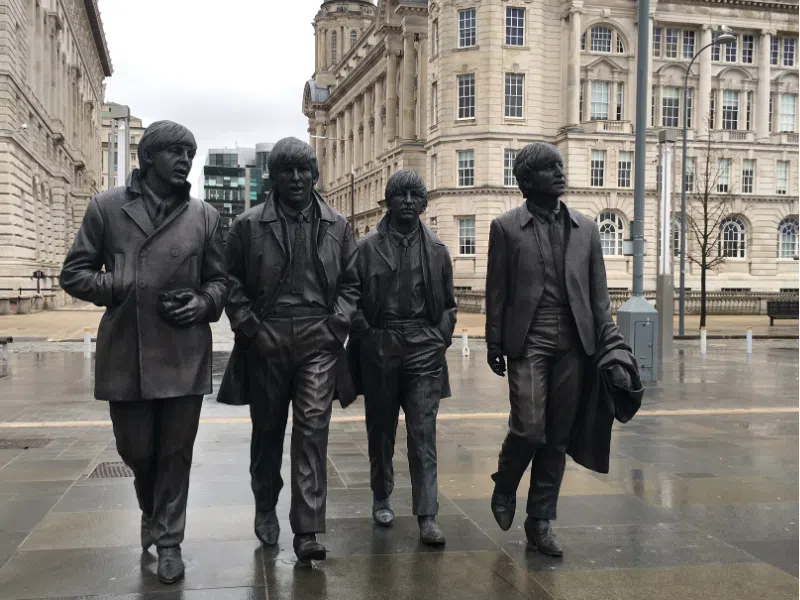
Liverpool grew rich on the River Mersey, and its waterfront still shows it: in the 19th century it was one of the busiest ports in the world. It is also the city of the Beatles and of an accent and a stew that are both called Scouse. Here are the facts and stories behind it.
10 fun facts about Liverpool
- The world's first commercial wet dock: the Old Dock opened in 1715, letting ships load and unload whatever the tide was doing. Its remains were rediscovered and now lie beneath the Liverpool ONE shopping district.
- Two birds that keep the city alive: two copper Liver Birds sit on top of the Royal Liver Building, completed in 1911. One looks out to sea, the other over the city, and legend says that if they ever flew away, Liverpool would cease to exist.
- Clocks bigger than Big Ben's: the clock faces on the Royal Liver Building are larger than those of the Great Clock at Westminster, which makes them the largest in Britain.
- Britain's largest cathedral: Liverpool Cathedral, built between 1904 and 1978, is the biggest cathedral in the UK. Its architect, Giles Gilbert Scott, was only 22 when he won the competition, and he later designed the classic red telephone box.
- Two cathedrals, one street: Hope Street links the Anglican cathedral with the Catholic Metropolitan Cathedral, consecrated in 1967 and nicknamed Paddy's Wigwam.
- A railway first: the Liverpool and Manchester Railway, opened in 1830, was the first inter-city line with timetabled passenger trains hauled by steam locomotives.
- Nearly 300 gigs in a cellar: the Beatles played the Cavern Club on Mathew Street around 290 times between 1961 and 1963. The original cellar was filled in during the 1970s, and the club you visit today is a reconstruction on almost the same site.
- A floor that is rarely seen: the Great Hall of St George's Hall, opened in 1854, has a floor of more than 30,000 Minton tiles. It is kept covered most of the time and is only revealed on special occasions.
- A World Heritage Site that lost its title: UNESCO listed the waterfront as Liverpool – Maritime Mercantile City in 2004 and removed it from the list in 2021 because of new development on the docks.
- One of Europe's oldest Chinese communities: Chinese seamen settled near the docks in the 19th century. The ornate arch on Nelson Street, put up in 2000, was made by craftsmen from Shanghai, Liverpool's twin city.
From fishing village to world port
Liverpool began as a small borough: King John granted its charter in 1207 because he wanted a port for sailing to Ireland. Much of its 18th-century wealth came from the slave trade: Liverpool ships carried more than a million enslaved Africans across the Atlantic, a history told today at the International Slavery Museum on the Royal Albert Dock. In the 19th century millions of emigrants left Europe through Liverpool for America and Australia. The Royal Liver Building, the Cunard Building and the Port of Liverpool Building, known together as the Three Graces, date from that confident era.
The Royal Albert Dock, explained
The Royal Albert Dock opened in 1846 and was designed by the dock engineer Jesse Hartley. Its warehouses were built of brick, stone and cast iron with no structural wood, so they could not burn. The dock lost its trade in the 20th century and closed in 1972. After restoration in the 1980s it became one of Liverpool's busiest areas, home to the Merseyside Maritime Museum, the International Slavery Museum and the Beatles Story.
What to eat in Liverpool
- Scouse: a slow-cooked stew of lamb or beef with potatoes and onions, served with pickled red cabbage and crusty bread. The name comes from lobscouse, a stew eaten by sailors.
- Blind scouse: the same stew without meat, from the days when many families could not afford it.
- Wet Nelly: a dense, syrupy bread pudding, Liverpool's version of the old Nelson cake.
- Everton toffee: the football club's nickname, the Toffees, goes back to the toffee shops of the old village of Everton, and you can still find the sweets in the city.
Good to know before you go
- Take the Mersey Ferry across the river for the best view of the Three Graces and the waterfront skyline.
- The city's national museums, including the World Museum, the Walker Art Gallery and the Museum of Liverpool, are free to enter; some special exhibitions need a ticket.
- Crosby Beach, a short train ride north, is home to Antony Gormley's Another Place: 100 cast-iron figures standing on the sand and looking out to sea. Check the tide times before you walk out.
- Everton moved to a new stadium at Bramley-Moore Dock for the 2025–26 season.
Explore Liverpool with World City Trail
Our Liverpool scavenger hunt turns these sights into a game you play on your phone. The route links 10 stops and takes around three hours, with about 58 minutes of walking, and includes the World Museum and St George's Hall.
At each stop you solve a puzzle and hear a short story, at your own pace. You can start whenever you like and play in English, German, French, Italian, Spanish or Dutch.
Play the Liverpool scavenger hunt →
Facts checked in October 2026.