
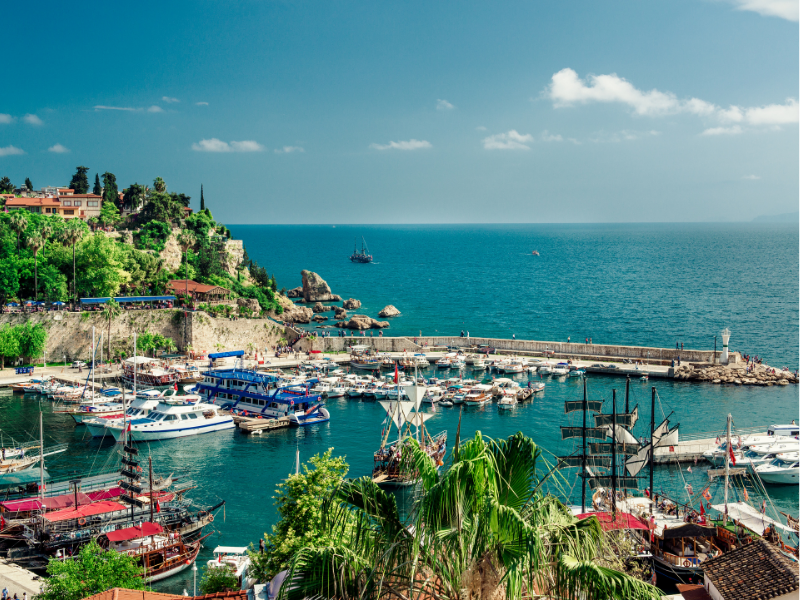
Antalya is two cities in one. Along the coast it is the capital of the Turkish Riviera, with long beaches and the Taurus Mountains rising behind them. Inside the old harbour walls it is Kaleiçi, a knot of Ottoman houses, Roman gates and Seljuk minarets where two thousand years of history sit on top of each other. Here are the facts and stories that make the city special.
10 fun facts about Antalya
- A city named after a king: Antalya was founded in the 2nd century BC by Attalos II, king of Pergamon, and named Attaleia after him. The modern Turkish name grew out of that Greek original.
- A gate for an emperor: Hadrian's Gate, with its three marble arches, was built in honour of Emperor Hadrian's visit in 130 AD.
- A fluted landmark: the Yivli Minare, the ribbed brick minaret that has become the emblem of the city, dates from the 13th century, when the Seljuk sultan Alaeddin Keykubad I ruled Antalya.
- Temple, church, mosque: the Kesik Minare (Broken Minaret) stands on a building that began as a Roman temple in the 2nd century AD, became a Byzantine church and then a mosque. A fire in 1896 destroyed everything but the minaret, and after restoration it reopened as a mosque in 2021.
- A Roman tower by the sea: the round Hıdırlık Tower at the southern corner of Kaleiçi was built by the Romans, probably in the 2nd century AD. Historians still debate whether it was a lighthouse, a tomb or part of the defences.
- A waterfall that ends in the sea: the Lower Düden Waterfall drops about 40 metres off the cliffs at Lara straight into the Mediterranean. Boat trips from the old harbour sail right up to it.
- A statue reunited: the lower half of the Weary Herakles was excavated at nearby Perge in 1980, while the upper half had been smuggled abroad and ended up in a Boston museum. It came home in 2011, and the two halves were joined again in Antalya.
- The real Saint Nicholas was a local: the 4th-century bishop who inspired Santa Claus served in Myra, today the town of Demre in Antalya province, where his church still stands.
- The city Alexander could not take: Termessos, an ancient city high in the mountains northwest of Antalya, was so well defended that Alexander the Great gave up his siege of it in 333 BC.
- The end of a famous trail: the Lycian Way, one of Turkey's best-known long-distance hikes, follows the coast from near Fethiye and finishes just outside Antalya.
The legend of heaven on earth
Legend says that King Attalos II of Pergamon sent his men out with a simple order: find him heaven on earth. They searched for a long time, until they reached a bay where the mountains came down to a warm sea, rivers ran over the cliffs and the land was green all year. Attalos is said to have founded his new city on that spot and given it his own name. Whether or not the story is true, the city soon became one of the most important harbours on this coast, and Romans, Byzantines, Seljuk Turks and Ottomans all ruled from the same small port that is still the heart of Kaleiçi.
Kaleiçi, explained
Kaleiçi means 'inside the castle', and it is the walled old town that grew up around the Roman harbour. Its lanes are lined with restored Ottoman houses with wooden upper floors and bay windows, many now small hotels, cafés and courtyard restaurants. Just above the walls, Republic Square opens out with its monument to Atatürk and one of the best views over the bay to the mountains.
What to eat in Antalya
- Antalya piyazı: a white bean salad dressed with tahini, vinegar and garlic, unlike the version found elsewhere in Turkey, and usually eaten with şiş köfte.
- Hibeş: a thick, spicy local dip of tahini, lemon, garlic and chilli, served as a meze with bread.
- Turunç: the bitter orange that grows all over the city. Look for its juice, jam and candied peel.
- Gözleme: thin flatbread folded around cheese, spinach or potato and cooked on a griddle, often made in front of you.
- Grilled fish: the restaurants around the old harbour serve the catch of the day.
Good to know before you go
- Summers are very hot. Explore Kaleiçi in the morning or early evening, and keep the middle of the day for the beach.
- The Antalya Museum, home of the city's finds from Perge, closed in 2025 so that a new museum could be built on the site. Check the current situation before you plan a visit.
- Perge and the Roman theatre of Aspendos, one of the best-preserved ancient theatres anywhere and still used for performances, make an easy half-day trip east of the city.
Explore Antalya with World City Trail
Our Antalya scavenger hunt turns these sights into a game you play on your phone. The route links 10 stops and takes around three hours, with about 40 minutes of walking, through the lanes of Kaleiçi old town and up to Republic Square.
At each stop you solve a puzzle and hear a short story, at your own pace. You can start whenever you like.
Play the Antalya scavenger hunt →
Facts checked in October 2026.