
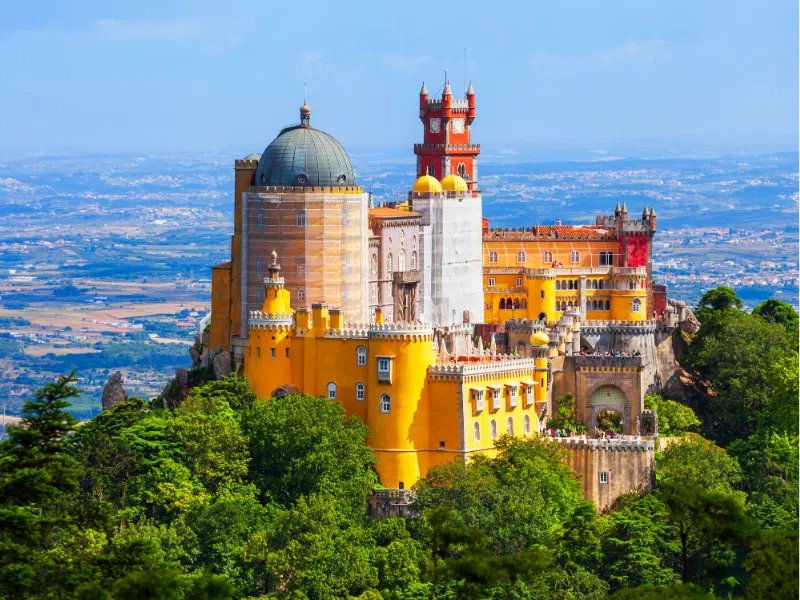
Sintra sits in a range of wooded hills just west of Lisbon, where Portuguese kings and wealthy romantics built palaces among the mist and granite boulders. Lord Byron called it a 'glorious Eden'. Here are the facts and stories that make it special.
10 fun facts about Sintra
- A UNESCO first: in 1995 Sintra became the first place in Europe to be listed by UNESCO as a cultural landscape, recognising how its palaces, parks and forest were shaped together.
- A palace on top of a monastery: in 1838 King Ferdinand II bought a ruined monastery on a hilltop and turned it into the Pena Palace, with work running into the 1850s. Its walls are painted in bold reds and yellows.
- Two giant chimneys: the Sintra National Palace in the town centre is recognisable from afar by the two conical chimneys above its kitchen, about 33 metres tall.
- Home to kings for 500 years: the National Palace was used by the Portuguese royal family from the early 15th century until the end of the monarchy in 1910, and it is one of the best-preserved medieval royal palaces in the country.
- A castle older than Portugal: the Moorish Castle was built between the 9th and 10th centuries, when the region was under Muslim rule. It passed to the Portuguese in 1147, after Afonso Henriques took Lisbon.
- A well you walk down: the Initiation Well at Quinta da Regaleira is 27 metres deep, with a spiral staircase of nine landings, often linked to the nine circles of Dante's Inferno. The estate was designed by the Italian stage designer Luigi Manini for the millionaire António Carvalho Monteiro.
- Byron's glorious Eden: Lord Byron visited in 1809 and praised Sintra in his long poem Childe Harold's Pilgrimage.
- An English garden in Portugal: Monserrate Palace was rebuilt from 1858 for the English businessman Francis Cook, who filled its park with plants from around the world.
- The edge of the continent: Cabo da Roca, in the municipality of Sintra, is the westernmost point of mainland Europe. A monument there quotes the poet Luís de Camões: 'where the land ends and the sea begins'.
- A town hall in fairy-tale style: Sintra's Town Hall was built between 1906 and 1908 by the architect Adães Bermudes in neo-Manueline style. Its tall tower has a roof of glazed tiles and is topped by an armillary sphere.
The legend of the Magpie Room
In the Sintra National Palace there is a room whose ceiling is covered with painted magpies. Legend says King João I was caught by his wife, Queen Philippa of Lancaster, kissing one of her ladies-in-waiting. The king insisted the kiss was innocent, 'por bem', meaning 'for good'. To silence the gossiping court, he had the ceiling painted with one magpie for every lady at court, 136 in all. Each bird holds a rose, the emblem of Philippa's House of Lancaster, and a banner with the words 'Por bem'.
The Pena Palace and the artist king
Ferdinand II was a German prince who married Queen Maria II of Portugal in 1836, and he was known as the 'artist king'. At Pena he mixed Manueline, Gothic and Moorish styles into a palace that looks like a stage set, and planted the park around it with trees from several continents. After his death it passed to his second wife, the Countess of Edla, who sold it to King Luís; the state bought it in 1889. In 2007 the Pena Palace was voted one of the Seven Wonders of Portugal.
What to eat in Sintra
- Travesseiros: 'pillows' of puff pastry filled with almond and egg cream. The Piriquita bakery, founded in 1862, began making them in the 1940s from a recipe in an old cookbook.
- Queijadas de Sintra: small, crisp tartlets filled with fresh cheese, sugar and cinnamon, a local speciality for centuries.
- Colares wine: grown in sandy soil near the coast, where the vines survived the phylloxera plague that destroyed most of Europe's vineyards in the 19th century.
- Pastéis de nata: the classic Portuguese custard tart is as good here as in Lisbon; eat one warm with a coffee.
Good to know before you go
- Book timed tickets for the Pena Palace online and arrive early, before the crowds.
- The palaces lie on steep, wooded hills. Wear good shoes, allow plenty of time, and expect it to be cooler and mistier than in Lisbon.
- The train from Lisbon's Rossio station takes about 40 minutes. Driving into the historic centre is not recommended, as streets are narrow and parking is very limited.
- Combine Sintra with Cabo da Roca and the coast towards Cascais for a full day out.
Explore Sintra with World City Trail
Our Sintra scavenger hunt turns these sights into a game you play on your phone. The route links 10 stops and takes around two hours, with about 34 minutes of walking, from Sintra train station past the Town Hall and through the historic centre.
At each stop you solve a puzzle and hear a short story, at your own pace. You can start whenever you like and play in English, German, French, Italian, Spanish or Portuguese.
Play the Sintra scavenger hunt →
Facts checked in October 2026.