
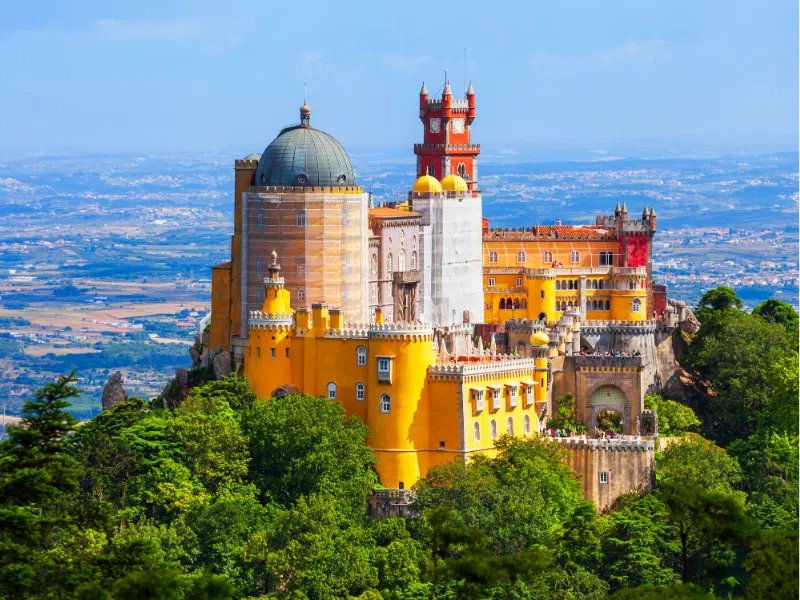
Sintra sits in a range of wooded hills just west of Lisbon, where Portuguese kings and wealthy romantics built palaces among the mist and granite boulders. Lord Byron called it a 'glorious Eden'. Here are the facts and stories that make it special.
10 curiosità su Sintra
- Una prima per l’UNESCO: nel 1995 Sintra è diventata il primo luogo d’Europa iscritto dall’UNESCO come paesaggio culturale, per come palazzi, parchi e foresta sono stati modellati insieme.
- Un palazzo sopra un monastero: nel 1838 il re Ferdinando II acquistò un monastero in rovina in cima a un colle e lo trasformò nel Palazzo di Pena, con lavori che durarono fino agli anni Cinquanta dell’Ottocento. Le sue mura sono dipinte di rossi e gialli accesi.
- Due camini giganti: il Palazzo Nazionale di Sintra, in centro, si riconosce da lontano per i due camini conici sopra la cucina, alti circa 33 metri.
- Residenza reale per 500 anni: il Palazzo Nazionale fu usato dalla famiglia reale portoghese dall’inizio del XV secolo fino alla fine della monarchia nel 1910, ed è uno dei palazzi reali medievali meglio conservati del Paese.
- Un castello più antico del Portogallo: il Castello dei Mori fu costruito tra il IX e il X secolo, quando la regione era sotto dominio musulmano. Passò ai portoghesi nel 1147, dopo che Afonso Henriques ebbe conquistato Lisbona.
- A well you walk down: the Initiation Well at Quinta da Regaleira is 27 metres deep, with a spiral staircase of nine landings, often linked to the nine circles of Dante's Inferno. The estate was designed by the Italian stage designer Luigi Manini for the millionaire António Carvalho Monteiro.
- Byron's glorious Eden: Lord Byron visited in 1809 and praised Sintra in his long poem Childe Harold's Pilgrimage.
- Un giardino inglese in Portogallo: il Palazzo di Monserrate fu ricostruito dal 1858 per l’uomo d’affari inglese Francis Cook, che riempì il parco di piante da tutto il mondo.
- The edge of the continent: Cabo da Roca, in the municipality of Sintra, is the westernmost point of mainland Europe. A monument there quotes the poet Luís de Camões: 'where the land ends and the sea begins'.
- A town hall in fairy-tale style: Sintra's Town Hall was built between 1906 and 1908 by the architect Adães Bermudes in neo-Manueline style. Its tall tower has a roof of glazed tiles and is topped by an armillary sphere.
La leggenda della Sala delle Gazze
In the Sintra National Palace there is a room whose ceiling is covered with painted magpies. Legend says King João I was caught by his wife, Queen Philippa of Lancaster, kissing one of her ladies-in-waiting. The king insisted the kiss was innocent, 'por bem', meaning 'for good'. To silence the gossiping court, he had the ceiling painted with one magpie for every lady at court, 136 in all. Each bird holds a rose, the emblem of Philippa's House of Lancaster, and a banner with the words 'Por bem'.
Il Palazzo di Pena e il re artista
Ferdinand II was a German prince who married Queen Maria II of Portugal in 1836, and he was known as the 'artist king'. At Pena he mixed Manueline, Gothic and Moorish styles into a palace that looks like a stage set, and planted the park around it with trees from several continents. After his death it passed to his second wife, the Countess of Edla, who sold it to King Luís; the state bought it in 1889. In 2007 the Pena Palace was voted one of the Seven Wonders of Portugal.
Cosa mangiare a Sintra
- Travesseiros: 'pillows' of puff pastry filled with almond and egg cream. The Piriquita bakery, founded in 1862, began making them in the 1940s from a recipe in an old cookbook.
- Queijadas de Sintra: piccole tortine croccanti ripiene di formaggio fresco, zucchero e cannella, specialità locale da secoli.
- Colares wine: grown in sandy soil near the coast, where the vines survived the phylloxera plague that destroyed most of Europe's vineyards in the 19th century.
- Pastéis de nata: la classica tortina portoghese alla crema è buona qui quanto a Lisbona; mangiala tiepida con un caffè.
Da sapere prima di partire
- Prenota online i biglietti a orario per il Palazzo di Pena e arriva presto, prima della folla.
- I palazzi si trovano su colline ripide e boscose. Metti scarpe comode, prenditi tempo e aspettati un clima più fresco e nebbioso che a Lisbona.
- The train from Lisbon's Rossio station takes about 40 minutes. Driving into the historic centre is not recommended, as streets are narrow and parking is very limited.
- Abbina Sintra a Cabo da Roca e alla costa verso Cascais per una giornata intera.
Scopri Sintra con World City Trail
La nostra caccia al tesoro a Sintra trasforma questi luoghi in un gioco sul tuo telefono. Il percorso collega 10 tappe e dura circa due ore, con circa 34 minuti di cammino, dalla stazione di Sintra al centro storico passando per il municipio.
A ogni tappa risolvi un enigma e ascolti una breve storia, al tuo ritmo. Puoi iniziare quando vuoi e giocare in italiano, inglese, tedesco, francese, spagnolo o portoghese.
Gioca alla caccia al tesoro di Sintra →
Fatti verificati a ottobre 2026.