
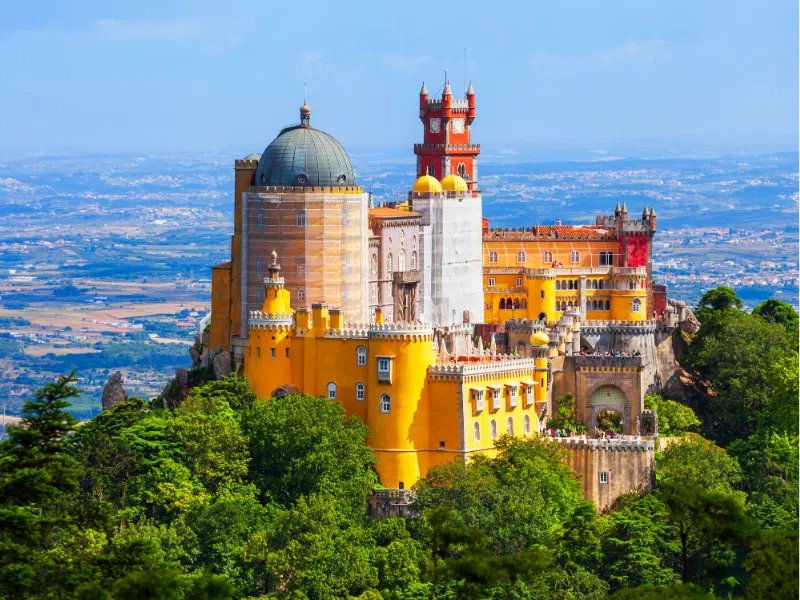
Sintra sits in a range of wooded hills just west of Lisbon, where Portuguese kings and wealthy romantics built palaces among the mist and granite boulders. Lord Byron called it a 'glorious Eden'. Here are the facts and stories that make it special.
10 anecdotes sur Sintra
- Une première pour l’UNESCO : en 1995, Sintra est devenu le premier site d’Europe inscrit par l’UNESCO en tant que paysage culturel, pour la façon dont ses palais, ses parcs et sa forêt ont été façonnés ensemble.
- Un palais sur un monastère : en 1838, le roi Ferdinand II acheta un monastère en ruine au sommet d’une colline et le transforma en palais de Pena, avec des travaux qui durèrent jusque dans les années 1850. Ses murs sont peints de rouges et de jaunes éclatants.
- Deux cheminées géantes : on reconnaît de loin le palais national de Sintra, au centre de la ville, à ses deux cheminées coniques au-dessus des cuisines, hautes d’environ 33 mètres.
- 500 ans de résidence royale : le palais national fut utilisé par la famille royale portugaise du début du XVe siècle jusqu’à la fin de la monarchie en 1910, et c’est l’un des palais royaux médiévaux les mieux conservés du pays.
- Un château plus ancien que le Portugal : le château des Maures fut construit entre le IXe et le Xe siècle, quand la région était sous domination musulmane. Il passa aux Portugais en 1147, après la prise de Lisbonne par Afonso Henriques.
- A well you walk down: the Initiation Well at Quinta da Regaleira is 27 metres deep, with a spiral staircase of nine landings, often linked to the nine circles of Dante's Inferno. The estate was designed by the Italian stage designer Luigi Manini for the millionaire António Carvalho Monteiro.
- Byron's glorious Eden: Lord Byron visited in 1809 and praised Sintra in his long poem Childe Harold's Pilgrimage.
- Un jardin anglais au Portugal : le palais de Monserrate fut reconstruit à partir de 1858 pour l’homme d’affaires anglais Francis Cook, qui remplit son parc de plantes du monde entier.
- The edge of the continent: Cabo da Roca, in the municipality of Sintra, is the westernmost point of mainland Europe. A monument there quotes the poet Luís de Camões: 'where the land ends and the sea begins'.
- A town hall in fairy-tale style: Sintra's Town Hall was built between 1906 and 1908 by the architect Adães Bermudes in neo-Manueline style. Its tall tower has a roof of glazed tiles and is topped by an armillary sphere.
La légende de la salle des Pies
In the Sintra National Palace there is a room whose ceiling is covered with painted magpies. Legend says King João I was caught by his wife, Queen Philippa of Lancaster, kissing one of her ladies-in-waiting. The king insisted the kiss was innocent, 'por bem', meaning 'for good'. To silence the gossiping court, he had the ceiling painted with one magpie for every lady at court, 136 in all. Each bird holds a rose, the emblem of Philippa's House of Lancaster, and a banner with the words 'Por bem'.
Le palais de Pena et le roi artiste
Ferdinand II was a German prince who married Queen Maria II of Portugal in 1836, and he was known as the 'artist king'. At Pena he mixed Manueline, Gothic and Moorish styles into a palace that looks like a stage set, and planted the park around it with trees from several continents. After his death it passed to his second wife, the Countess of Edla, who sold it to King Luís; the state bought it in 1889. In 2007 the Pena Palace was voted one of the Seven Wonders of Portugal.
Que manger à Sintra
- Travesseiros: 'pillows' of puff pastry filled with almond and egg cream. The Piriquita bakery, founded in 1862, began making them in the 1940s from a recipe in an old cookbook.
- Queijadas de Sintra : de petites tartelettes croustillantes garnies de fromage frais, de sucre et de cannelle, spécialité locale depuis des siècles.
- Colares wine: grown in sandy soil near the coast, where the vines survived the phylloxera plague that destroyed most of Europe's vineyards in the 19th century.
- Pastéis de nata : la tartelette à la crème portugaise est aussi bonne ici qu’à Lisbonne ; mangez-la tiède avec un café.
Bon à savoir avant de partir
- Réservez en ligne des billets horodatés pour le palais de Pena et arrivez tôt, avant la foule.
- Les palais se trouvent sur des collines boisées et escarpées. Portez de bonnes chaussures, prévoyez du temps et attendez-vous à un temps plus frais et plus brumeux qu’à Lisbonne.
- The train from Lisbon's Rossio station takes about 40 minutes. Driving into the historic centre is not recommended, as streets are narrow and parking is very limited.
- Associez Sintra au cabo da Roca et à la côte vers Cascais pour une journée complète.
Découvrir Sintra avec World City Trail
Notre chasse au trésor à Sintra transforme ces lieux en un jeu sur votre téléphone. Le parcours relie 10 étapes et dure environ deux heures, dont environ 34 minutes de marche, de la gare de Sintra jusqu’au centre historique en passant par l’hôtel de ville.
À chaque étape, vous résolvez une énigme et écoutez une courte histoire, à votre rythme. Vous pouvez commencer quand vous voulez et jouer en français, anglais, allemand, italien, espagnol ou portugais.
Jouer à la chasse au trésor de Sintra →
Faits vérifiés en octobre 2026.