
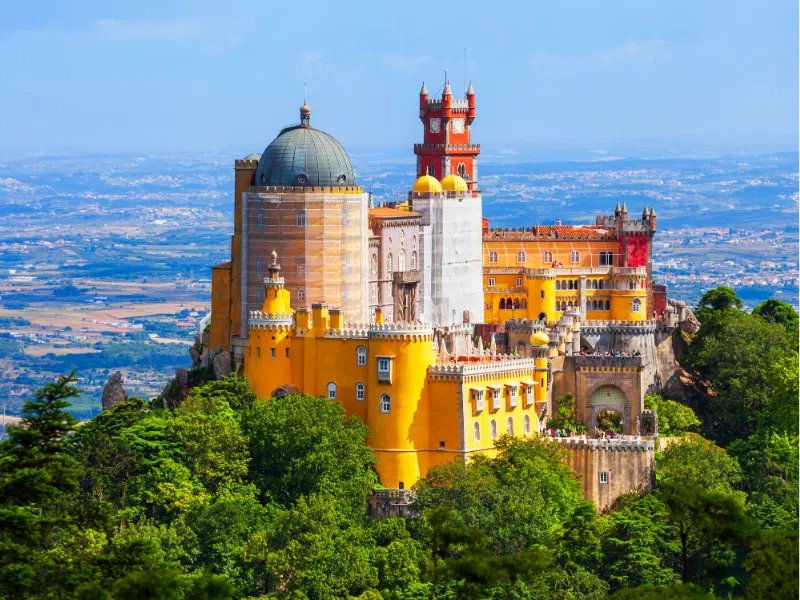
Sintra sits in a range of wooded hills just west of Lisbon, where Portuguese kings and wealthy romantics built palaces among the mist and granite boulders. Lord Byron called it a 'glorious Eden'. Here are the facts and stories that make it special.
10 ciekawostek o Sintrze
- Pierwsza w Europie: w 1995 roku Sintra jako pierwsze miejsce w Europie została wpisana przez UNESCO jako krajobraz kulturowy, bo jej pałace, parki i las kształtowano razem.
- Pałac na klasztorze: w 1838 roku król Ferdynand II kupił zrujnowany klasztor na szczycie wzgórza i przebudował go na Pałac Pena; prace trwały do lat 50. XIX wieku. Jego mury pomalowano na intensywną czerwień i żółć.
- Dwa olbrzymie kominy: Pałac Narodowy w centrum Sintry rozpoznasz z daleka po dwóch stożkowych kominach nad kuchnią, wysokich na około 33 metry.
- Siedziba królów przez 500 lat: portugalska rodzina królewska korzystała z Pałacu Narodowego od początku XV wieku do końca monarchii w 1910 roku, a to jeden z najlepiej zachowanych średniowiecznych pałaców królewskich w kraju.
- Zamek starszy niż Portugalia: Zamek Maurów zbudowano w IX i X wieku, gdy region był pod panowaniem muzułmańskim. W 1147 roku, po zdobyciu Lizbony przez Afonsa Henriquesa, przeszedł w ręce Portugalczyków.
- A well you walk down: the Initiation Well at Quinta da Regaleira is 27 metres deep, with a spiral staircase of nine landings, often linked to the nine circles of Dante's Inferno. The estate was designed by the Italian stage designer Luigi Manini for the millionaire António Carvalho Monteiro.
- Byron's glorious Eden: Lord Byron visited in 1809 and praised Sintra in his long poem Childe Harold's Pilgrimage.
- Angielski ogród w Portugalii: Pałac Monserrate przebudowano od 1858 roku dla angielskiego przedsiębiorcy Francisa Cooka, który wypełnił park roślinami z całego świata.
- The edge of the continent: Cabo da Roca, in the municipality of Sintra, is the westernmost point of mainland Europe. A monument there quotes the poet Luís de Camões: 'where the land ends and the sea begins'.
- A town hall in fairy-tale style: Sintra's Town Hall was built between 1906 and 1908 by the architect Adães Bermudes in neo-Manueline style. Its tall tower has a roof of glazed tiles and is topped by an armillary sphere.
Legenda o Sali Srok
In the Sintra National Palace there is a room whose ceiling is covered with painted magpies. Legend says King João I was caught by his wife, Queen Philippa of Lancaster, kissing one of her ladies-in-waiting. The king insisted the kiss was innocent, 'por bem', meaning 'for good'. To silence the gossiping court, he had the ceiling painted with one magpie for every lady at court, 136 in all. Each bird holds a rose, the emblem of Philippa's House of Lancaster, and a banner with the words 'Por bem'.
Pałac Pena i król artysta
Ferdinand II was a German prince who married Queen Maria II of Portugal in 1836, and he was known as the 'artist king'. At Pena he mixed Manueline, Gothic and Moorish styles into a palace that looks like a stage set, and planted the park around it with trees from several continents. After his death it passed to his second wife, the Countess of Edla, who sold it to King Luís; the state bought it in 1889. In 2007 the Pena Palace was voted one of the Seven Wonders of Portugal.
Co zjeść w Sintrze
- Travesseiros: 'pillows' of puff pastry filled with almond and egg cream. The Piriquita bakery, founded in 1862, began making them in the 1940s from a recipe in an old cookbook.
- Queijadas de Sintra: małe, chrupiące babeczki z twarożkiem, cukrem i cynamonem, lokalny przysmak od stuleci.
- Colares wine: grown in sandy soil near the coast, where the vines survived the phylloxera plague that destroyed most of Europe's vineyards in the 19th century.
- Pastéis de nata: klasyczne portugalskie babeczki z kremem są tu tak dobre jak w Lizbonie; zjedz jedną ciepłą do kawy.
Dobrze wiedzieć przed wizytą
- Zarezerwuj online bilety na określoną godzinę do Pałacu Pena i przyjedź wcześnie, przed tłumami.
- Pałace leżą na stromych, zalesionych wzgórzach. Załóż wygodne buty, zarezerwuj sporo czasu i spodziewaj się chłodniejszej, bardziej mglistej pogody niż w Lizbonie.
- The train from Lisbon's Rossio station takes about 40 minutes. Driving into the historic centre is not recommended, as streets are narrow and parking is very limited.
- Połącz Sintrę z Cabo da Roca i wybrzeżem w stronę Cascais, by wypełnić cały dzień.
Odkryj Sintrę z World City Trail
Nasza gra miejska w Sintrze zamienia te miejsca w grę na telefonie. Trasa łączy 10 przystanków i trwa mniej więcej dwie godziny, w tym około 34 minut marszu, od dworca kolejowego w Sintrze obok ratusza i przez historyczne centrum.
Na każdym przystanku rozwiązujesz zagadkę i słuchasz krótkiej historii, we własnym tempie. Możesz zacząć, kiedy chcesz, i grać po angielsku, niemiecku, francusku, włosku, hiszpańsku lub portugalsku.
Zagraj w grę miejską w Sintrze →
Fakty sprawdzone w październiku 2026.