
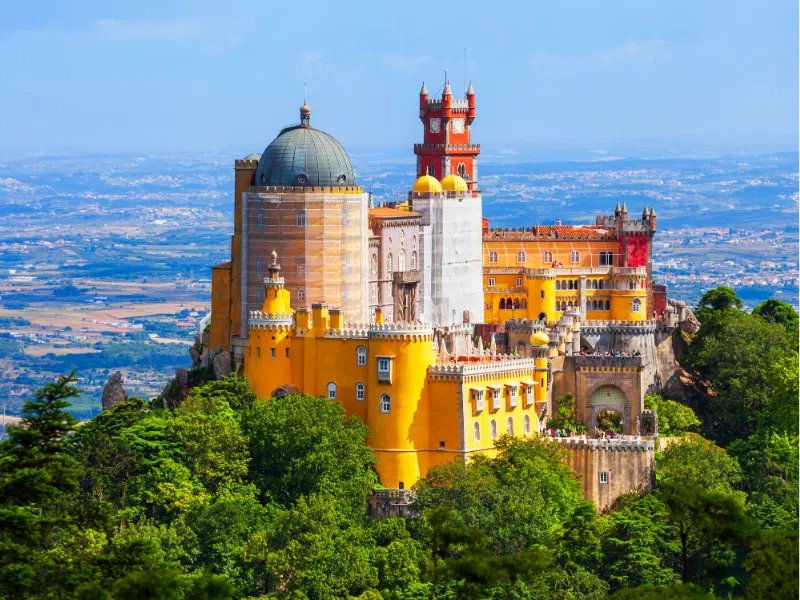
Sintra sits in a range of wooded hills just west of Lisbon, where Portuguese kings and wealthy romantics built palaces among the mist and granite boulders. Lord Byron called it a 'glorious Eden'. Here are the facts and stories that make it special.
10 leuke weetjes over Sintra
- Een UNESCO-primeur: in 1995 werd Sintra de eerste plek in Europa die UNESCO erkende als cultuurlandschap, omdat paleizen, parken en bos hier samen zijn vormgegeven.
- Een paleis op een klooster: in 1838 kocht koning Ferdinand II een vervallen klooster op een heuveltop en bouwde het om tot het Pena-paleis, met werkzaamheden tot in de jaren 1850. De muren zijn felrood en geel geschilderd.
- Twee reusachtige schoorstenen: het Nationaal Paleis van Sintra in het centrum herken je van ver aan de twee kegelvormige schoorstenen boven de keuken, zo’n 33 meter hoog.
- 500 jaar koninklijk: het Nationaal Paleis werd van het begin van de 15e eeuw tot het einde van de monarchie in 1910 door de Portugese koninklijke familie gebruikt en is een van de best bewaarde middeleeuwse koninklijke paleizen van het land.
- Een kasteel ouder dan Portugal: het Moorse Kasteel werd gebouwd tussen de 9e en 10e eeuw, toen de regio onder islamitisch bewind stond. Het ging in 1147 over naar de Portugezen, nadat Afonso Henriques Lissabon had veroverd.
- A well you walk down: the Initiation Well at Quinta da Regaleira is 27 metres deep, with a spiral staircase of nine landings, often linked to the nine circles of Dante's Inferno. The estate was designed by the Italian stage designer Luigi Manini for the millionaire António Carvalho Monteiro.
- Byron's glorious Eden: Lord Byron visited in 1809 and praised Sintra in his long poem Childe Harold's Pilgrimage.
- Een Engelse tuin in Portugal: het paleis van Monserrate werd vanaf 1858 herbouwd voor de Engelse zakenman Francis Cook, die het park vulde met planten uit de hele wereld.
- The edge of the continent: Cabo da Roca, in the municipality of Sintra, is the westernmost point of mainland Europe. A monument there quotes the poet Luís de Camões: 'where the land ends and the sea begins'.
- A town hall in fairy-tale style: Sintra's Town Hall was built between 1906 and 1908 by the architect Adães Bermudes in neo-Manueline style. Its tall tower has a roof of glazed tiles and is topped by an armillary sphere.
De legende van de Eksterzaal
In the Sintra National Palace there is a room whose ceiling is covered with painted magpies. Legend says King João I was caught by his wife, Queen Philippa of Lancaster, kissing one of her ladies-in-waiting. The king insisted the kiss was innocent, 'por bem', meaning 'for good'. To silence the gossiping court, he had the ceiling painted with one magpie for every lady at court, 136 in all. Each bird holds a rose, the emblem of Philippa's House of Lancaster, and a banner with the words 'Por bem'.
Het Pena-paleis en de kunstenaarskoning
Ferdinand II was a German prince who married Queen Maria II of Portugal in 1836, and he was known as the 'artist king'. At Pena he mixed Manueline, Gothic and Moorish styles into a palace that looks like a stage set, and planted the park around it with trees from several continents. After his death it passed to his second wife, the Countess of Edla, who sold it to King Luís; the state bought it in 1889. In 2007 the Pena Palace was voted one of the Seven Wonders of Portugal.
Wat je moet eten in Sintra
- Travesseiros: 'pillows' of puff pastry filled with almond and egg cream. The Piriquita bakery, founded in 1862, began making them in the 1940s from a recipe in an old cookbook.
- Queijadas de Sintra: kleine, krokante taartjes gevuld met verse kaas, suiker en kaneel, al eeuwen een lokale specialiteit.
- Colares wine: grown in sandy soil near the coast, where the vines survived the phylloxera plague that destroyed most of Europe's vineyards in the 19th century.
- Pastéis de nata: het klassieke Portugese roomtaartje is hier net zo lekker als in Lissabon; eet het lauw bij een koffie.
Goed om te weten voor je gaat
- Boek online tickets met tijdslot voor het Pena-paleis en kom vroeg, voor de drukte.
- De paleizen liggen op steile, beboste heuvels. Draag goede schoenen, neem de tijd en reken op koeler en mistiger weer dan in Lissabon.
- The train from Lisbon's Rossio station takes about 40 minutes. Driving into the historic centre is not recommended, as streets are narrow and parking is very limited.
- Combineer Sintra met Cabo da Roca en de kust richting Cascais voor een hele dag uit.
Ontdek Sintra met World City Trail
Onze schattenjacht in Sintra maakt van deze plekken een spel op je telefoon. De route verbindt 10 stops en duurt zo’n twee uur, waarvan ongeveer 34 minuten lopen, van het station van Sintra langs het stadhuis en door het historische centrum.
Bij elke stop los je een puzzel op en hoor je een kort verhaal, in je eigen tempo. Je kunt beginnen wanneer je wilt en spelen in het Engels, Duits, Frans, Italiaans, Spaans of Portugees.
Speel de schattenjacht in Sintra →
Feiten gecontroleerd in oktober 2026.