
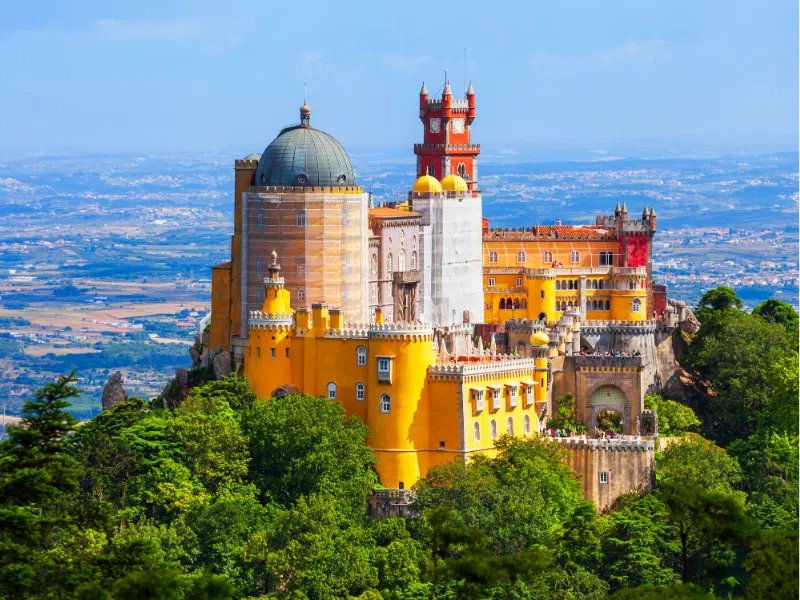
Sintra sits in a range of wooded hills just west of Lisbon, where Portuguese kings and wealthy romantics built palaces among the mist and granite boulders. Lord Byron called it a 'glorious Eden'. Here are the facts and stories that make it special.
10 spannende Fakten über Sintra
- Eine UNESCO-Premiere: 1995 wurde Sintra als erster Ort in Europa von der UNESCO als Kulturlandschaft anerkannt, weil Paläste, Parks und Wald hier gemeinsam gestaltet wurden.
- Ein Palast auf einem Kloster: 1838 kaufte König Ferdinand II. ein verfallenes Kloster auf einem Gipfel und baute es zum Pena-Palast um; die Arbeiten dauerten bis in die 1850er-Jahre. Seine Mauern leuchten in kräftigem Rot und Gelb.
- Zwei riesige Schornsteine: Den Nationalpalast von Sintra im Ortszentrum erkennt man schon von Weitem an den zwei kegelförmigen Schornsteinen über seiner Küche, rund 33 Meter hoch.
- 500 Jahre Königssitz: Der Nationalpalast wurde vom frühen 15. Jahrhundert bis zum Ende der Monarchie 1910 von der portugiesischen Königsfamilie genutzt und ist einer der am besten erhaltenen mittelalterlichen Königspaläste des Landes.
- Eine Burg, älter als Portugal: Die Maurische Burg entstand im 9. und 10. Jahrhundert, als die Region unter muslimischer Herrschaft stand. 1147, nachdem Afonso Henriques Lissabon erobert hatte, ging sie an die Portugiesen.
- A well you walk down: the Initiation Well at Quinta da Regaleira is 27 metres deep, with a spiral staircase of nine landings, often linked to the nine circles of Dante's Inferno. The estate was designed by the Italian stage designer Luigi Manini for the millionaire António Carvalho Monteiro.
- Byron's glorious Eden: Lord Byron visited in 1809 and praised Sintra in his long poem Childe Harold's Pilgrimage.
- Ein englischer Garten in Portugal: Der Palast von Monserrate wurde ab 1858 für den englischen Geschäftsmann Francis Cook umgebaut, der den Park mit Pflanzen aus aller Welt füllte.
- The edge of the continent: Cabo da Roca, in the municipality of Sintra, is the westernmost point of mainland Europe. A monument there quotes the poet Luís de Camões: 'where the land ends and the sea begins'.
- A town hall in fairy-tale style: Sintra's Town Hall was built between 1906 and 1908 by the architect Adães Bermudes in neo-Manueline style. Its tall tower has a roof of glazed tiles and is topped by an armillary sphere.
Die Legende vom Elsternsaal
In the Sintra National Palace there is a room whose ceiling is covered with painted magpies. Legend says King João I was caught by his wife, Queen Philippa of Lancaster, kissing one of her ladies-in-waiting. The king insisted the kiss was innocent, 'por bem', meaning 'for good'. To silence the gossiping court, he had the ceiling painted with one magpie for every lady at court, 136 in all. Each bird holds a rose, the emblem of Philippa's House of Lancaster, and a banner with the words 'Por bem'.
Der Pena-Palast und der Künstlerkönig
Ferdinand II was a German prince who married Queen Maria II of Portugal in 1836, and he was known as the 'artist king'. At Pena he mixed Manueline, Gothic and Moorish styles into a palace that looks like a stage set, and planted the park around it with trees from several continents. After his death it passed to his second wife, the Countess of Edla, who sold it to King Luís; the state bought it in 1889. In 2007 the Pena Palace was voted one of the Seven Wonders of Portugal.
Was man in Sintra essen sollte
- Travesseiros: 'pillows' of puff pastry filled with almond and egg cream. The Piriquita bakery, founded in 1862, began making them in the 1940s from a recipe in an old cookbook.
- Queijadas de Sintra: kleine, knusprige Törtchen mit Frischkäse, Zucker und Zimt, seit Jahrhunderten eine Spezialität des Ortes.
- Colares wine: grown in sandy soil near the coast, where the vines survived the phylloxera plague that destroyed most of Europe's vineyards in the 19th century.
- Pastéis de nata: Das klassische portugiesische Puddingtörtchen ist hier so gut wie in Lissabon; iss es warm zu einem Kaffee.
Gut zu wissen vor dem Besuch
- Buche Zeitfenster-Tickets für den Pena-Palast online und komm früh, vor den Menschenmengen.
- Die Paläste liegen an steilen, bewaldeten Hängen. Trag gute Schuhe, plane viel Zeit ein und rechne mit kühlerem, nebligerem Wetter als in Lissabon.
- The train from Lisbon's Rossio station takes about 40 minutes. Driving into the historic centre is not recommended, as streets are narrow and parking is very limited.
- Verbinde Sintra mit Cabo da Roca und der Küste Richtung Cascais zu einem ganzen Tagesausflug.
Sintra mit World City Trail entdecken
Unsere Schnitzeljagd in Sintra macht aus diesen Sehenswürdigkeiten ein Spiel auf deinem Handy. Die Route verbindet 10 Stationen und dauert etwa zwei Stunden, davon rund 34 Minuten zu Fuß, vom Bahnhof Sintra vorbei am Rathaus und durch das historische Zentrum.
An jeder Station löst du ein Rätsel und hörst eine kurze Geschichte, in deinem eigenen Tempo. Du kannst starten, wann du willst, und auf Deutsch, Englisch, Französisch, Italienisch, Spanisch oder Portugiesisch spielen.
Die Schnitzeljagd in Sintra spielen →
Fakten geprüft im Oktober 2026.