
Liverpool enriqueceu à beira do rio Mersey, e a frente ribeirinha ainda o mostra: no século XIX era um dos portos mais movimentados do mundo. É também a cidade dos Beatles e de um sotaque e de um guisado que se chamam ambos Scouse. Estes são os factos e as histórias por trás de tudo isso.
10 curiosidades sobre Liverpool
- The world's first commercial wet dock: the Old Dock opened in 1715, letting ships load and unload whatever the tide was doing. Its remains were rediscovered and now lie beneath the Liverpool ONE shopping district.
- Duas aves que mantêm a cidade viva: no topo do Royal Liver Building, concluído em 1911, estão dois Liver Birds de cobre. Um olha para o mar, o outro para a cidade, e diz a lenda que, se algum dia voassem, Liverpool deixaria de existir.
- Clocks bigger than Big Ben's: the clock faces on the Royal Liver Building are larger than those of the Great Clock at Westminster, which makes them the largest in Britain.
- Britain's largest cathedral: Liverpool Cathedral, built between 1904 and 1978, is the biggest cathedral in the UK. Its architect, Giles Gilbert Scott, was only 22 when he won the competition, and he later designed the classic red telephone box.
- Two cathedrals, one street: Hope Street links the Anglican cathedral with the Catholic Metropolitan Cathedral, consecrated in 1967 and nicknamed Paddy's Wigwam.
- Uma estreia ferroviária: a Liverpool and Manchester Railway, inaugurada em 1830, foi a primeira linha entre cidades com comboios de passageiros com horário fixo puxados por locomotivas a vapor.
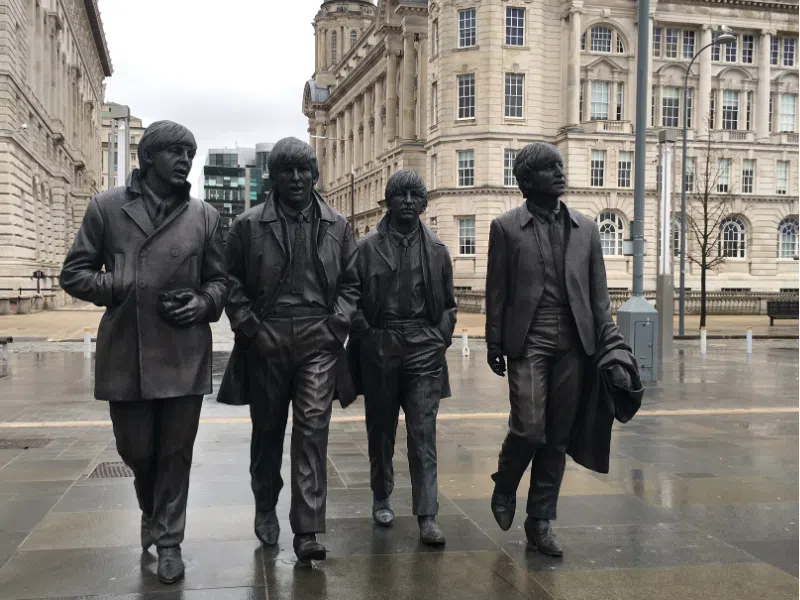
- Quase 300 concertos numa cave: os Beatles tocaram no Cavern Club, na Mathew Street, cerca de 290 vezes entre 1961 e 1963. A cave original foi aterrada nos anos 70, e o clube que visitas hoje é uma reconstrução quase no mesmo sítio.
- A floor that is rarely seen: the Great Hall of St George's Hall, opened in 1854, has a floor of more than 30,000 Minton tiles. It is kept covered most of the time and is only revealed on special occasions.
- Um Património Mundial que perdeu o título: a UNESCO classificou a frente ribeirinha em 2004 como Liverpool – Cidade Mercantil Marítima e retirou-a da lista em 2021 por causa de novas construções nas docas.
- One of Europe's oldest Chinese communities: Chinese seamen settled near the docks in the 19th century. The ornate arch on Nelson Street, put up in 2000, was made by craftsmen from Shanghai, Liverpool's twin city.
De aldeia piscatória a porto mundial
Liverpool começou como um pequeno burgo: o rei João Sem Terra deu-lhe foral em 1207 porque queria um porto para navegar até à Irlanda. No século XVIII, grande parte da sua riqueza veio do tráfico de escravos: navios de Liverpool levaram mais de um milhão de africanos escravizados através do Atlântico, uma história contada hoje no International Slavery Museum, no Royal Albert Dock. No século XIX, milhões de emigrantes deixaram a Europa por Liverpool rumo à América e à Austrália. O Royal Liver Building, o Cunard Building e o Port of Liverpool Building, conhecidos em conjunto como as Three Graces, são dessa época confiante.
O Royal Albert Dock, explicado
The Royal Albert Dock opened in 1846 and was designed by the dock engineer Jesse Hartley. Its warehouses were built of brick, stone and cast iron with no structural wood, so they could not burn. The dock lost its trade in the 20th century and closed in 1972. After restoration in the 1980s it became one of Liverpool's busiest areas, home to the Merseyside Maritime Museum, the International Slavery Museum and the Beatles Story.
O que comer em Liverpool
- Scouse: um guisado lento de borrego ou vaca com batata e cebola, servido com couve-roxa em pickle e pão estaladiço. O nome vem de lobscouse, um prato de marinheiros.
- Blind scouse: o mesmo guisado sem carne, do tempo em que muitas famílias não a podiam pagar.
- Wet Nelly: a dense, syrupy bread pudding, Liverpool's version of the old Nelson cake.
- Everton toffee: the football club's nickname, the Toffees, goes back to the toffee shops of the old village of Everton, and you can still find the sweets in the city.
Antes de ires
- Apanha o Mersey Ferry para atravessar o rio: é a melhor vista das Three Graces e da linha do horizonte ribeirinha.
- The city's national museums, including the World Museum, the Walker Art Gallery and the Museum of Liverpool, are free to enter; some special exhibitions need a ticket.
- Crosby Beach, a short train ride north, is home to Antony Gormley's Another Place: 100 cast-iron figures standing on the sand and looking out to sea. Check the tide times before you walk out.
- O Everton mudou-se para um novo estádio em Bramley-Moore Dock na época 2025-26.
Descobre Liverpool com a World City Trail
Our Liverpool scavenger hunt turns these sights into a game you play on your phone. The route links 10 stops and takes around three hours, with about 58 minutes of walking, and includes the World Museum and St George's Hall.
Em cada paragem resolves um enigma e ouves uma pequena história, ao teu ritmo. Podes começar quando quiseres e jogar em inglês, alemão, francês, italiano, espanhol ou neerlandês.
Jogar a caça ao tesouro de Liverpool →
Factos verificados em outubro de 2026.