
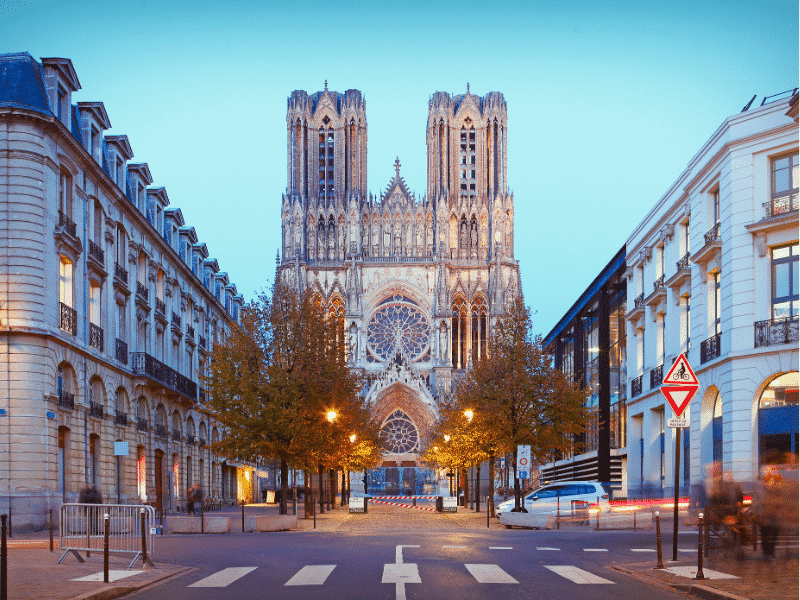
Reims is where France made its kings. For eight centuries the coronation took place in its Gothic cathedral, and the city stands on chalk hollowed out by cellars where champagne matures in the dark. Here are the facts and stories that make the city special.
10 fun facts about Reims
- The city of coronations: between 1027 and 1825, almost every king of France was crowned in Reims. The last was Charles X, on 29 May 1825.
- An angel that lost its head: the Smiling Angel beside the north portal of the west front was decapitated on 19 September 1914, when German shelling set the cathedral on fire. The broken head was found, restored and put back on 13 February 1926.
- Rebuilt with American help: the cathedral was badly damaged in the First World War, and John D. Rockefeller Jr. gave a large donation in the 1920s towards its restoration.
- Windows by Marc Chagall: the stained-glass windows in the axial chapel, behind the high altar, were designed by Chagall and installed in 1974.
- A lost maze you still see everywhere: the cathedral floor once had a large labyrinth, removed by the canons in 1779. Its design lives on as the emblem of France's historic monuments.
- The widest arch in the Roman world: the Porte de Mars, built in the early 3rd century AD, is 32 metres long and 13 metres high. It was one of four gates of Roman Durocortorum.
- Where the war in Europe ended: on 7 May 1945, Germany signed its unconditional surrender at General Eisenhower's headquarters, a school near the railway station. The map room is preserved as the Museum of the Surrender.
- A widow's invention: Barbe-Nicole Clicquot took over her late husband's champagne house in 1805 and is credited with the riddling table around 1816, which made it possible to clear the sediment from bottles.
- Three monuments, one listing: the cathedral, the Palace of Tau and the former Abbey of Saint-Remi have been a UNESCO World Heritage Site together since 1991.
- Champagne under the streets: the Champagne Hillsides, Houses and Cellars, including the Saint-Nicaise hill in Reims, joined the UNESCO list in 2015. Some houses age their bottles in deep chalk pits first dug in Roman times.
The Holy Ampulla and the crowning of Charles VII
Legend says that when Bishop Remi baptised Clovis, king of the Franks, in Reims around the year 500, the crowd was so dense that the cleric carrying the holy oil could not get through. A dove came down from heaven with a small flask, the Holy Ampulla, and later kings were anointed with its oil. The most famous coronation came in 1429. Much of northern France was in the hands of the English and their Burgundian allies, and the dauphin Charles had never been crowned. Joan of Arc convinced him to march to Reims through hostile country; the city opened its gates, and on 17 July 1429 Charles VII was crowned in the cathedral, with Joan close by holding her banner. In 1793, during the Revolution, the ampulla was smashed in public, but fragments were saved and used at the coronation of Charles X in 1825.
The Palace of Tau, explained
The Palace of Tau, the archbishops' palace next to the cathedral, is named after the Greek letter tau because its early buildings had a T-shaped plan. Kings stayed here before their coronation, and the royal banquet was held in its great hall afterwards. The palace closed for renovation in 2023 and is being turned into a museum of the coronations, expected to reopen in 2027, so check its status before you go.
What to eat in Reims
- Champagne: Reims is home to many of the great houses, and most offer cellar visits with a tasting.
- Biscuit rose de Reims: a crisp, pink, lightly sweet biscuit baked in Reims for more than three centuries. Dip it in champagne, as people here have long done.
- Jambon de Reims: cooked ham pressed into a mould with herbs and coated in breadcrumbs, served cold in slices.
- Chaource: a soft, creamy cow's-milk cheese from the south of the Champagne region, with protected designation of origin.
- Ratafia de Champagne: a sweet aperitif of grape juice fortified with grape spirit, served chilled.
Good to know before you go
- The TGV from Paris Gare de l'Est takes about 45 minutes, so Reims works as a day trip. Staying the night lets you see the cathedral façade lit up after dark.
- Climbing the cathedral towers is only possible on guided visits at certain times of year. Check dates in advance if you want the view.
- Many champagne houses are on or near the Saint-Nicaise hill, south-east of the centre, close to the Basilica of Saint-Remi. Combine them in one half-day.
Explore Reims with World City Trail
Our Reims scavenger hunt turns these sights into a game you play on your phone. The route links 10 stops and takes around two hours, with about 31 minutes of walking, and leads you past Reims Cathedral, the Palace of Tau and the Porte de Mars.
At each stop you solve a puzzle and hear a short story, at your own pace. You can start whenever you like.
Play the Reims scavenger hunt →
Facts checked in October 2026.