
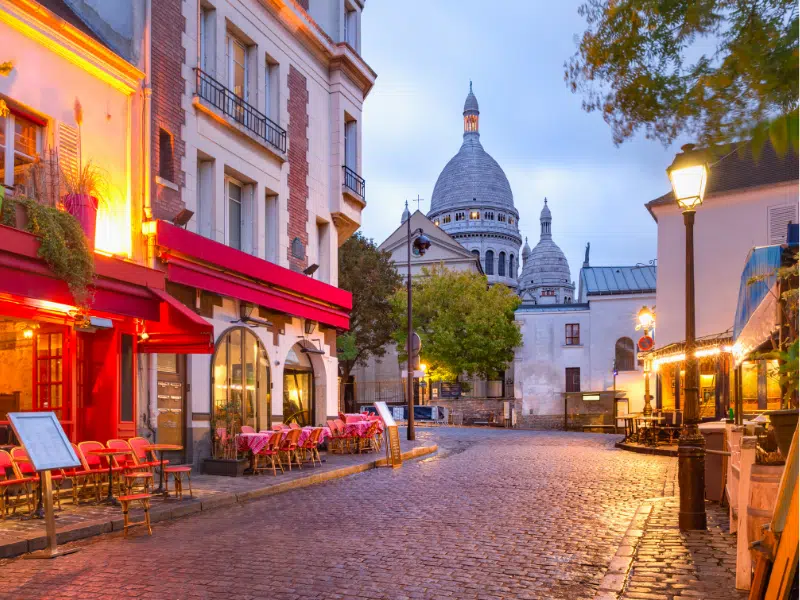
Montmartre è un villaggio su una collina che Parigi ha inglobato nel 1860 senza mai addomesticarlo del tutto. Viuzze ripide, una vera vigna e le cupole bianche del Sacré-Cœur dominano la città, e verso il 1900 i suoi atelier economici e i suoi cabaret attirarono Picasso, Renoir, Toulouse-Lautrec e Van Gogh. Ecco i fatti e le storie che rendono speciale il quartiere.
10 curiosità su Montmartre
- Una chiesa che resta bianca da sola: il Sacré-Cœur, iniziato nel 1875 e consacrato nel 1919, è costruito in travertino di Château-Landon. La pietra rilascia calcite quando piove, ed è per questo che la basilica sulla collina più alta di Parigi sembra sempre appena pulita.
- Un villaggio fino al 1860: Montmartre era un comune a sé, fatto di mulini, vigne e cave di gesso, finché il 1º gennaio 1860 entrò a far parte di Parigi. È grazie al gesso di queste cave che il gesso fine si chiama ancora ‘gesso di Parigi’.
- Una vera vigna in città: il Clos Montmartre, sul pendio di rue des Saules, fu piantato nel 1933. Ogni ottobre la vendemmia si festeggia con la Fête des Vendanges, un fine settimana di sfilate e bancarelle di cibo.
- Two windmills survive: of the many mills that once turned on the hill, the Moulin Radet and the Moulin Blute-Fin still stand. The dance hall beside them, the Moulin de la Galette, is the scene of Renoir's 1876 painting, now in the Musée d'Orsay.
- Where modern art took a leap: in the Bateau-Lavoir, a ramshackle studio building named by the poet Max Jacob after the laundry boats on the Seine, Picasso painted Les Demoiselles d'Avignon in 1907. A fire destroyed most of it in 1970, and it was rebuilt in 1978.
- I love you, 612 times: the Wall of Love in the Square Jehan-Rictus, created in 2000 by Frédéric Baron and the calligrapher Claire Kito, covers 40 square metres with 612 dark blue enamel tiles. They carry the words 'I love you' in more than 250 languages.
- A man stuck in a wall: on the Place Marcel-Aymé, a bronze man is caught halfway through a stone wall. He is the hero of Marcel Aymé's short story Le Passe-Muraille, about a clerk who can walk through walls, and the statue was made in 1989 by the actor Jean Marais.
- Una delle chiese più antiche di Parigi: Saint-Pierre de Montmartre, proprio accanto al Sacré-Cœur, fu consacrata nel 1147, più di sette secoli prima che iniziasse la costruzione della sua famosa vicina.
- Where the Paris Commune began: on 18 March 1871, French troops tried to remove the National Guard's cannons parked on the hill. The crowd stopped them, and the uprising known as the Paris Commune started here.
- Un ingresso della metro Belle Époque: la stazione Abbesses ha uno dei soli due ingressi originali con tettoia in vetro di Hector Guimard rimasti a Parigi; fu spostato qui dall’Hôtel de Ville nel 1974. I binari si trovano a circa 36 metri sottoterra.
La leggenda di san Dionigi
Montmartre's best-known story is about Denis, the first bishop of Paris, who was put to death with his companions Rusticus and Eleutherius around the middle of the third century. Legend says that after he was beheaded on the hill, Denis picked up his own head, washed it in a spring and walked north for several kilometres, preaching all the way, until he collapsed where the Basilica of Saint-Denis stands today. That is why the hill is often explained as the 'mount of martyrs', although historians point out that the name may come from older Roman temples. A statue of the saint holding his head stands in the Square Suzanne-Buisson.
Cosa mangiare a Montmartre
- Una baguette: Parigi premia ogni anno la migliore baguette tradizionale, e il fornaio vincitore rifornisce l’Eliseo per un anno. Cerca le panetterie che espongono il premio.
- Crêpes e galettes: crêpes dolci dai chioschi di strada, oppure galettes salate di grano saraceno con prosciutto, uovo e formaggio in una crêperie.
- Soupe à l'oignon gratinée: onion soup baked under a thick crust of bread and melted cheese, a bistro classic for cold days.
- Croque-monsieur: un toast caldo con prosciutto e formaggio coperto di besciamella; con un uovo fritto sopra diventa un croque-madame.
- Clos Montmartre wine: the hill's own vineyard produces a small amount of wine each year, sold mainly at auction for local charities.
Da sapere prima di partire
- Vieni di prima mattina: la scalinata del Sacré-Cœur e Place du Tertre sono tranquille prima delle dieci circa e affollate a mezzogiorno.
- La funicolare corre accanto alla scalinata sotto il Sacré-Cœur e accetta un normale biglietto della metro, risparmiandoti una salita ripida.
- Per la vista più bella di Parigi, sali i circa 300 gradini fino alla cupola del Sacré-Cœur. Serve un biglietto a parte, mentre la basilica è gratuita.
Scopri Montmartre con World City Trail
La nostra caccia al tesoro a Montmartre trasforma questi luoghi in un gioco sul tuo telefono. Il percorso collega 10 tappe e dura circa due ore, con circa 22 minuti a piedi, e passa tra l’altro per il Muro dei ti amo, il Bateau-Lavoir, Place du Tertre e la statua del Passe-Muraille.
A ogni tappa risolvi un enigma e ascolti una breve storia, al tuo ritmo. Puoi iniziare quando vuoi.
Gioca alla caccia al tesoro di Montmartre →
Fatti verificati a ottobre 2026.