
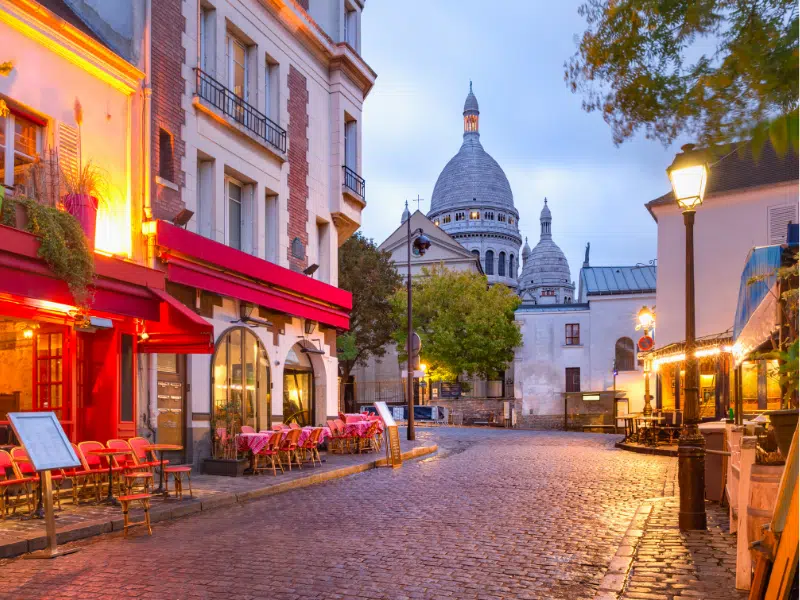
Montmartre é uma aldeia numa colina que Paris absorveu em 1860 mas nunca domou por completo. Ruelas íngremes, uma vinha a sério e as cúpulas brancas do Sacré-Cœur dominam a cidade, e por volta de 1900 os seus ateliês baratos e cabarés atraíram Picasso, Renoir, Toulouse-Lautrec e Van Gogh. Estes são os factos e as histórias que tornam o bairro especial.
10 curiosidades sobre Montmartre
- Uma igreja que se mantém branca sozinha: o Sacré-Cœur, começado em 1875 e consagrado em 1919, é feito de travertino de Château-Landon. A pedra liberta calcite quando chove, e é por isso que a basílica, na colina mais alta de Paris, parece sempre acabada de limpar.
- Uma aldeia até 1860: Montmartre foi um município independente de moinhos, vinhas e pedreiras de gesso até passar a fazer parte de Paris a 1 de janeiro de 1860. É por causa desse gesso que o gesso fino ainda se chama ‘gesso de Paris’.
- Uma vinha a sério na cidade: o Clos Montmartre, na encosta da rue des Saules, foi plantado em 1933. Todos os anos, em outubro, a vindima é celebrada com a Fête des Vendanges, um fim de semana de desfiles e bancas de comida.
- Two windmills survive: of the many mills that once turned on the hill, the Moulin Radet and the Moulin Blute-Fin still stand. The dance hall beside them, the Moulin de la Galette, is the scene of Renoir's 1876 painting, now in the Musée d'Orsay.
- Where modern art took a leap: in the Bateau-Lavoir, a ramshackle studio building named by the poet Max Jacob after the laundry boats on the Seine, Picasso painted Les Demoiselles d'Avignon in 1907. A fire destroyed most of it in 1970, and it was rebuilt in 1978.
- I love you, 612 times: the Wall of Love in the Square Jehan-Rictus, created in 2000 by Frédéric Baron and the calligrapher Claire Kito, covers 40 square metres with 612 dark blue enamel tiles. They carry the words 'I love you' in more than 250 languages.
- A man stuck in a wall: on the Place Marcel-Aymé, a bronze man is caught halfway through a stone wall. He is the hero of Marcel Aymé's short story Le Passe-Muraille, about a clerk who can walk through walls, and the statue was made in 1989 by the actor Jean Marais.
- Uma das igrejas mais antigas de Paris: Saint-Pierre de Montmartre, mesmo ao lado do Sacré-Cœur, foi consagrada em 1147, mais de sete séculos antes de começar a construção da sua famosa vizinha.
- Where the Paris Commune began: on 18 March 1871, French troops tried to remove the National Guard's cannons parked on the hill. The crowd stopped them, and the uprising known as the Paris Commune started here.
- Uma entrada de metro da Belle Époque: a estação Abbesses tem uma das duas únicas entradas originais com cobertura de vidro de Hector Guimard que restam em Paris; foi trazida do Hôtel de Ville em 1974. As plataformas ficam a cerca de 36 metros de profundidade.
A lenda de São Dinis
Montmartre's best-known story is about Denis, the first bishop of Paris, who was put to death with his companions Rusticus and Eleutherius around the middle of the third century. Legend says that after he was beheaded on the hill, Denis picked up his own head, washed it in a spring and walked north for several kilometres, preaching all the way, until he collapsed where the Basilica of Saint-Denis stands today. That is why the hill is often explained as the 'mount of martyrs', although historians point out that the name may come from older Roman temples. A statue of the saint holding his head stands in the Square Suzanne-Buisson.
O que comer em Montmartre
- Uma baguete: Paris escolhe todos os anos a melhor baguete tradicional, e o padeiro vencedor fornece o Palácio do Eliseu durante um ano. Procura as padarias que exibem o prémio.
- Crêpes e galettes: crêpes doces das bancas de rua, ou galettes salgadas de trigo-sarraceno com fiambre, ovo e queijo numa crêperie.
- Soupe à l'oignon gratinée: onion soup baked under a thick crust of bread and melted cheese, a bistro classic for cold days.
- Croque-monsieur: uma tosta de fiambre e queijo coberta de bechamel; com um ovo estrelado por cima passa a croque-madame.
- Clos Montmartre wine: the hill's own vineyard produces a small amount of wine each year, sold mainly at auction for local charities.
Antes de ires
- Vai cedo de manhã: as escadarias do Sacré-Cœur e a Place du Tertre estão calmas até por volta das dez e cheias ao meio-dia.
- O funicular sobe ao lado das escadarias por baixo do Sacré-Cœur e aceita um bilhete normal de metro, o que te poupa uma subida íngreme.
- Para a melhor vista de Paris, sobe os cerca de 300 degraus até à cúpula do Sacré-Cœur. É preciso um bilhete à parte; a basílica é gratuita.
Descobre Montmartre com a World City Trail
A nossa caça ao tesouro em Montmartre transforma estes locais num jogo no teu telemóvel. O percurso liga 10 paragens e demora cerca de duas horas, com cerca de 22 minutos a pé, e passa, entre outros locais, pelo Muro do Amor, pelo Bateau-Lavoir, pela Place du Tertre e pela estátua do Passe-Muraille.
Em cada paragem resolves um enigma e ouves uma pequena história, ao teu ritmo. Podes começar quando quiseres.
Jogar a caça ao tesouro de Montmartre →
Factos verificados em outubro de 2026.