
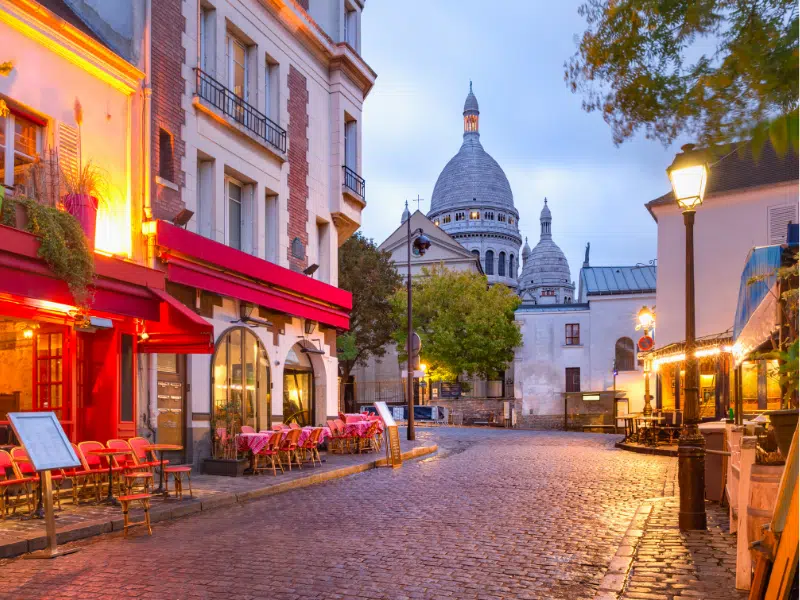
Montmartre is a village on a hill that Paris absorbed in 1860 but never fully tamed. Steep lanes, a working vineyard and the white domes of the Sacré-Cœur sit above the city, and around 1900 its cheap studios and cabarets drew Picasso, Renoir, Toulouse-Lautrec and Van Gogh. Here are the facts and stories that make the neighbourhood special.
10 fun facts about Montmartre
- A church that keeps itself white: the Sacré-Cœur, begun in 1875 and consecrated in 1919, is built of travertine from Château-Landon. The stone releases calcite when it rains, which is why the basilica on the highest hill in Paris always looks freshly cleaned.
- A village until 1860: Montmartre was a separate commune of windmills, vineyards and gypsum quarries until it became part of Paris on 1 January 1860. The gypsum from its quarries is why fine plaster is still called plaster of Paris.
- A real vineyard in the city: the Clos Montmartre, on the slope of the rue des Saules, was planted in 1933. Every October the harvest is celebrated with the Fête des Vendanges, a weekend of parades and food stalls.
- Two windmills survive: of the many mills that once turned on the hill, the Moulin Radet and the Moulin Blute-Fin still stand. The dance hall beside them, the Moulin de la Galette, is the scene of Renoir's 1876 painting, now in the Musée d'Orsay.
- Where modern art took a leap: in the Bateau-Lavoir, a ramshackle studio building named by the poet Max Jacob after the laundry boats on the Seine, Picasso painted Les Demoiselles d'Avignon in 1907. A fire destroyed most of it in 1970, and it was rebuilt in 1978.
- I love you, 612 times: the Wall of Love in the Square Jehan-Rictus, created in 2000 by Frédéric Baron and the calligrapher Claire Kito, covers 40 square metres with 612 dark blue enamel tiles. They carry the words 'I love you' in more than 250 languages.
- A man stuck in a wall: on the Place Marcel-Aymé, a bronze man is caught halfway through a stone wall. He is the hero of Marcel Aymé's short story Le Passe-Muraille, about a clerk who can walk through walls, and the statue was made in 1989 by the actor Jean Marais.
- One of the oldest churches in Paris: Saint-Pierre de Montmartre, right next to the Sacré-Cœur, was consecrated in 1147, more than seven centuries before its famous neighbour was begun.
- Where the Paris Commune began: on 18 March 1871, French troops tried to remove the National Guard's cannons parked on the hill. The crowd stopped them, and the uprising known as the Paris Commune started here.
- A metro entrance from 1900s Paris: the Abbesses station has one of only two original glass-roofed entrances by Hector Guimard still in Paris; it was moved here from the Hôtel de Ville in 1974. The platforms lie about 36 metres underground.
The legend of Saint Denis
Montmartre's best-known story is about Denis, the first bishop of Paris, who was put to death with his companions Rusticus and Eleutherius around the middle of the third century. Legend says that after he was beheaded on the hill, Denis picked up his own head, washed it in a spring and walked north for several kilometres, preaching all the way, until he collapsed where the Basilica of Saint-Denis stands today. That is why the hill is often explained as the 'mount of martyrs', although historians point out that the name may come from older Roman temples. A statue of the saint holding his head stands in the Square Suzanne-Buisson.
What to eat in Montmartre
- A baguette: Paris holds a competition for the best traditional baguette every year, and the winning baker supplies the Élysée Palace for a year. Look for bakeries that display the award.
- Crêpes and galettes: sweet crêpes from street stands, or savoury buckwheat galettes with ham, egg and cheese at a sit-down crêperie.
- Soupe à l'oignon gratinée: onion soup baked under a thick crust of bread and melted cheese, a bistro classic for cold days.
- Croque-monsieur: a toasted ham and cheese sandwich topped with béchamel; with a fried egg on top it becomes a croque-madame.
- Clos Montmartre wine: the hill's own vineyard produces a small amount of wine each year, sold mainly at auction for local charities.
Good to know before you go
- Come early in the morning: the steps of the Sacré-Cœur and the Place du Tertre are calm before about ten, and crowded by midday.
- The funicular runs beside the steps below the Sacré-Cœur and accepts a standard metro ticket, which saves a steep climb.
- For the best view in Paris, climb the roughly 300 steps to the dome of the Sacré-Cœur. It needs a separate ticket from the free basilica.
Explore Montmartre with World City Trail
Our Montmartre scavenger hunt turns these sights into a game you play on your phone. The route links 10 stops and takes around two hours, with about 22 minutes of walking, and its stops include the Wall of Love, the Bateau-Lavoir, the Place du Tertre and the Passe-Muraille statue.
At each stop you solve a puzzle and hear a short story, at your own pace. You can start whenever you like.
Play the Montmartre scavenger hunt →
Facts checked in October 2026.