
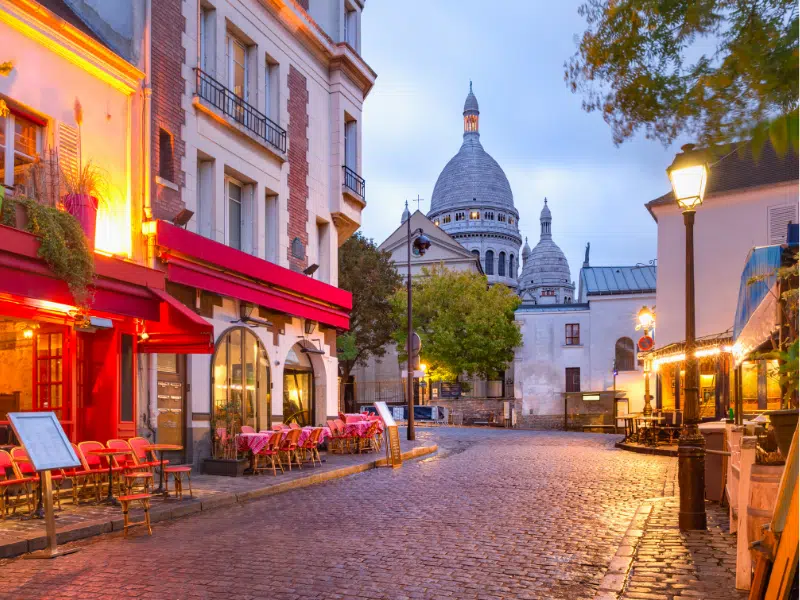
Montmartre to wioska na wzgórzu, którą Paryż wchłonął w 1860 roku, ale nigdy do końca nie oswoił. Strome uliczki, prawdziwa winnica i białe kopuły Sacré-Cœur górują nad miastem, a około 1900 roku tanie pracownie i kabarety przyciągnęły tu Picassa, Renoira, Toulouse-Lautreca i Van Gogha. Oto fakty i historie, które sprawiają, że ta dzielnica jest wyjątkowa.
10 ciekawostek o Montmartre
- Kościół, który sam pozostaje biały: Sacré-Cœur, budowana od 1875 roku i konsekrowana w 1919 roku, powstała z trawertynu z Château-Landon. Kamień w deszczu uwalnia kalcyt, dlatego bazylika na najwyższym wzgórzu Paryża zawsze wygląda jak świeżo umyta.
- Wioska do 1860 roku: Montmartre było osobną gminą z wiatrakami, winnicami i kamieniołomami gipsu, dopóki 1 stycznia 1860 roku nie zostało włączone do Paryża. To od tutejszego gipsu drobny gips do dziś nazywa się po angielsku i francusku „gipsem paryskim”.
- Prawdziwa winnica w mieście: Clos Montmartre na zboczu rue des Saules założono w 1933 roku. Każdego października winobranie świętuje się podczas Fête des Vendanges, weekendu parad i straganów z jedzeniem.
- Two windmills survive: of the many mills that once turned on the hill, the Moulin Radet and the Moulin Blute-Fin still stand. The dance hall beside them, the Moulin de la Galette, is the scene of Renoir's 1876 painting, now in the Musée d'Orsay.
- Where modern art took a leap: in the Bateau-Lavoir, a ramshackle studio building named by the poet Max Jacob after the laundry boats on the Seine, Picasso painted Les Demoiselles d'Avignon in 1907. A fire destroyed most of it in 1970, and it was rebuilt in 1978.
- I love you, 612 times: the Wall of Love in the Square Jehan-Rictus, created in 2000 by Frédéric Baron and the calligrapher Claire Kito, covers 40 square metres with 612 dark blue enamel tiles. They carry the words 'I love you' in more than 250 languages.
- A man stuck in a wall: on the Place Marcel-Aymé, a bronze man is caught halfway through a stone wall. He is the hero of Marcel Aymé's short story Le Passe-Muraille, about a clerk who can walk through walls, and the statue was made in 1989 by the actor Jean Marais.
- Jeden z najstarszych kościołów Paryża: Saint-Pierre de Montmartre, tuż obok Sacré-Cœur, konsekrowano w 1147 roku, ponad siedem wieków przed rozpoczęciem budowy jego słynnej sąsiadki.
- Where the Paris Commune began: on 18 March 1871, French troops tried to remove the National Guard's cannons parked on the hill. The crowd stopped them, and the uprising known as the Paris Commune started here.
- Wejście do metra z czasów belle époque: stacja Abbesses ma jedno z zaledwie dwóch zachowanych w Paryżu oryginalnych, przeszklonych wejść Hectora Guimarda; przeniesiono je tu spod Hôtel de Ville w 1974 roku. Perony leżą około 36 metrów pod ziemią.
Legenda o świętym Dionizym
Montmartre's best-known story is about Denis, the first bishop of Paris, who was put to death with his companions Rusticus and Eleutherius around the middle of the third century. Legend says that after he was beheaded on the hill, Denis picked up his own head, washed it in a spring and walked north for several kilometres, preaching all the way, until he collapsed where the Basilica of Saint-Denis stands today. That is why the hill is often explained as the 'mount of martyrs', although historians point out that the name may come from older Roman temples. A statue of the saint holding his head stands in the Square Suzanne-Buisson.
Co zjeść na Montmartre
- Bagietka: Paryż co roku wybiera najlepszą tradycyjną bagietkę, a zwycięski piekarz przez rok zaopatruje Pałac Elizejski. Szukaj piekarni, które chwalą się tą nagrodą.
- Naleśniki i galettes: słodkie crêpes z ulicznych budek albo wytrawne galettes z mąki gryczanej z szynką, jajkiem i serem w crêperie.
- Soupe à l'oignon gratinée: onion soup baked under a thick crust of bread and melted cheese, a bistro classic for cold days.
- Croque-monsieur: zapiekana kanapka z szynką i serem pod beszamelem; z jajkiem sadzonym na wierzchu staje się croque-madame.
- Clos Montmartre wine: the hill's own vineyard produces a small amount of wine each year, sold mainly at auction for local charities.
Dobrze wiedzieć przed wizytą
- Przyjdź wcześnie rano: schody Sacré-Cœur i Place du Tertre są spokojne mniej więcej do dziesiątej, a w południe pełne ludzi.
- Kolejka linowo-terenowa jedzie obok schodów poniżej Sacré-Cœur i honoruje zwykły bilet metra, co oszczędza stromej wspinaczki.
- Po najlepszy widok na Paryż wejdź po około 300 stopniach na kopułę Sacré-Cœur. Potrzebny jest osobny bilet, sama bazylika jest bezpłatna.
Odkryj Montmartre z World City Trail
Nasza gra miejska na Montmartre zamienia te miejsca w grę na telefonie. Trasa łączy 10 przystanków i trwa około dwóch godzin, z czego około 22 minut to marsz, a po drodze są m.in. Ściana Miłości, Bateau-Lavoir, Place du Tertre i rzeźba Passe-Muraille.
Na każdym przystanku rozwiązujesz zagadkę i słuchasz krótkiej historii, we własnym tempie. Możesz zacząć, kiedy chcesz.
Zagraj w grę miejską na Montmartre →
Fakty sprawdzone w październiku 2026.