
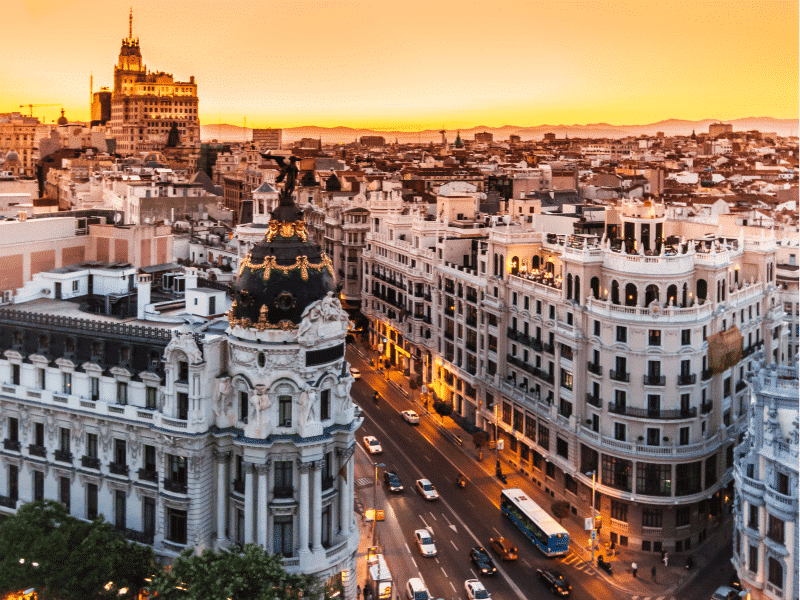
Madrid became Spain's capital almost by chance, when King Philip II moved his court here in 1561, and it has been growing into the role ever since. Today it is a city of grand boulevards and tiny tapas bars, of three world-class art museums a short walk apart, and of late evenings that make dinner at ten feel early. Here are the facts and stories behind it.
10 fun facts about Madrid
- A capital since 1561: Philip II moved the royal court from Toledo to what was then a modest town. Apart from a short spell between 1601 and 1606, when the court sat in Valladolid, Madrid has been the capital ever since.
- The centre of Spain's roads: a plaque in the pavement of the Puerta del Sol, in front of the old Royal Post Office, marks Kilómetro Cero, the point from which Spain's national radial roads are measured.
- A bear and a strawberry tree: Madrid's coat of arms shows a bear reaching up to a madroño, a strawberry tree. The bronze version by Antonio Navarro Santafé, weighing about 20 tonnes, has stood in the Puerta del Sol since 1967.
- The oldest restaurant in the world: Sobrino de Botín, a few steps from the Plaza Mayor, opened in 1725 and is listed by Guinness World Records as the oldest restaurant still in business.
- A square for markets, bullfights and trials: the Plaza Mayor was completed in 1619 to designs by Juan Gómez de Mora. It hosted markets, bullfights, royal celebrations and trials of the Inquisition, and was rebuilt several times after fires.
- A palace of more than 3,000 rooms: the Royal Palace has about 3,418 rooms and more than 135,000 square metres of floor space, making it the largest royal palace in Western Europe. It was built after the old Alcázar fortress burned down on Christmas Eve 1734, and today it is used for state ceremonies rather than as a home.
- A golden triangle of art: the Prado, the Thyssen-Bornemisza and the Reina Sofía lie within a short walk of each other.
- A landscape on the World Heritage List: in 2021 UNESCO listed the Paseo del Prado and the Retiro Park together, a site known in Spain as the Landscape of Light: a tree-lined avenue of museums, fountains and gardens laid out from the 16th century onwards.
- A monument to the devil: in the Retiro stands the Fountain of the Fallen Angel, Ricardo Bellver's sculpture of Lucifer tumbling from heaven, inaugurated in 1885. It is often called one of the very few public monuments in the world dedicated to the devil.
- Goya at the door: Mariano Benlliure's bronze statue of Francisco de Goya, unveiled in 1902, stands outside the Prado's north entrance, the Puerta de Goya. Inside, the museum holds the world's largest collection of his work, including the dark and haunting Black Paintings.
Why people from Madrid are called cats
Madrid began as Mayrit, a fortress built in the 9th century by Muhammad I, Emir of Córdoba, on the ridge where the Royal Palace stands today; a stretch of its wall still survives below the Almudena Cathedral. In 1085 King Alfonso VI of Castile took the town. Legend says that during the siege a young soldier climbed the steep wall with only his dagger, gripping the gaps between the stones so nimbly that his comrades shouted that he looked like a cat. He reached the top and planted the Christian banner, and his family took the name Gato. Ever since, people born in Madrid, ideally with parents and grandparents born here too, have been nicknamed gatos.
What to eat in Madrid
- Cocido madrileño: a slow-cooked chickpea stew served in stages, first the broth with fine noodles, then the chickpeas and vegetables, then the meats.
- Bocadillo de calamares: fried squid rings in a crusty roll, the classic snack from the bars around the Plaza Mayor.
- Chocolate con churros: thick hot chocolate for dipping fried dough. Chocolatería San Ginés, in a passage off Calle Arenal, has served it since 1894.
- Callos a la madrileña: tripe stewed with chorizo, black pudding and paprika, a traditional winter dish in old taverns.
- Vermut: in Madrid, vermouth on tap with an olive and a slice of orange is a pre-lunch ritual, especially on Sundays around the Rastro flea market.
Good to know before you go
- The Royal Palace can close at short notice for official ceremonies, so check the Patrimonio Nacional website on the day of your visit.
- For sunset, walk to the Temple of Debod, an ancient Egyptian temple given to Spain by Egypt and rebuilt in a park near the Royal Palace in 1972.
- Toledo and Segovia make easy day trips: both are around half an hour away by high-speed train.
Explore Madrid with World City Trail
Our Madrid scavenger hunt turns these sights into a game you play on your phone. The route links 10 stops and takes around three hours, with about 50 minutes of walking, and includes the Prado Museum and the Goya monument.
At each stop you solve a puzzle and hear a short story, at your own pace. You can start whenever you like and play in English, German, French, Italian, Spanish or Dutch.
Play the Madrid scavenger hunt →
Facts checked in October 2026.