
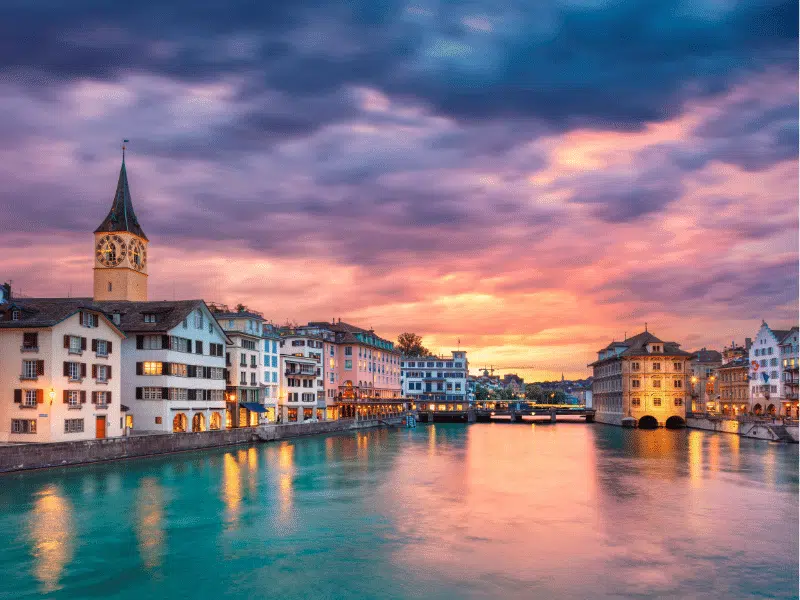
Zurich is Switzerland's largest city, yet its Old Town is small enough to cross on foot in half an hour. On both banks of the Limmat you find guild houses, church towers and narrow lanes where a religious revolution and an artistic one both began. Here are the facts and stories that make the city special.
10 fun facts about Zurich
- A giant clock: each of the four clock faces on the tower of St Peter's Church measures about 8.7 metres across, one of the largest church clock faces in Europe. From 1340 until 1911 a fire watchman lived up in the tower and scanned the rooftops for smoke.
- The biggest city, not the capital: Zurich is the largest city in Switzerland, but the federal government sits in Bern. The Swiss avoid the word capital altogether and call Bern the federal city.
- Where the Swiss Reformation began: Huldrych Zwingli became the preacher of the Grossmünster in 1519 and from its pulpit set off the Reformation in German-speaking Switzerland.
- A church founded for a king's daughter: the Fraumünster was founded in 853 by King Louis the German, who made his daughter Hildegard its first abbess.
- Five windows by Marc Chagall: the choir of the Fraumünster has five stained-glass windows by Chagall, installed in 1970.
- The birthplace of Dada: in February 1916 a group of artists opened the Cabaret Voltaire on Spiegelgasse and launched the Dada movement. In the same year Lenin moved into a flat a few doors down the same lane, where he lived until 1917.
- Einstein's university: Albert Einstein studied at the Federal Polytechnic, today's ETH Zurich, and graduated in 1900. The school was founded in 1855.
- A snowman that predicts the summer: at the Sechseläuten spring festival in April, a snowman called the Böögg is set on fire on a huge pyre. Tradition says that the faster its head explodes, the better the summer will be.
- A Roman name: the city takes its name from Turicum, a Roman customs post on the Limmat. The hill of the Lindenhof was later the site of a Roman fort.
- A museum that looks like a castle: the Swiss National Museum opened next to the main station in 1898 in a building by the city architect Gustav Gull. A modern extension by Christ & Gantenbein was added in 2016.
The legend of Felix and Regula
Zurich's patron saints are a brother and sister, Felix and Regula. Legend says they belonged to the Theban Legion, Christian soldiers of the Roman army, and fled to Zurich to escape persecution. They were caught and beheaded on the bank of the Limmat, where the Wasserkirche stands today. Then, the story goes, they picked up their own heads and climbed the hill to where they wished to be buried. The Grossmünster was built over their graves, and legend adds that Charlemagne found them when his horse knelt there. A seated statue of Charlemagne still sits on the Grossmünster's south tower, and the beheaded saints appear on the city's seal.
The Lindenhof, explained
The Lindenhof is a quiet, tree-shaded square on a hill above the Limmat, and the place where Zurich's story begins: first a Roman fort, later a royal palace of the Carolingians. Legend says that in 1292, when a Habsburg army besieged the city, the women of Zurich put on armour and marched onto the Lindenhof, and the enemy, thinking a second army had arrived, withdrew. Today people come for the giant chess boards under the lime trees and the view over the Old Town to the Grossmünster and the university.
What to eat in Zurich
- Zürcher Geschnetzeltes: thin strips of veal in a creamy mushroom and white wine sauce, served with a golden rösti.
- Birchermüesli: the original muesli, created around 1900 by the Zurich doctor Maximilian Bircher-Benner for the patients of his clinic.
- Luxemburgerli: small, light macarons in many flavours from Confiserie Sprüngli, whose café on Paradeplatz is a Zurich institution.
- Tirggel: thin, hard honey biscuits pressed with pictures, a Zurich speciality at Christmas time.
- Chocolate: the Lindt Home of Chocolate in Kilchberg, on the lake just south of the city, has a museum and a giant chocolate fountain.
Good to know before you go
- For the best view, take the S10 train from the main station up the Uetliberg, the city's own mountain, where on clear days you can see the Alps.
- Boats of the Zurich lake fleet leave from Bürkliplatz, at the end of Bahnhofstrasse. Even a short round trip is worth it.
- In summer, swim like the locals: the city runs lake and river baths, some of which turn into bars in the evening.
- The Rhine Falls, one of the most powerful waterfalls in Europe, make an easy half-day trip by train.
Explore Zurich with World City Trail
Our Zurich scavenger hunt turns these sights into a game you play on your phone. The route links 10 stops and takes around three hours, with about 47 minutes of walking, including the Swiss National Museum, Bahnhofplatz and the Lindenhof.
At each stop you solve a puzzle and hear a short story, at your own pace. You can start whenever you like and play in English, German, French, Italian, Spanish or Dutch.
Play the Zurich scavenger hunt →
Facts checked in October 2026.