
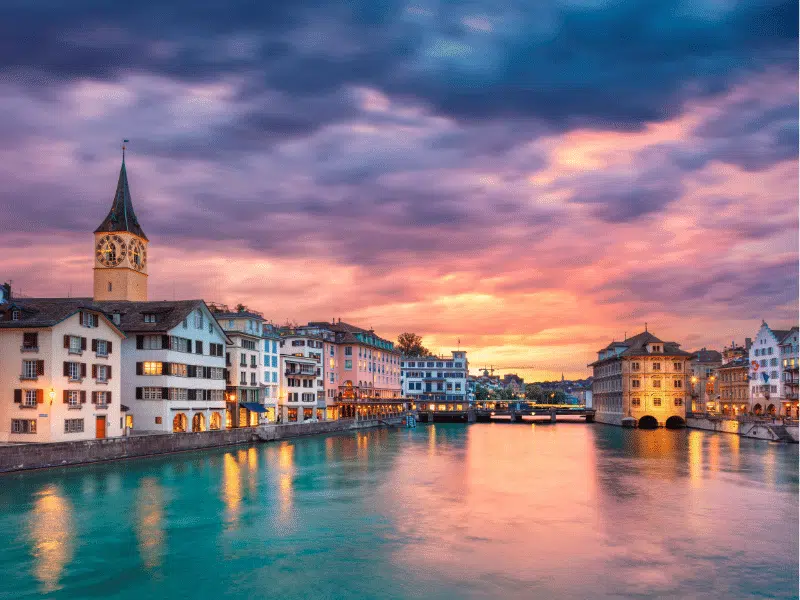
Zurich is Switzerland's largest city, yet its Old Town is small enough to cross on foot in half an hour. On both banks of the Limmat you find guild houses, church towers and narrow lanes where a religious revolution and an artistic one both began. Here are the facts and stories that make the city special.
10 curiosidades sobre Zúrich
- A giant clock: each of the four clock faces on the tower of St Peter's Church measures about 8.7 metres across, one of the largest church clock faces in Europe. From 1340 until 1911 a fire watchman lived up in the tower and scanned the rooftops for smoke.
- La ciudad más grande, no la capital: Zúrich es la ciudad más grande de Suiza, pero el gobierno federal está en Berna. Los suizos evitan incluso la palabra capital y llaman a Berna la ciudad federal.
- Donde empezó la Reforma suiza: Ulrico Zuinglio se convirtió en predicador del Grossmünster en 1519 y desde su púlpito puso en marcha la Reforma en la Suiza de habla alemana.
- A church founded for a king's daughter: the Fraumünster was founded in 853 by King Louis the German, who made his daughter Hildegard its first abbess.
- Cinco vidrieras de Marc Chagall: el coro del Fraumünster tiene cinco vidrieras de Chagall, instaladas en 1970.
- La cuna del dadaísmo: en febrero de 1916 un grupo de artistas abrió el Cabaret Voltaire en la Spiegelgasse y lanzó el movimiento dadá. Ese mismo año Lenin se mudó a unas casas de distancia en la misma calle, donde vivió hasta 1917.
- Einstein's university: Albert Einstein studied at the Federal Polytechnic, today's ETH Zurich, and graduated in 1900. The school was founded in 1855.
- Un muñeco de nieve que predice el verano: en la fiesta de primavera del Sechseläuten, en abril, se quema sobre una enorme hoguera un muñeco de nieve llamado Böögg. Según la tradición, cuanto antes explota su cabeza, mejor será el verano.
- Un nombre romano: la ciudad debe su nombre a Turicum, un puesto aduanero romano junto al Limmat. En la colina del Lindenhof se levantó después un fuerte romano.
- A museum that looks like a castle: the Swiss National Museum opened next to the main station in 1898 in a building by the city architect Gustav Gull. A modern extension by Christ & Gantenbein was added in 2016.
La leyenda de Félix y Régula
Zurich's patron saints are a brother and sister, Felix and Regula. Legend says they belonged to the Theban Legion, Christian soldiers of the Roman army, and fled to Zurich to escape persecution. They were caught and beheaded on the bank of the Limmat, where the Wasserkirche stands today. Then, the story goes, they picked up their own heads and climbed the hill to where they wished to be buried. The Grossmünster was built over their graves, and legend adds that Charlemagne found them when his horse knelt there. A seated statue of Charlemagne still sits on the Grossmünster's south tower, and the beheaded saints appear on the city's seal.
El Lindenhof, explicado
The Lindenhof is a quiet, tree-shaded square on a hill above the Limmat, and the place where Zurich's story begins: first a Roman fort, later a royal palace of the Carolingians. Legend says that in 1292, when a Habsburg army besieged the city, the women of Zurich put on armour and marched onto the Lindenhof, and the enemy, thinking a second army had arrived, withdrew. Today people come for the giant chess boards under the lime trees and the view over the Old Town to the Grossmünster and the university.
Qué comer en Zúrich
- Zürcher Geschnetzeltes: tiras finas de ternera en una salsa cremosa de champiñones y vino blanco, servidas con un rösti dorado.
- Birchermüesli: el muesli original, creado hacia 1900 por el médico zuriqués Maximilian Bircher-Benner para los pacientes de su clínica.
- Luxemburgerli: pequeños macarons ligeros de muchos sabores de la Confiserie Sprüngli, cuyo café en la Paradeplatz es toda una institución en Zúrich.
- Tirggel: galletas finas y duras de miel con dibujos en relieve, una especialidad zuriquesa de Navidad.
- Chocolate: la Lindt Home of Chocolate de Kilchberg, junto al lago, justo al sur de la ciudad, tiene un museo y una gigantesca fuente de chocolate.
Antes de ir
- For the best view, take the S10 train from the main station up the Uetliberg, the city's own mountain, where on clear days you can see the Alps.
- Los barcos de la flota del lago de Zúrich salen de Bürkliplatz, al final de la Bahnhofstrasse. Incluso un paseo corto te muestra la ciudad desde el agua.
- En verano, haz como los zuriqueses y báñate: la ciudad gestiona baños en el lago y en el río, y algunos se convierten en bares por la noche.
- Las cataratas del Rin, de las más caudalosas de Europa, son una excursión fácil de medio día en tren.
Descubre Zúrich con World City Trail
Nuestra búsqueda del tesoro en Zúrich convierte estos lugares en un juego en tu móvil. La ruta une 10 paradas y dura unas tres horas, con unos 47 minutos a pie, entre ellas el Museo Nacional Suizo, la Bahnhofplatz y el Lindenhof.
En cada parada resuelves un acertijo y escuchas una historia breve, a tu ritmo. Puedes empezar cuando quieras y jugar en español, inglés, alemán, francés, italiano o neerlandés.
Juega a la búsqueda del tesoro de Zúrich →
Datos comprobados en octubre de 2026.