
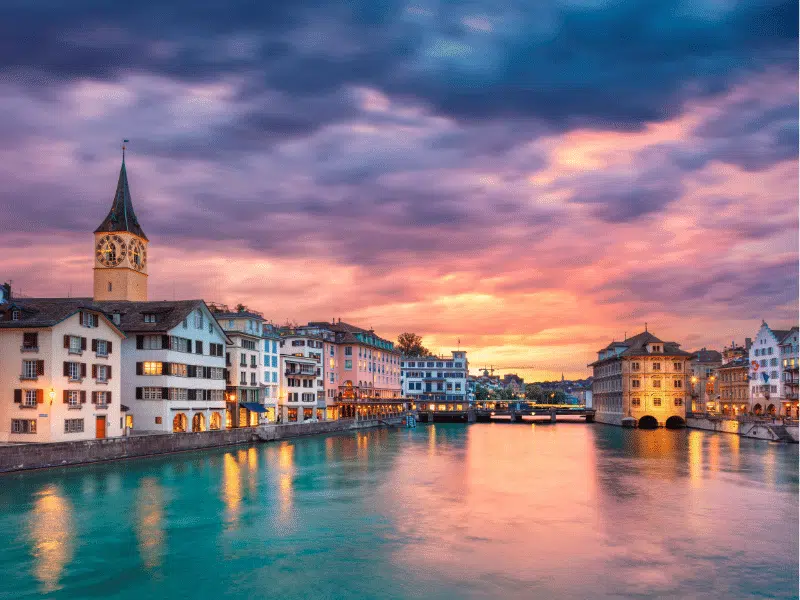
Zurich is Switzerland's largest city, yet its Old Town is small enough to cross on foot in half an hour. On both banks of the Limmat you find guild houses, church towers and narrow lanes where a religious revolution and an artistic one both began. Here are the facts and stories that make the city special.
10 curiosità su Zurigo
- A giant clock: each of the four clock faces on the tower of St Peter's Church measures about 8.7 metres across, one of the largest church clock faces in Europe. From 1340 until 1911 a fire watchman lived up in the tower and scanned the rooftops for smoke.
- La città più grande, non la capitale: Zurigo è la città più grande della Svizzera, ma il governo federale ha sede a Berna. Gli svizzeri evitano persino la parola capitale e chiamano Berna città federale.
- Qui iniziò la Riforma svizzera: Huldrych Zwingli divenne predicatore del Grossmünster nel 1519 e dal suo pulpito avviò la Riforma nella Svizzera tedesca.
- A church founded for a king's daughter: the Fraumünster was founded in 853 by King Louis the German, who made his daughter Hildegard its first abbess.
- Cinque vetrate di Marc Chagall: il coro del Fraumünster ha cinque vetrate di Chagall, installate nel 1970.
- La culla del Dada: nel febbraio 1916 un gruppo di artisti aprì il Cabaret Voltaire nella Spiegelgasse e diede vita al movimento Dada. Nello stesso anno Lenin si trasferì a poche case di distanza nello stesso vicolo, dove visse fino al 1917.
- Einstein's university: Albert Einstein studied at the Federal Polytechnic, today's ETH Zurich, and graduated in 1900. The school was founded in 1855.
- Un pupazzo di neve che predice l’estate: alla festa di primavera del Sechseläuten, ad aprile, un pupazzo di neve chiamato Böögg viene bruciato su un enorme rogo. Secondo la tradizione, più in fretta esplode la sua testa, più bella sarà l’estate.
- Un nome romano: la città prende il nome da Turicum, una stazione doganale romana sulla Limmat. Sulla collina del Lindenhof sorse poi un forte romano.
- A museum that looks like a castle: the Swiss National Museum opened next to the main station in 1898 in a building by the city architect Gustav Gull. A modern extension by Christ & Gantenbein was added in 2016.
La leggenda di Felice e Regola
Zurich's patron saints are a brother and sister, Felix and Regula. Legend says they belonged to the Theban Legion, Christian soldiers of the Roman army, and fled to Zurich to escape persecution. They were caught and beheaded on the bank of the Limmat, where the Wasserkirche stands today. Then, the story goes, they picked up their own heads and climbed the hill to where they wished to be buried. The Grossmünster was built over their graves, and legend adds that Charlemagne found them when his horse knelt there. A seated statue of Charlemagne still sits on the Grossmünster's south tower, and the beheaded saints appear on the city's seal.
Il Lindenhof in breve
The Lindenhof is a quiet, tree-shaded square on a hill above the Limmat, and the place where Zurich's story begins: first a Roman fort, later a royal palace of the Carolingians. Legend says that in 1292, when a Habsburg army besieged the city, the women of Zurich put on armour and marched onto the Lindenhof, and the enemy, thinking a second army had arrived, withdrew. Today people come for the giant chess boards under the lime trees and the view over the Old Town to the Grossmünster and the university.
Cosa mangiare a Zurigo
- Zürcher Geschnetzeltes: sottili striscioline di vitello in una salsa cremosa ai funghi e vino bianco, servite con un rösti dorato.
- Birchermüesli: il muesli originale, creato intorno al 1900 dal medico zurighese Maximilian Bircher-Benner per i pazienti della sua clinica.
- Luxemburgerli: piccoli macaron leggeri in tanti gusti della Confiserie Sprüngli, il cui caffè sulla Paradeplatz è un’istituzione a Zurigo.
- Tirggel: biscotti al miele sottili e duri, decorati con immagini in rilievo, una specialità zurighese del periodo natalizio.
- Cioccolato: la Lindt Home of Chocolate a Kilchberg, sul lago appena a sud della città, ha un museo e una gigantesca fontana di cioccolato.
Da sapere prima di partire
- For the best view, take the S10 train from the main station up the Uetliberg, the city's own mountain, where on clear days you can see the Alps.
- I battelli della flotta del lago di Zurigo partono da Bürkliplatz, in fondo alla Bahnhofstrasse. Anche un breve giro ti mostra la città dall’acqua.
- D’estate fai come gli zurighesi e vai a nuotare: la città gestisce bagni sul lago e sul fiume, alcuni dei quali la sera diventano bar.
- Le cascate del Reno, tra le più potenti d’Europa, sono una comoda gita di mezza giornata in treno.
Scopri Zurigo con World City Trail
La nostra caccia al tesoro a Zurigo trasforma questi luoghi in un gioco sul tuo telefono. Il percorso collega 10 tappe e dura circa tre ore, con circa 47 minuti di cammino, tra cui il Museo nazionale svizzero, la Bahnhofplatz e il Lindenhof.
A ogni tappa risolvi un enigma e ascolti una breve storia, al tuo ritmo. Puoi iniziare quando vuoi e giocare in italiano, inglese, tedesco, francese, spagnolo o olandese.
Gioca alla caccia al tesoro di Zurigo →
Fatti verificati a ottobre 2026.