
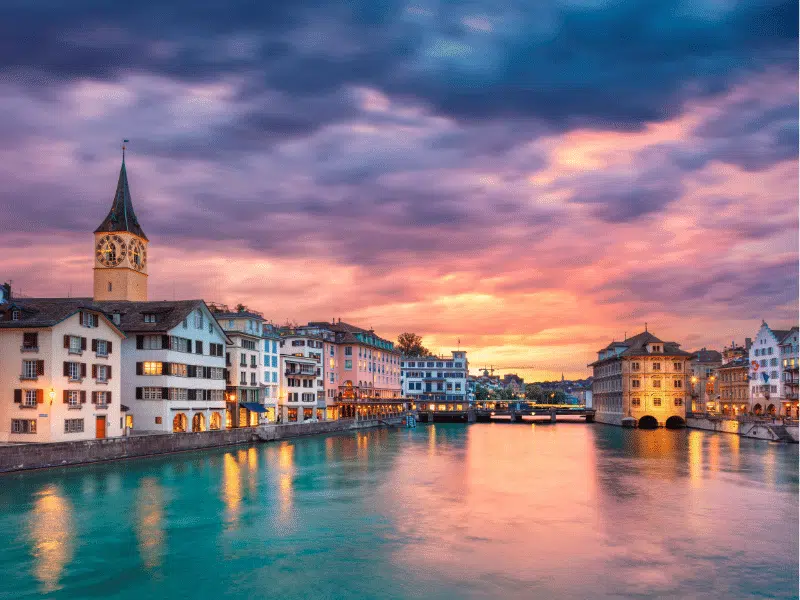
Zurich is Switzerland's largest city, yet its Old Town is small enough to cross on foot in half an hour. On both banks of the Limmat you find guild houses, church towers and narrow lanes where a religious revolution and an artistic one both began. Here are the facts and stories that make the city special.
10 curiosidades sobre Zurique
- A giant clock: each of the four clock faces on the tower of St Peter's Church measures about 8.7 metres across, one of the largest church clock faces in Europe. From 1340 until 1911 a fire watchman lived up in the tower and scanned the rooftops for smoke.
- A maior cidade, não a capital: Zurique é a maior cidade da Suíça, mas o governo federal está em Berna. Os suíços evitam até a palavra capital e chamam a Berna a cidade federal.
- Onde começou a Reforma suíça: Ulrico Zuínglio tornou-se pregador do Grossmünster em 1519 e, do seu púlpito, lançou a Reforma na Suíça de língua alemã.
- A church founded for a king's daughter: the Fraumünster was founded in 853 by King Louis the German, who made his daughter Hildegard its first abbess.
- Cinco vitrais de Marc Chagall: o coro do Fraumünster tem cinco vitrais de Chagall, colocados em 1970.
- O berço do dadaísmo: em fevereiro de 1916, um grupo de artistas abriu o Cabaret Voltaire na Spiegelgasse e lançou o movimento Dada. No mesmo ano, Lenine mudou-se para umas casas mais à frente na mesma rua, onde viveu até 1917.
- Einstein's university: Albert Einstein studied at the Federal Polytechnic, today's ETH Zurich, and graduated in 1900. The school was founded in 1855.
- Um boneco de neve que prevê o verão: na festa da primavera Sechseläuten, em abril, um boneco de neve chamado Böögg é queimado numa enorme fogueira. Diz a tradição que, quanto mais depressa a cabeça explode, melhor será o verão.
- Um nome romano: a cidade deve o nome a Turicum, um posto alfandegário romano junto ao Limmat. Na colina do Lindenhof ergueu-se mais tarde um forte romano.
- A museum that looks like a castle: the Swiss National Museum opened next to the main station in 1898 in a building by the city architect Gustav Gull. A modern extension by Christ & Gantenbein was added in 2016.
A lenda de Félix e Régula
Zurich's patron saints are a brother and sister, Felix and Regula. Legend says they belonged to the Theban Legion, Christian soldiers of the Roman army, and fled to Zurich to escape persecution. They were caught and beheaded on the bank of the Limmat, where the Wasserkirche stands today. Then, the story goes, they picked up their own heads and climbed the hill to where they wished to be buried. The Grossmünster was built over their graves, and legend adds that Charlemagne found them when his horse knelt there. A seated statue of Charlemagne still sits on the Grossmünster's south tower, and the beheaded saints appear on the city's seal.
O Lindenhof, explicado
The Lindenhof is a quiet, tree-shaded square on a hill above the Limmat, and the place where Zurich's story begins: first a Roman fort, later a royal palace of the Carolingians. Legend says that in 1292, when a Habsburg army besieged the city, the women of Zurich put on armour and marched onto the Lindenhof, and the enemy, thinking a second army had arrived, withdrew. Today people come for the giant chess boards under the lime trees and the view over the Old Town to the Grossmünster and the university.
O que comer em Zurique
- Zürcher Geschnetzeltes: tiras finas de vitela num molho cremoso de cogumelos e vinho branco, servidas com um rösti dourado.
- Birchermüesli: o muesli original, criado por volta de 1900 pelo médico de Zurique Maximilian Bircher-Benner para os doentes da sua clínica.
- Luxemburgerli: pequenos macarons leves de muitos sabores da Confiserie Sprüngli, cujo café na Paradeplatz é uma instituição em Zurique.
- Tirggel: bolachas de mel finas e duras com imagens em relevo, uma especialidade de Zurique no Natal.
- Chocolate: a Lindt Home of Chocolate em Kilchberg, junto ao lago, logo a sul da cidade, tem um museu e uma gigantesca fonte de chocolate.
Antes de ires
- For the best view, take the S10 train from the main station up the Uetliberg, the city's own mountain, where on clear days you can see the Alps.
- Os barcos da frota do lago de Zurique partem da Bürkliplatz, no fim da Bahnhofstrasse. Até um passeio curto te mostra a cidade a partir da água.
- No verão, faz como os locais e vai nadar: a cidade tem banhos no lago e no rio, e alguns transformam-se em bares à noite.
- As cataratas do Reno, das mais caudalosas da Europa, são um passeio fácil de meio dia de comboio.
Descobre Zurique com a World City Trail
A nossa caça ao tesouro em Zurique transforma estes locais num jogo no teu telemóvel. O percurso liga 10 paragens e demora cerca de três horas, com cerca de 47 minutos a pé, incluindo o Museu Nacional Suíço, a Bahnhofplatz e o Lindenhof.
Em cada paragem resolves um enigma e ouves uma pequena história, ao teu ritmo. Podes começar quando quiseres e jogar em inglês, alemão, francês, italiano, espanhol ou neerlandês.
Jogar a caça ao tesouro de Zurique →
Factos verificados em outubro de 2026.