What is the Madrid self-guided walking tour?
The Madrid self-guided walking tour is a walk you lead yourself, with audio narration on your phone doing the work a guide would otherwise do. Allow about 3 hours: 60 minutes of that is walking, the route runs 4.5 km, and there are 10 stops where you halt and listen. Nothing is timed and no group leaves without you.
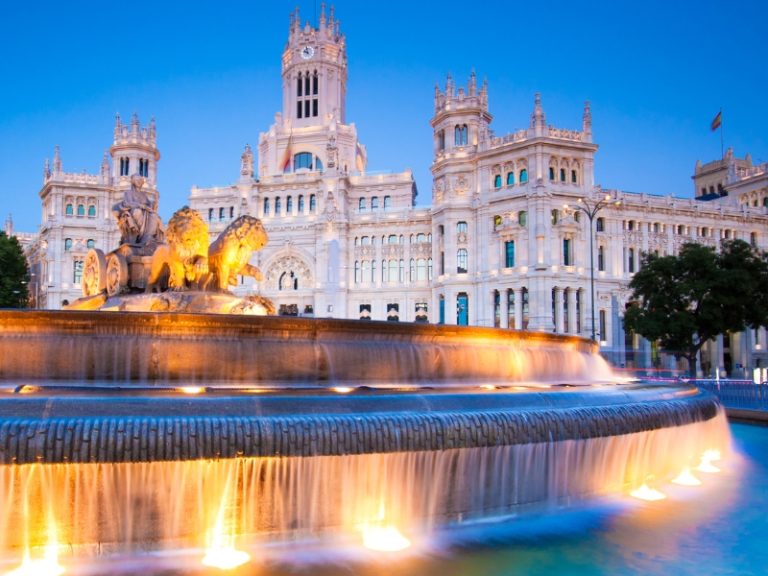
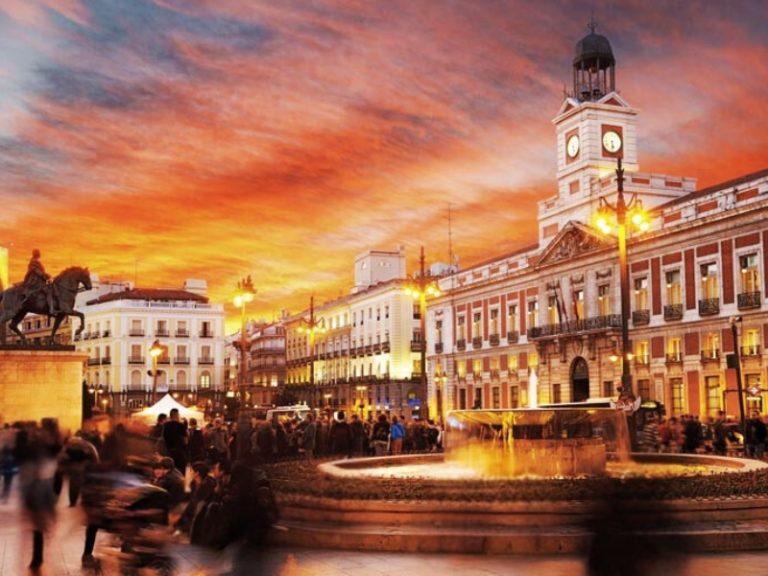
Outside the Prado the narration opens with Villanueva's building of 1785, drawn up as a cabinet of natural history long before it hung paintings. At the Cibeles Fountain you hear that the lions pulling the goddess are Atalanta and Hippomenes, turned into beasts by the gods. Later come the twelve grapes eaten under the clock of Puerta del Sol on New Year's Eve, and the account of Galileo working out the balance of Philip IV's rearing horse.
- Durationabout 3 hours
- Walkingabout 60 min · 4.5 km
- Stops10
- LanguagesEnglish, German, French, Italian, Spanish, Dutch
What you do on the walk
Listen
At each stop the audio gives you the history of the place, its legends and the details worth looking for. The same text sits on the screen for anyone who would rather read.
Walk on
Google Maps links one stop to the next: 60 minutes of walking over 4.5 km, at whatever pace you keep.
Stop when you like
Take a coffee, spend an hour in a gallery, then pick the walk up again the same day or another one.
Eat and browse
Tips for food and shops near the route come with the stops. The opening point and the order of the stops are yours to set in the app.
See the route and attractions →
How it works
- Book online Choose the number of people. Your booking reference arrives by email straight away.
- Get the app Download the World City Trail app from the App Store or Google Play and enter your booking reference.
- Walk when you like Start whenever you are ready, walk at your own pace and pause any time. No guide, no fixed schedule.
Who the walk suits
A first visit to Madrid
One walk sorts the museums, gates and squares of the centre into place and explains what you are standing in front of.
Anyone who dislikes groups
No flag to follow and no meeting point: you stay as long as something holds you and move on when you choose.
A single free day
3 hours covers the stretch from the Prado to the Royal Palace, so the evening is left for a terrace and a late dinner.
Good to know
- Bring a charged smartphone with mobile data; a power bank helps.
- No entry tickets needed: everything happens outside the buildings. Going inside is optional and paid separately.
- Family friendly; children must be accompanied by an adult.
- Not suitable for wheelchair users and difficult with strollers.
- Groups of up to 5 work best; larger groups split up, one ticket per person.
- Every purchase helps support stray cats and dogs in Greece.
The walk stop by stop: the Prado, Puerta de Alcalá, Puerta del Sol, Plaza de Oriente
10 stops · about 60 min walking · start: Prado Museum · finish: Plaza de Oriente
The opening stop is the Prado Museum, with the Monument to Goya a few steps along its northern side. From there the way reaches the Puerta de Felipe IV at the edge of the Retiro, then the Puerta de Alcalá and the Cibeles Fountain, before Calle de Alcalá carries you up to the Metropolis Building and down into Puerta del Sol. Plaza Mayor and the Church of San Ginés follow, and Plaza de Oriente, between the Royal Palace and the Teatro Real, brings the walk to a close. Another opening stop or another order is a setting in the app, and no stop asks for an entry ticket.
Open the route map ↗
1Prado MuseumStart
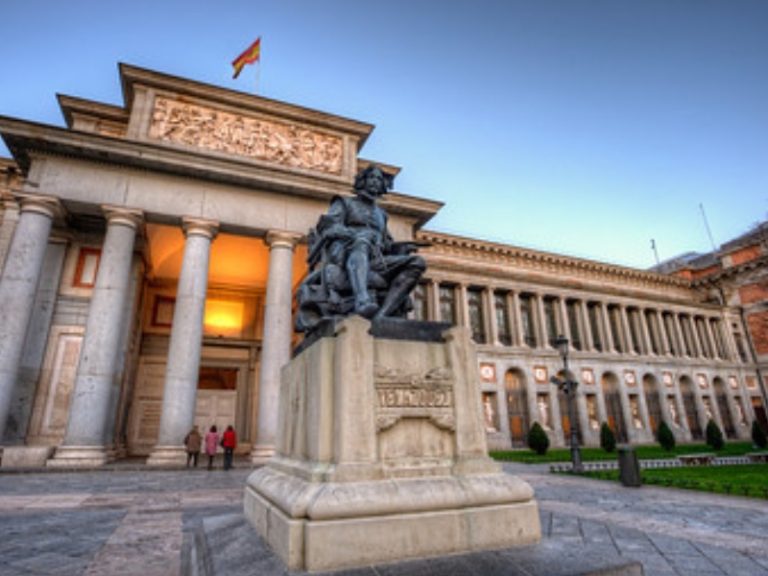
Juan de Villanueva designed this neoclassical building in 1785 for King Charles III as a natural history cabinet. It opened as a royal museum of paintings and sculpture in 1819 and is now one of the world's great art museums, with works by Velázquez, Goya and El Greco. A statue of Velázquez stands in front of its main façade.
2Monument to Goya
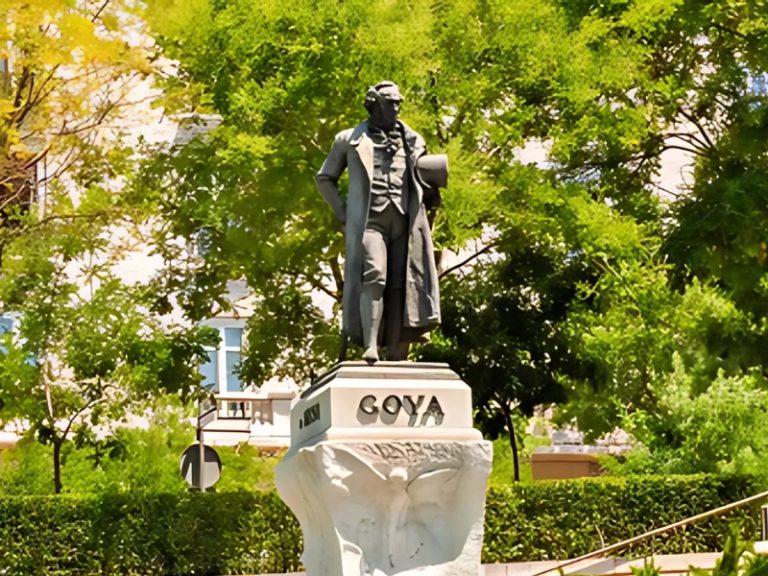
This bronze statue of Francisco de Goya by the sculptor Mariano Benlliure stands outside the north side of the Prado, by the entrance named after the painter. Unveiled in 1902, it honours the artist from Aragon whose works, including his late Black Paintings, fill many rooms of the museum behind him.
3Puerta de Felipe IV
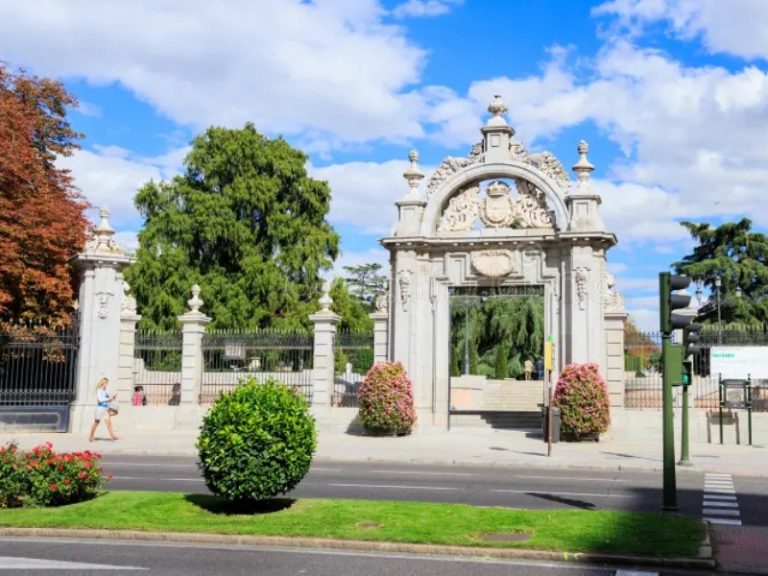
Melchor de Bueras built this baroque granite gate in 1680 as a triumphal arch for the arrival of Marie Louise of Orléans, first wife of Charles II. In 1690 it welcomed his second wife, Maria Anna of Neuburg, whose inscription it still bears. Moved from its first site, it now marks an entrance to the Retiro gardens.
4Puerta de Alcalá
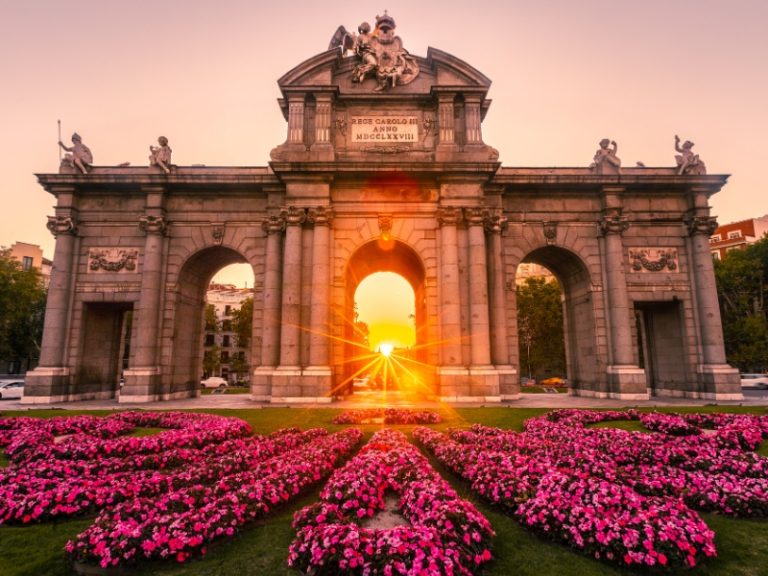
King Charles III commissioned this neoclassical gate from Francesco Sabatini, and it was inaugurated in 1778 as a gate in the old city wall on the road to Alcalá de Henares. It has five openings, three arches and two rectangular passages. Today it stands in the middle of the Plaza de la Independencia, beside the Retiro Park.
5Cibeles Fountain
Ventura Rodríguez designed this fountain around 1780: the goddess Cybele, carved by Francisco Gutiérrez, rides a chariot pulled by two lions by Roberto Michel. In mythology the lions are Atalanta and Hippomenes, turned into animals by the gods. Real Madrid fans gather here to celebrate their team's titles.
Read the full story →
6Metropolis Building
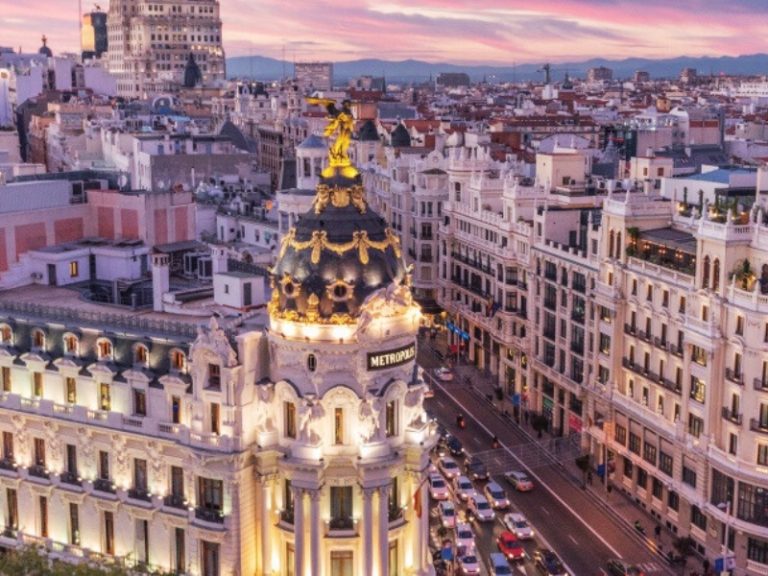
This domed building on the corner of Calle de Alcalá and Gran Vía was designed by the French architects Jules and Raymond Février and inaugurated in 1911 for the insurance company La Unión y el Fénix. The winged Victory on its dome has stood there since 1977, replacing the original statue of the Phoenix with Ganymede.
Read the full story →
7Puerta del Sol
In front of the Real Casa de Correos, the 18th-century post office that now houses the regional government, a plaque marks Kilometre Zero of Spain's national roads. On New Year's Eve, Spaniards eat twelve grapes to the chimes of its clock. Nearby stands the Bear and the Strawberry Tree, the symbol of Madrid, unveiled in 1967.
Read the full story →
8Plaza Mayor
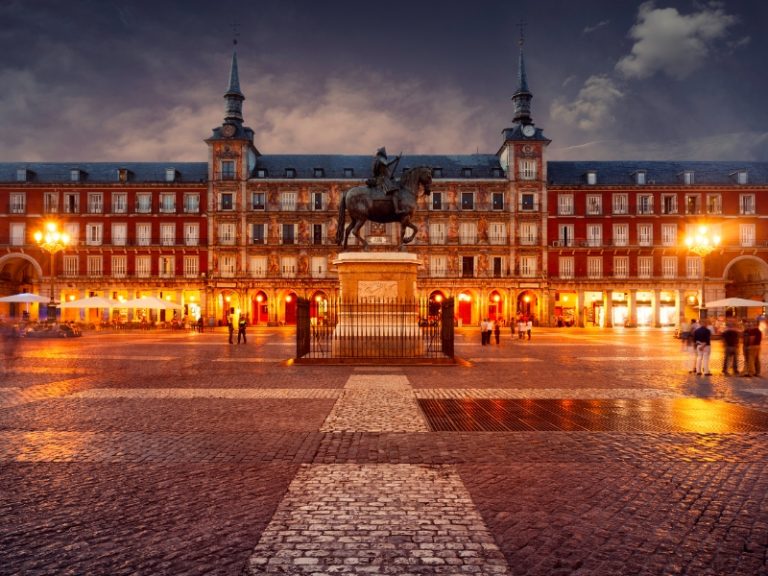
Madrid's arcaded main square was completed in 1619 under Philip III by Juan Gómez de Mora and rebuilt by Juan de Villanueva after a fire in 1790. In the centre stands the bronze equestrian statue of Philip III by Giambologna and Pietro Tacca, placed here in 1848. The painted façade of the Casa de la Panadería dates from 1992.
9Church of San Ginés
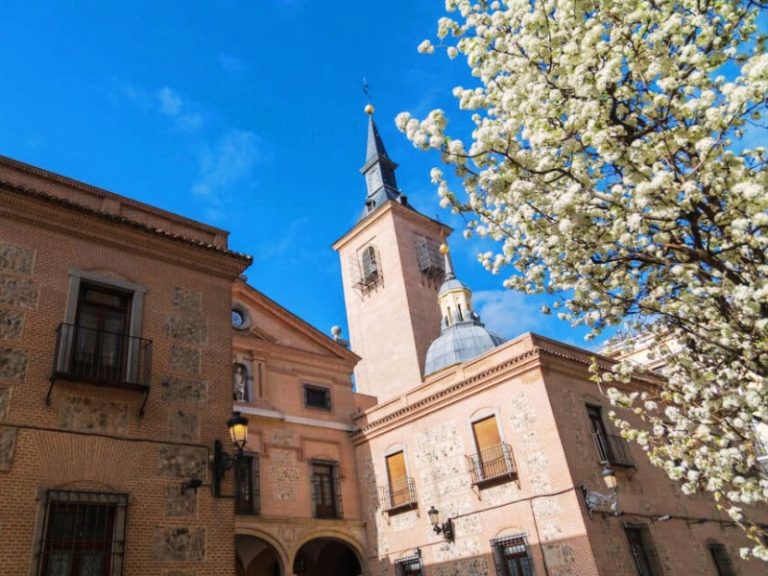
San Ginés on Calle del Arenal is one of the oldest parishes in Madrid; the present church dates from 1645, while the bell tower survives from an earlier building. Lope de Vega married here and Francisco de Quevedo was baptised here. In the alley behind it, the Chocolatería San Ginés is known for hot chocolate with churros.
10Plaza de OrienteFinish
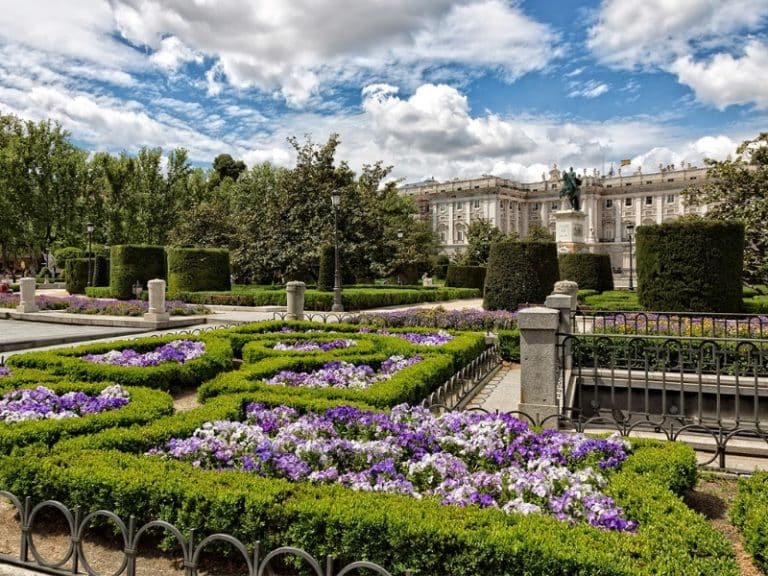
This square between the Royal Palace and the Teatro Real took its present form in the 1840s. In the centre rides Philip IV in a bronze by Pietro Tacca, sent to Madrid in 1640: the rearing horse rests only on its hind legs, and Galileo Galilei is said to have calculated its balance. Statues of Spanish kings line the gardens.
Only logged in customers who have purchased this product may leave a review.





Bolivia –
Collected on GetYourGuide
India –
Collected on GetYourGuide
Each Managment and information of the places explained was immaculate . No wonder Get your guide is one of the best app to explore ?????????????????????????? Regards Bopanna