
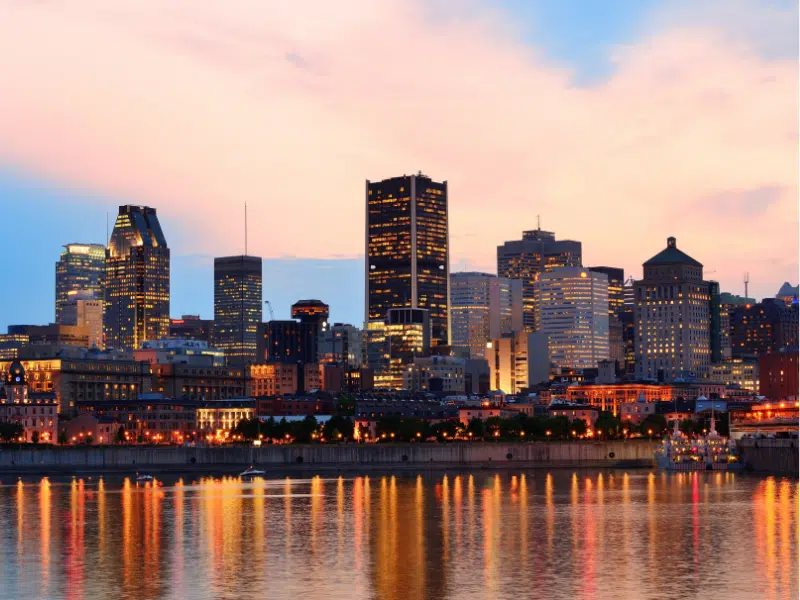
Montréal è una delle più grandi città francofone del mondo, costruita su un’isola nel fiume San Lorenzo intorno alla piccola montagna che le ha dato il nome. Mescola strade di pietra del Seicento con l’architettura audace dell’Expo 67, campanili e panetterie di bagel, e inverni così freddi da aver creato un’intera rete di passaggi sotto il centro. Ecco i fatti e le storie che la raccontano.
10 curiosità su Montréal
- Named after a mountain: in 1535 the French explorer Jacques Cartier climbed the hill above the Iroquoian village of Hochelaga and called it Mont Royal. The city's name comes from it.
- Fondata come missione: Paul de Chomedey de Maisonneuve e l’infermiera Jeanne Mance fondarono Ville-Marie nel 1642 come missione cattolica sulla riva del fiume, nell’attuale Vieux-Montréal.
- A cross that keeps a promise: in 1643 Maisonneuve carried a wooden cross up Mount Royal to give thanks after the young settlement survived a flood. Today's illuminated steel cross on the summit dates from 1924.
- A park by Central Park's designer: Frederick Law Olmsted, co-designer of New York's Central Park, laid out Mount Royal Park, which opened in 1876.
- City of a hundred steeples: visiting in 1881, Mark Twain joked that this was the first city he had seen where you couldn't throw a brick without breaking a church window.
- A converted architect: Notre-Dame Basilica, completed in 1829, was designed by James O'Donnell, an Irish-American Protestant who converted to Catholicism before his death and was buried in its crypt.
- Expo 67: the 1967 World's Fair drew more than 50 million visits. It left behind Moshe Safdie's stacked-box housing complex Habitat 67 and Buckminster Fuller's geodesic dome, now the Biosphere.
- The world's tallest leaning tower: the tower of the Olympic Stadium, built for the 1976 Summer Olympics, rises 165 metres at an angle of 45 degrees, a Guinness World Record for the tallest man-made leaning tower.
- Uno skyline che si inchina alla montagna: da decenni le regole urbanistiche mantengono i grattacieli del centro più bassi della cima del Mont Royal.
- Hockey's most successful club: the Montreal Canadiens, founded in 1909, have won the Stanley Cup 24 times, more than any other team.
A copy of St Peter's in downtown Montreal
When Montreal's Catholic cathedral burned down in 1852, Bishop Ignace Bourget decided to build its replacement not in the French-speaking east but in the west of the city, then the heart of the English-speaking, largely Protestant business district. He wanted it to show Montreal's loyalty to the Pope, so he chose St Peter's Basilica in Rome as the model. The architect Victor Bourgeau refused at first, saying St Peter's could not be reproduced on a smaller scale, but Bourget pressed on. Work began in 1875 and the church was consecrated in 1894. Under the dome stands a copy of Bernini's bronze canopy, made in 1900, and along the roofline stand statues of the patron saints of the 13 parishes that helped pay for the building. In 1955 it took its current name, Mary, Queen of the World.
Il Vieux-Montréal in breve
The streets between Notre-Dame Street and the river follow the plan of the French colonial town. Place d'Armes is its centre, with Notre-Dame Basilica on one side, a monument to Maisonneuve in the middle and the head office of the Bank of Montreal, founded in 1817 as Canada's first bank, opposite.
Cosa mangiare a Montréal
- Bagel: più piccoli, densi e dolci di quelli di New York, bolliti in acqua e miele e cotti nel forno a legna. St-Viateur e Fairmount, nel Mile End, sono i due indirizzi famosi.
- Smoked meat: brisket cured with spices and piled into rye-bread sandwiches with mustard. Schwartz's on boulevard Saint-Laurent has been serving it since 1928.
- Poutine: patatine con cagliata di formaggio fresca che scricchiola sotto i denti e salsa gravy calda, un piatto nato nel Québec rurale negli anni Cinquanta.
- Tire d'érable: hot maple syrup poured on snow and rolled onto a stick, the classic treat at the sugar shacks in early spring.
- Tourtière: un pasticcio di carne speziata che le famiglie del Québec servono tradizionalmente a Natale e Capodanno.
Da sapere prima di partire
- D’inverno usa la città sotterranea, una rete di passaggi che collega stazioni della metro, centri commerciali e grattacieli del centro, così puoi attraversare gran parte del centro senza uscire.
- Per la vista classica sullo skyline, sali sul Mont Royal fino al Belvédère Kondiaronk. I sentieri partono vicino alla parte alta delle strade del centro.
- Il francese è la lingua ufficiale del Québec. Quasi tutti nel centro di Montréal parlano anche inglese, ma iniziare con un bonjour è sempre apprezzato.
- Per i prodotti locali vai al Marché Jean-Talon nella Piccola Italia, dove i produttori del Québec vendono di tutto, dai frutti di bosco ai prodotti d’acero.
Scopri Montréal con World City Trail
La nostra caccia al tesoro a Montréal trasforma questi luoghi in un gioco sul tuo telefono. Il percorso collega 10 tappe e dura circa tre ore, con circa 59 minuti a piedi, e passa tra l’altro dalla Cattedrale di Maria Regina del Mondo.
A ogni tappa risolvi un enigma e ascolti una breve storia, al tuo ritmo. Puoi iniziare quando vuoi.
Gioca alla caccia al tesoro di Montréal →
Fatti verificati a ottobre 2026.