
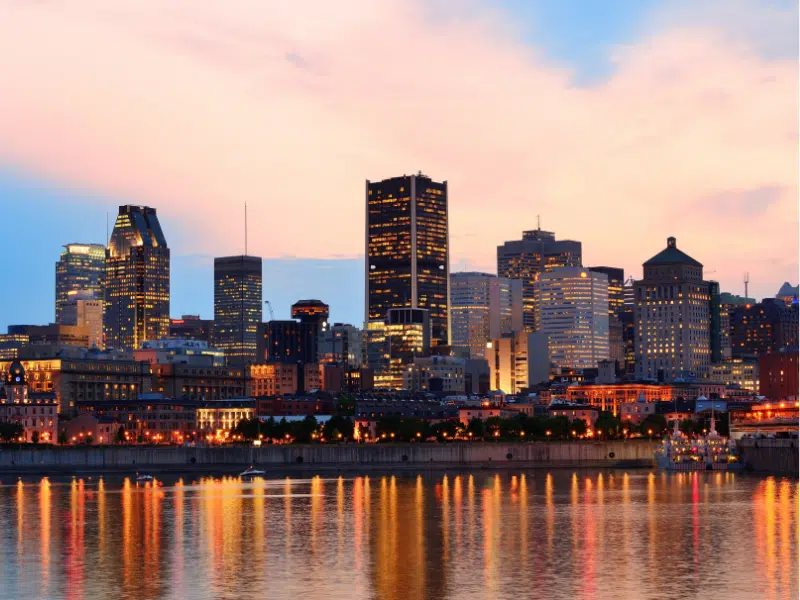
Montreal é uma das maiores cidades francófonas do mundo, construída numa ilha do rio São Lourenço à volta da pequena montanha que lhe deu o nome. Mistura ruas de pedra do século XVII com a arquitetura ousada da Expo 67, campanários com padarias de bagels, e invernos tão frios que deram origem a toda uma rede de passagens debaixo do centro. Estes são os factos e as histórias por trás dela.
10 curiosidades sobre Montreal
- Named after a mountain: in 1535 the French explorer Jacques Cartier climbed the hill above the Iroquoian village of Hochelaga and called it Mont Royal. The city's name comes from it.
- Fundada como missão: Paul de Chomedey de Maisonneuve e a enfermeira Jeanne Mance fundaram Ville-Marie em 1642 como missão católica na margem do rio, no que é hoje o Velho Montreal.
- A cross that keeps a promise: in 1643 Maisonneuve carried a wooden cross up Mount Royal to give thanks after the young settlement survived a flood. Today's illuminated steel cross on the summit dates from 1924.
- A park by Central Park's designer: Frederick Law Olmsted, co-designer of New York's Central Park, laid out Mount Royal Park, which opened in 1876.
- City of a hundred steeples: visiting in 1881, Mark Twain joked that this was the first city he had seen where you couldn't throw a brick without breaking a church window.
- A converted architect: Notre-Dame Basilica, completed in 1829, was designed by James O'Donnell, an Irish-American Protestant who converted to Catholicism before his death and was buried in its crypt.
- Expo 67: the 1967 World's Fair drew more than 50 million visits. It left behind Moshe Safdie's stacked-box housing complex Habitat 67 and Buckminster Fuller's geodesic dome, now the Biosphere.
- The world's tallest leaning tower: the tower of the Olympic Stadium, built for the 1976 Summer Olympics, rises 165 metres at an angle of 45 degrees, a Guinness World Record for the tallest man-made leaning tower.
- Um horizonte que se curva perante a montanha: há décadas que as regras urbanísticas mantêm as torres do centro mais baixas do que o cimo do Mont Royal.
- Hockey's most successful club: the Montreal Canadiens, founded in 1909, have won the Stanley Cup 24 times, more than any other team.
A copy of St Peter's in downtown Montreal
When Montreal's Catholic cathedral burned down in 1852, Bishop Ignace Bourget decided to build its replacement not in the French-speaking east but in the west of the city, then the heart of the English-speaking, largely Protestant business district. He wanted it to show Montreal's loyalty to the Pope, so he chose St Peter's Basilica in Rome as the model. The architect Victor Bourgeau refused at first, saying St Peter's could not be reproduced on a smaller scale, but Bourget pressed on. Work began in 1875 and the church was consecrated in 1894. Under the dome stands a copy of Bernini's bronze canopy, made in 1900, and along the roofline stand statues of the patron saints of the 13 parishes that helped pay for the building. In 1955 it took its current name, Mary, Queen of the World.
O Velho Montreal, explicado
The streets between Notre-Dame Street and the river follow the plan of the French colonial town. Place d'Armes is its centre, with Notre-Dame Basilica on one side, a monument to Maisonneuve in the middle and the head office of the Bank of Montreal, founded in 1817 as Canada's first bank, opposite.
O que comer em Montreal
- Bagels: mais pequenos, densos e doces do que os de Nova Iorque, cozidos em água com mel e assados em forno a lenha. A St-Viateur e a Fairmount, no Mile End, são as duas moradas famosas.
- Smoked meat: brisket cured with spices and piled into rye-bread sandwiches with mustard. Schwartz's on boulevard Saint-Laurent has been serving it since 1928.
- Poutine: batatas fritas com coalhada de queijo fresca que range ao trincar e molho gravy quente, um prato do Quebeque rural dos anos 1950.
- Tire d'érable: hot maple syrup poured on snow and rolled onto a stick, the classic treat at the sugar shacks in early spring.
- Tourtière: uma tarte de carne condimentada que as famílias do Quebeque servem tradicionalmente no Natal e no Ano Novo.
Antes de ires
- No inverno, usa a cidade subterrânea, uma rede de passagens que liga estações de metro, centros comerciais e torres de escritórios do centro, para atravessares boa parte do centro sem saíres à rua.
- Para a vista clássica dos arranha-céus, sobe o Mont Royal até ao Belvédère Kondiaronk. Os caminhos começam perto do topo das ruas do centro.
- O francês é a língua oficial do Quebeque. A maioria das pessoas no centro de Montreal também fala inglês, mas começar com um bonjour é sempre bem recebido.
- Para produtos locais, vai ao Marché Jean-Talon, na Pequena Itália, onde agricultores do Quebeque vendem de tudo, de frutos vermelhos a produtos de ácer.
Descobre Montreal com a World City Trail
A nossa caça ao tesouro em Montreal transforma estes locais num jogo no teu telemóvel. O percurso liga 10 paragens e demora cerca de três horas, com cerca de 59 minutos a pé, e passa, entre outros, pela Catedral de Maria Rainha do Mundo.
Em cada paragem resolves um enigma e ouves uma pequena história, ao teu ritmo. Podes começar quando quiseres.
Jogar a caça ao tesouro de Montreal →
Factos verificados em outubro de 2026.