
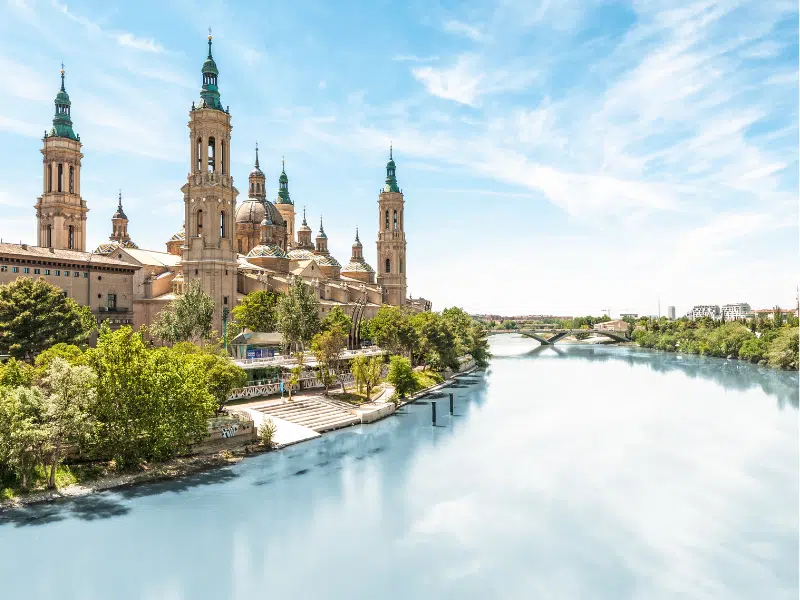
Zaragoza has been a Roman colony, the seat of an Islamic kingdom and the capital of the Kingdom of Aragon, and each era left a building you can still walk into. It is Spain's fifth-largest city, yet its centre is compact, strung along the River Ebro around one of the country's best-known basilicas. Here are the facts and stories that make it special.
10 curiosidades sobre Saragoça
- Com nome de imperador: os romanos fundaram a cidade por volta de 14 a.C. como Caesaraugusta, em honra do imperador Augusto. Ao longo dos séculos, o nome foi-se gastando até ao árabe Saraqusta e, por fim, Zaragoza.
- Um pilar vindo do céu: segundo a tradição, a 2 de janeiro do ano 40 a Virgem Maria apareceu ao apóstolo Santiago nas margens do Ebro e deu-lhe uma coluna de jaspe. A Basílica do Pilar foi construída à volta dela.
- Quatro torres e onze cúpulas: a basílica foi construída sobretudo entre 1681 e 1872. Algumas abóbadas à volta da sua Santa Capela foram pintadas por um jovem Francisco de Goya.
- Bombas que nunca explodiram: em 1936, durante a Guerra Civil Espanhola, foram lançadas três bombas sobre a basílica e nenhuma explodiu. Duas continuam expostas lá dentro.
- Goya's home ground: Francisco de Goya was born in 1746 in Fuendetodos, a village south of Zaragoza, and trained as a painter in the city before making his name in Madrid.
- Um palácio islâmico que acolhe um parlamento: a Aljafería foi construída sobretudo entre 1065 e 1081 para al-Muqtadir, soberano da taifa de Saragoça. Mais tarde palácio real e sede da Inquisição, acolhe hoje as Cortes de Aragão, o parlamento regional.
- A tower from an opera: the Aljafería's Troubadour Tower is named after the 1836 play El trovador by Antonio García Gutiérrez, which Verdi turned into his opera Il trovatore.
- Mudéjar heritage: in 2001 the Aljafería, La Seo cathedral and the church of San Pablo were added to the UNESCO World Heritage site 'Mudéjar Architecture of Aragon', known for its patterned brick and glazed tiles.
- Uma praça de touros de 1764: a Plaza de Toros de la Misericordia abriu em 1764, o que faz dela uma das mais antigas de Espanha, e tem mais de 10 000 lugares.
- A world's fair about water: in 2008 Zaragoza hosted Expo 2008, themed on water and sustainable development, on a meander of the Ebro. Several of its buildings, such as the Bridge Pavilion by Zaha Hadid, still stand.
Os cercos de Saragoça e Agustina de Aragão
In the summer of 1808, Napoleon's troops laid siege to Zaragoza, and the city held out far longer than anyone expected. Its best-known story is about Agustina, a young woman bringing supplies to the defenders at the Portillo gate. Seeing that the gunners there had fallen, she fired a cannon at the advancing French herself and rallied the defence. The French withdrew that August but returned in December, and after a second siege of house-to-house fighting and disease the city surrendered in February 1809. Agustina de Aragón became a national heroine, Goya drew her in his series The Disasters of War, and she is buried in the church of the Portillo.
O Mercado Central, explicado
Zaragoza's central market, designed by Félix Navarro and opened in 1903, is a modernist hall of iron and glass on the edge of the old town. After nearly two years of restoration it reopened in February 2020. Its stalls sell lamb, cured ham, cheese and vegetables from the Ebro valley, and it is a good place to put together a picnic for the riverbank.
O que comer em Saragoça
- Ternasco de Aragón: borrego jovem, normalmente assado com batatas, protegido como indicação geográfica.
- Migas a la aragonesa: migalhas de pão fritas com alho, chouriço e porco, muitas vezes servidas com uvas ou um ovo estrelado.
- Borraja: borragem, um legume local normalmente cozido com batatas e regado com azeite.
- Tapas no Tubo: um emaranhado de ruelas da cidade velha cheio de pequenos bares de tapas.
- Frutas de Aragón and adoquines: candied fruit dipped in chocolate, and the giant 'cobblestone' sweets of the Pilar, wrapped in paper printed with a jota verse.
Antes de ires
- A lift goes up one of the basilica's towers for a view over the Ebro, the domes and the city.
- Atravessa a Puente de Piedra, a ponte de pedra, ao fim da tarde para a vista clássica da basílica refletida no rio.
- The Fiestas del Pilar fill the city in the week around 12 October. On the 12th, the Ofrenda de Flores covers a huge frame around the Virgin's figure with flowers. Book accommodation early.
- Os fãs de Goya podem ver os seus frescos na basílica e os seus quadros no Museo Goya, na cidade velha, e depois visitar a casa onde nasceu em Fuendetodos.
Descobre Saragoça com a World City Trail
A nossa caça ao tesouro em Saragoça transforma estes locais num jogo no teu telemóvel. O percurso liga 10 paragens e demora cerca de três horas, com cerca de 48 minutos a pé: o Palácio da Aljafería, a Plaza de Toros de la Misericordia e o Mercado Central.
Em cada paragem resolves um enigma e ouves uma pequena história, ao teu ritmo. Podes começar quando quiseres e jogar em inglês, alemão, francês, italiano, espanhol ou neerlandês.
Jogar a caça ao tesouro de Saragoça →
Factos verificados em outubro de 2026.