
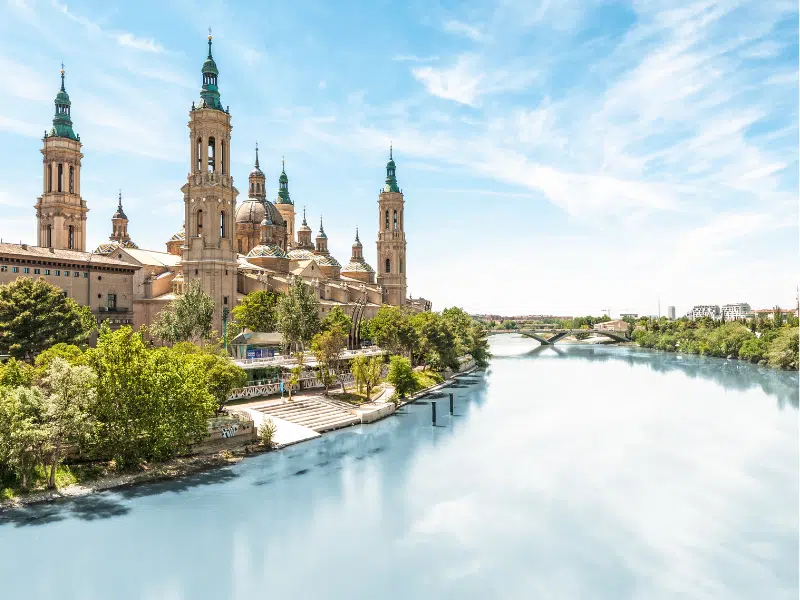
Zaragoza has been a Roman colony, the seat of an Islamic kingdom and the capital of the Kingdom of Aragon, and each era left a building you can still walk into. It is Spain's fifth-largest city, yet its centre is compact, strung along the River Ebro around one of the country's best-known basilicas. Here are the facts and stories that make it special.
10 fun facts about Zaragoza
- Named after an emperor: the Romans founded the city as Caesaraugusta around 14 BC, in honour of Emperor Augustus. Over the centuries the name was worn down to Saraqusta in Arabic and finally Zaragoza.
- A pillar from heaven: tradition says that on 2 January in the year 40, the Virgin Mary appeared to the apostle James on the banks of the Ebro and gave him a jasper column. The Basilica del Pilar is built around it.
- Four towers and eleven domes: the basilica was built mainly between 1681 and 1872. Some of the vaults around its Holy Chapel were painted by a young Francisco de Goya.
- Bombs that never went off: in 1936, during the Spanish Civil War, three bombs were dropped on the basilica and none of them exploded. Two are still on display inside.
- Goya's home ground: Francisco de Goya was born in 1746 in Fuendetodos, a village south of Zaragoza, and trained as a painter in the city before making his name in Madrid.
- An Islamic palace that houses a parliament: the Aljafería was built mostly between 1065 and 1081 for al-Muqtadir, ruler of the taifa of Zaragoza. Later a royal palace and a headquarters of the Inquisition, it is now the seat of the Cortes de Aragón, the regional parliament.
- A tower from an opera: the Aljafería's Troubadour Tower is named after the 1836 play El trovador by Antonio García Gutiérrez, which Verdi turned into his opera Il trovatore.
- Mudéjar heritage: in 2001 the Aljafería, La Seo cathedral and the church of San Pablo were added to the UNESCO World Heritage site 'Mudéjar Architecture of Aragon', known for its patterned brick and glazed tiles.
- A bullring from 1764: the Plaza de Toros de la Misericordia opened in 1764, which makes it one of the older bullrings in Spain, and it seats more than 10,000 people.
- A world's fair about water: in 2008 Zaragoza hosted Expo 2008, themed on water and sustainable development, on a meander of the Ebro. Several of its buildings, such as the Bridge Pavilion by Zaha Hadid, still stand.
The sieges of Zaragoza and Agustina de Aragón
In the summer of 1808, Napoleon's troops laid siege to Zaragoza, and the city held out far longer than anyone expected. Its best-known story is about Agustina, a young woman bringing supplies to the defenders at the Portillo gate. Seeing that the gunners there had fallen, she fired a cannon at the advancing French herself and rallied the defence. The French withdrew that August but returned in December, and after a second siege of house-to-house fighting and disease the city surrendered in February 1809. Agustina de Aragón became a national heroine, Goya drew her in his series The Disasters of War, and she is buried in the church of the Portillo.
The Mercado Central, explained
Zaragoza's central market, designed by Félix Navarro and opened in 1903, is a modernist hall of iron and glass on the edge of the old town. After nearly two years of restoration it reopened in February 2020. Its stalls sell lamb, cured ham, cheese and vegetables from the Ebro valley, and it is a good place to put together a picnic for the riverbank.
What to eat in Zaragoza
- Ternasco de Aragón: young lamb, usually roasted with potatoes, protected as a geographical indication.
- Migas a la aragonesa: fried breadcrumbs with garlic, chorizo and pork, often served with grapes or a fried egg.
- Borraja: borage, a local vegetable usually boiled with potatoes and dressed with olive oil.
- Tapas in El Tubo: a tangle of narrow lanes in the old town packed with small tapas bars.
- Frutas de Aragón and adoquines: candied fruit dipped in chocolate, and the giant 'cobblestone' sweets of the Pilar, wrapped in paper printed with a jota verse.
Good to know before you go
- A lift goes up one of the basilica's towers for a view over the Ebro, the domes and the city.
- Cross the Puente de Piedra, the stone bridge, in the late afternoon for the classic view of the basilica reflected in the river.
- The Fiestas del Pilar fill the city in the week around 12 October. On the 12th, the Ofrenda de Flores covers a huge frame around the Virgin's figure with flowers. Book accommodation early.
- Goya fans can see his frescoes in the basilica and his paintings at the Museo Goya in the old town, then visit his birthplace in Fuendetodos.
Explore Zaragoza with World City Trail
Our Zaragoza scavenger hunt turns these sights into a game you play on your phone. The route links 10 stops and takes around three hours, with about 48 minutes of walking: the Aljafería Palace, the Plaza de Toros de la Misericordia and the Mercado Central.
At each stop you solve a puzzle and hear a short story, at your own pace. You can start whenever you like and play in English, German, French, Italian, Spanish or Dutch.
Play the Zaragoza scavenger hunt →
Facts checked in October 2026.