
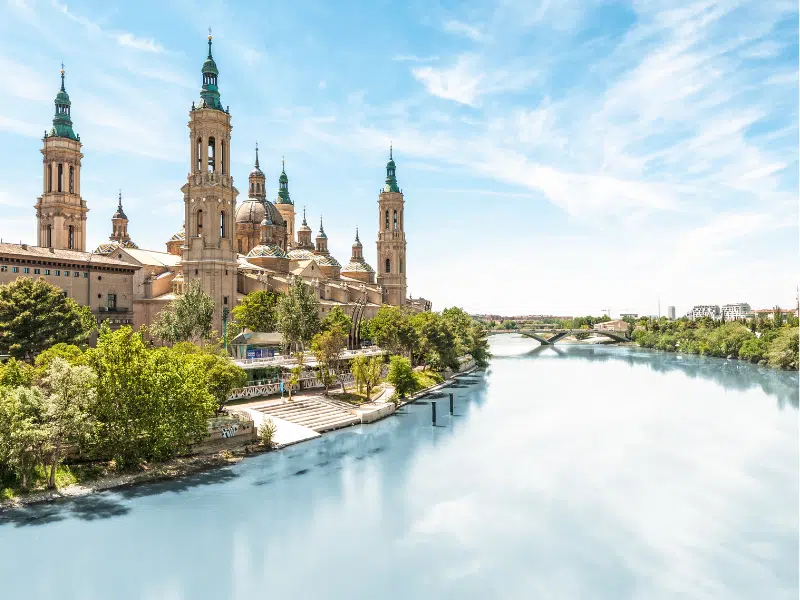
Zaragoza has been a Roman colony, the seat of an Islamic kingdom and the capital of the Kingdom of Aragon, and each era left a building you can still walk into. It is Spain's fifth-largest city, yet its centre is compact, strung along the River Ebro around one of the country's best-known basilicas. Here are the facts and stories that make it special.
10 curiosità su Saragozza
- Il nome di un imperatore: i Romani fondarono la città intorno al 14 a.C. come Caesaraugusta, in onore dell’imperatore Augusto. Nei secoli il nome si consumò nell’arabo Saraqusta e infine in Zaragoza.
- Un pilastro dal cielo: secondo la tradizione, il 2 gennaio dell’anno 40 la Vergine Maria apparve all’apostolo Giacomo sulle rive dell’Ebro e gli consegnò una colonna di diaspro. La Basilica del Pilar è costruita intorno a essa.
- Quattro torri e undici cupole: la basilica fu costruita soprattutto tra il 1681 e il 1872. Alcune volte intorno alla sua Santa Cappella furono affrescate da un giovane Francisco de Goya.
- Bombe mai esplose: nel 1936, durante la guerra civile spagnola, tre bombe furono sganciate sulla basilica e nessuna esplose. Due sono ancora esposte all’interno.
- Goya's home ground: Francisco de Goya was born in 1746 in Fuendetodos, a village south of Zaragoza, and trained as a painter in the city before making his name in Madrid.
- Un palazzo islamico che ospita un parlamento: l’Aljafería fu costruita per lo più tra il 1065 e il 1081 per al-Muqtadir, sovrano della taifa di Saragozza. In seguito palazzo reale e sede dell’Inquisizione, oggi ospita le Cortes de Aragón, il parlamento regionale.
- A tower from an opera: the Aljafería's Troubadour Tower is named after the 1836 play El trovador by Antonio García Gutiérrez, which Verdi turned into his opera Il trovatore.
- Mudéjar heritage: in 2001 the Aljafería, La Seo cathedral and the church of San Pablo were added to the UNESCO World Heritage site 'Mudéjar Architecture of Aragon', known for its patterned brick and glazed tiles.
- Un’arena del 1764: la Plaza de Toros de la Misericordia fu inaugurata nel 1764, il che la rende una delle arene più antiche di Spagna, e ha oltre 10.000 posti.
- A world's fair about water: in 2008 Zaragoza hosted Expo 2008, themed on water and sustainable development, on a meander of the Ebro. Several of its buildings, such as the Bridge Pavilion by Zaha Hadid, still stand.
Gli assedi di Saragozza e Agustina d’Aragona
In the summer of 1808, Napoleon's troops laid siege to Zaragoza, and the city held out far longer than anyone expected. Its best-known story is about Agustina, a young woman bringing supplies to the defenders at the Portillo gate. Seeing that the gunners there had fallen, she fired a cannon at the advancing French herself and rallied the defence. The French withdrew that August but returned in December, and after a second siege of house-to-house fighting and disease the city surrendered in February 1809. Agustina de Aragón became a national heroine, Goya drew her in his series The Disasters of War, and she is buried in the church of the Portillo.
Il Mercado Central in breve
Zaragoza's central market, designed by Félix Navarro and opened in 1903, is a modernist hall of iron and glass on the edge of the old town. After nearly two years of restoration it reopened in February 2020. Its stalls sell lamb, cured ham, cheese and vegetables from the Ebro valley, and it is a good place to put together a picnic for the riverbank.
Cosa mangiare a Saragozza
- Ternasco de Aragón: agnello giovane, di solito arrosto con patate, tutelato da un’indicazione geografica.
- Migas a la aragonesa: briciole di pane fritte con aglio, chorizo e maiale, spesso servite con uva o un uovo fritto.
- Borraja: la borragine, un ortaggio locale di solito lessato con patate e condito con olio d’oliva.
- Tapas nel Tubo: un intrico di vicoli stretti nel centro storico pieno di piccoli bar di tapas.
- Frutas de Aragón and adoquines: candied fruit dipped in chocolate, and the giant 'cobblestone' sweets of the Pilar, wrapped in paper printed with a jota verse.
Da sapere prima di partire
- A lift goes up one of the basilica's towers for a view over the Ebro, the domes and the city.
- Attraversa il Puente de Piedra, il ponte di pietra, nel tardo pomeriggio per la vista classica della basilica riflessa nel fiume.
- The Fiestas del Pilar fill the city in the week around 12 October. On the 12th, the Ofrenda de Flores covers a huge frame around the Virgin's figure with flowers. Book accommodation early.
- Gli appassionati di Goya possono vedere i suoi affreschi nella basilica e i suoi quadri al Museo Goya nel centro storico, e poi visitare la sua casa natale a Fuendetodos.
Scopri Saragozza con World City Trail
La nostra caccia al tesoro a Saragozza trasforma questi luoghi in un gioco sul tuo telefono. Il percorso collega 10 tappe e dura circa tre ore, con circa 48 minuti di cammino: il Palazzo dell’Aljafería, la Plaza de Toros de la Misericordia e il Mercado Central.
A ogni tappa risolvi un enigma e ascolti una breve storia, al tuo ritmo. Puoi iniziare quando vuoi e giocare in italiano, inglese, tedesco, francese, spagnolo o olandese.
Gioca alla caccia al tesoro di Saragozza →
Fatti verificati a ottobre 2026.