
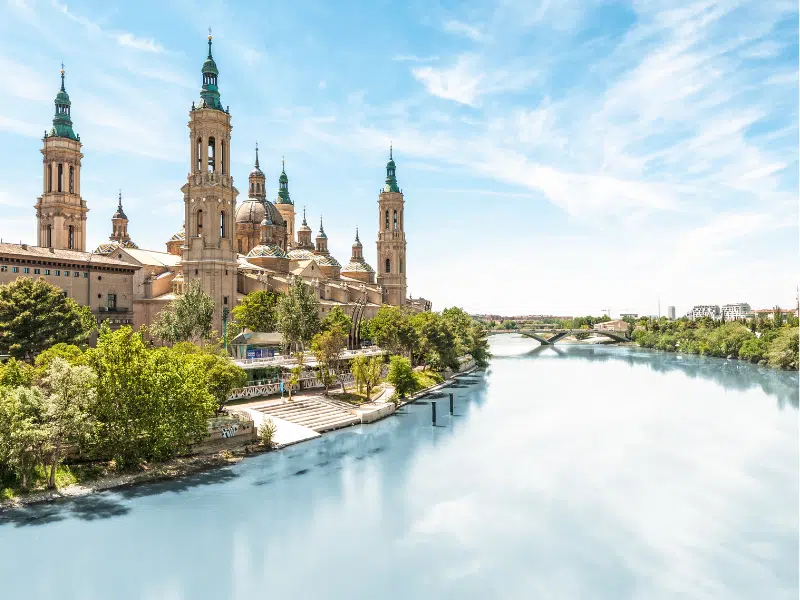
Zaragoza has been a Roman colony, the seat of an Islamic kingdom and the capital of the Kingdom of Aragon, and each era left a building you can still walk into. It is Spain's fifth-largest city, yet its centre is compact, strung along the River Ebro around one of the country's best-known basilicas. Here are the facts and stories that make it special.
10 spannende Fakten über Saragossa
- Benannt nach einem Kaiser: Die Römer gründeten die Stadt um 14 v. Chr. als Caesaraugusta, zu Ehren von Kaiser Augustus. Im Lauf der Jahrhunderte schliff sich der Name zum arabischen Saraqusta und schließlich zu Zaragoza ab.
- Eine Säule vom Himmel: Der Überlieferung nach erschien die Jungfrau Maria am 2. Januar des Jahres 40 dem Apostel Jakobus am Ufer des Ebro und gab ihm eine Säule aus Jaspis. Die Basilika del Pilar ist um sie herum gebaut.
- Vier Türme und elf Kuppeln: Die Basilika entstand vor allem zwischen 1681 und 1872. Einige Gewölbe rund um ihre Heilige Kapelle hat der junge Francisco de Goya ausgemalt.
- Bomben, die nie explodierten: 1936, im Spanischen Bürgerkrieg, fielen drei Bomben auf die Basilika, und keine davon explodierte. Zwei sind bis heute im Inneren ausgestellt.
- Goya's home ground: Francisco de Goya was born in 1746 in Fuendetodos, a village south of Zaragoza, and trained as a painter in the city before making his name in Madrid.
- Ein islamischer Palast mit Parlament: Die Aljafería wurde größtenteils zwischen 1065 und 1081 für al-Muqtadir erbaut, den Herrscher der Taifa von Saragossa. Später Königspalast und Sitz der Inquisition, beherbergt sie heute die Cortes de Aragón, das Regionalparlament.
- A tower from an opera: the Aljafería's Troubadour Tower is named after the 1836 play El trovador by Antonio García Gutiérrez, which Verdi turned into his opera Il trovatore.
- Mudéjar heritage: in 2001 the Aljafería, La Seo cathedral and the church of San Pablo were added to the UNESCO World Heritage site 'Mudéjar Architecture of Aragon', known for its patterned brick and glazed tiles.
- Eine Stierkampfarena von 1764: Die Plaza de Toros de la Misericordia wurde 1764 eröffnet, ist damit eine der älteren Arenen Spaniens und bietet über 10.000 Menschen Platz.
- A world's fair about water: in 2008 Zaragoza hosted Expo 2008, themed on water and sustainable development, on a meander of the Ebro. Several of its buildings, such as the Bridge Pavilion by Zaha Hadid, still stand.
Die Belagerungen von Saragossa und Agustina de Aragón
In the summer of 1808, Napoleon's troops laid siege to Zaragoza, and the city held out far longer than anyone expected. Its best-known story is about Agustina, a young woman bringing supplies to the defenders at the Portillo gate. Seeing that the gunners there had fallen, she fired a cannon at the advancing French herself and rallied the defence. The French withdrew that August but returned in December, and after a second siege of house-to-house fighting and disease the city surrendered in February 1809. Agustina de Aragón became a national heroine, Goya drew her in his series The Disasters of War, and she is buried in the church of the Portillo.
Der Mercado Central kurz erklärt
Zaragoza's central market, designed by Félix Navarro and opened in 1903, is a modernist hall of iron and glass on the edge of the old town. After nearly two years of restoration it reopened in February 2020. Its stalls sell lamb, cured ham, cheese and vegetables from the Ebro valley, and it is a good place to put together a picnic for the riverbank.
Was man in Saragossa essen sollte
- Ternasco de Aragón: junges Lamm, meist mit Kartoffeln im Ofen gebraten, mit geschützter geografischer Angabe.
- Migas a la aragonesa: geröstete Brotkrumen mit Knoblauch, Chorizo und Schweinefleisch, oft mit Trauben oder Spiegelei serviert.
- Borraja: Borretsch, ein regionales Gemüse, meist mit Kartoffeln gekocht und mit Olivenöl angemacht.
- Tapas im Tubo: ein Gewirr enger Gassen in der Altstadt voller kleiner Tapas-Bars.
- Frutas de Aragón and adoquines: candied fruit dipped in chocolate, and the giant 'cobblestone' sweets of the Pilar, wrapped in paper printed with a jota verse.
Gut zu wissen vor dem Besuch
- A lift goes up one of the basilica's towers for a view over the Ebro, the domes and the city.
- Geh am späten Nachmittag über die Puente de Piedra, die Steinbrücke, für den klassischen Blick auf die Basilika, die sich im Fluss spiegelt.
- The Fiestas del Pilar fill the city in the week around 12 October. On the 12th, the Ofrenda de Flores covers a huge frame around the Virgin's figure with flowers. Book accommodation early.
- Goya-Fans sehen seine Fresken in der Basilika und seine Gemälde im Museo Goya in der Altstadt und besuchen dann sein Geburtshaus in Fuendetodos.
Saragossa mit World City Trail entdecken
Unsere Schnitzeljagd in Saragossa macht aus diesen Sehenswürdigkeiten ein Spiel auf deinem Handy. Die Route verbindet 10 Stationen und dauert etwa drei Stunden, davon rund 48 Minuten zu Fuß: der Aljafería-Palast, die Plaza de Toros de la Misericordia und der Mercado Central.
An jeder Station löst du ein Rätsel und hörst eine kurze Geschichte, in deinem eigenen Tempo. Du kannst starten, wann du willst, und auf Deutsch, Englisch, Französisch, Italienisch, Spanisch oder Niederländisch spielen.
Die Schnitzeljagd in Saragossa spielen →
Fakten geprüft im Oktober 2026.