
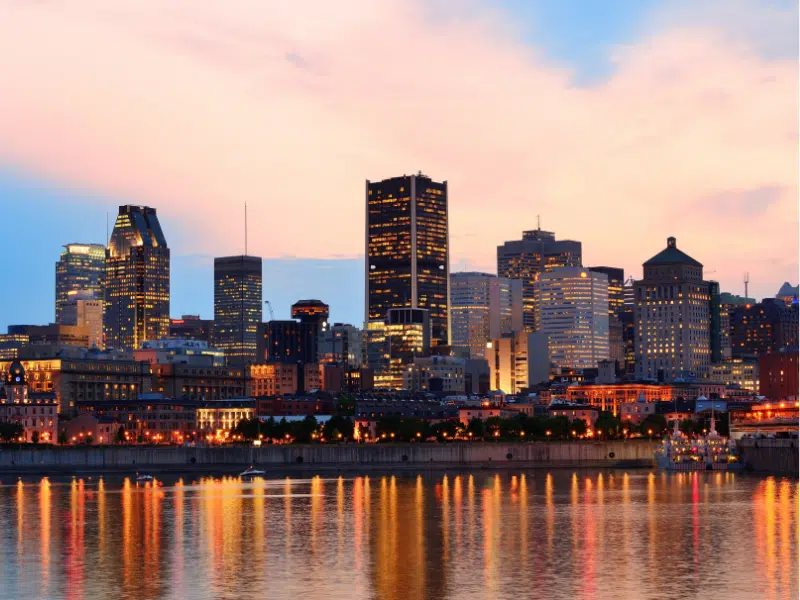
Montreal is one of the largest French-speaking cities in the world, built on an island in the St Lawrence River around the small mountain that gave it its name. It mixes 17th-century stone streets with the bold architecture of Expo 67, church spires with bagel bakeries, and winters cold enough to have shaped a whole network of passages under the city centre. Here are the facts and stories behind it.
10 fun facts about Montreal
- Named after a mountain: in 1535 the French explorer Jacques Cartier climbed the hill above the Iroquoian village of Hochelaga and called it Mont Royal. The city's name comes from it.
- Founded as a mission: Paul de Chomedey de Maisonneuve and the nurse Jeanne Mance founded Ville-Marie in 1642 as a Catholic mission on the riverbank, in what is now Old Montreal.
- A cross that keeps a promise: in 1643 Maisonneuve carried a wooden cross up Mount Royal to give thanks after the young settlement survived a flood. Today's illuminated steel cross on the summit dates from 1924.
- A park by Central Park's designer: Frederick Law Olmsted, co-designer of New York's Central Park, laid out Mount Royal Park, which opened in 1876.
- City of a hundred steeples: visiting in 1881, Mark Twain joked that this was the first city he had seen where you couldn't throw a brick without breaking a church window.
- A converted architect: Notre-Dame Basilica, completed in 1829, was designed by James O'Donnell, an Irish-American Protestant who converted to Catholicism before his death and was buried in its crypt.
- Expo 67: the 1967 World's Fair drew more than 50 million visits. It left behind Moshe Safdie's stacked-box housing complex Habitat 67 and Buckminster Fuller's geodesic dome, now the Biosphere.
- The world's tallest leaning tower: the tower of the Olympic Stadium, built for the 1976 Summer Olympics, rises 165 metres at an angle of 45 degrees, a Guinness World Record for the tallest man-made leaning tower.
- A skyline that bows to the mountain: for decades, city planning rules have kept downtown towers lower than the summit of Mount Royal.
- Hockey's most successful club: the Montreal Canadiens, founded in 1909, have won the Stanley Cup 24 times, more than any other team.
A copy of St Peter's in downtown Montreal
When Montreal's Catholic cathedral burned down in 1852, Bishop Ignace Bourget decided to build its replacement not in the French-speaking east but in the west of the city, then the heart of the English-speaking, largely Protestant business district. He wanted it to show Montreal's loyalty to the Pope, so he chose St Peter's Basilica in Rome as the model. The architect Victor Bourgeau refused at first, saying St Peter's could not be reproduced on a smaller scale, but Bourget pressed on. Work began in 1875 and the church was consecrated in 1894. Under the dome stands a copy of Bernini's bronze canopy, made in 1900, and along the roofline stand statues of the patron saints of the 13 parishes that helped pay for the building. In 1955 it took its current name, Mary, Queen of the World.
Old Montreal, explained
The streets between Notre-Dame Street and the river follow the plan of the French colonial town. Place d'Armes is its centre, with Notre-Dame Basilica on one side, a monument to Maisonneuve in the middle and the head office of the Bank of Montreal, founded in 1817 as Canada's first bank, opposite.
What to eat in Montreal
- Bagels: smaller, denser and sweeter than New York bagels, boiled in honey-sweetened water and baked in wood-fired ovens. St-Viateur and Fairmount in the Mile End are the two famous names.
- Smoked meat: brisket cured with spices and piled into rye-bread sandwiches with mustard. Schwartz's on boulevard Saint-Laurent has been serving it since 1928.
- Poutine: fries topped with fresh cheese curds that squeak when you bite them and hot gravy, a dish from rural Quebec in the 1950s.
- Tire d'érable: hot maple syrup poured on snow and rolled onto a stick, the classic treat at the sugar shacks in early spring.
- Tourtière: a spiced meat pie that Quebec families traditionally serve at Christmas and New Year.
Good to know before you go
- In winter, use the underground city, a network of passages linking metro stations, shopping centres and office towers downtown, so you can cross much of the centre without going outside.
- For the classic view of the skyline, walk up Mount Royal to the Kondiaronk Belvedere. Paths start near the top of the downtown streets.
- French is the official language of Quebec. Most people in central Montreal also speak English, but starting with a bonjour is always appreciated.
- For local produce, head to the Jean-Talon Market in Little Italy, where Quebec farmers sell everything from berries to maple products.
Explore Montreal with World City Trail
Our Montreal scavenger hunt turns these sights into a game you play on your phone. The route links 10 stops and takes around three hours, with about 59 minutes of walking, and includes Mary, Queen of the World Cathedral.
At each stop you solve a puzzle and hear a short story, at your own pace. You can start whenever you like.
Play the Montreal scavenger hunt →
Facts checked in October 2026.