
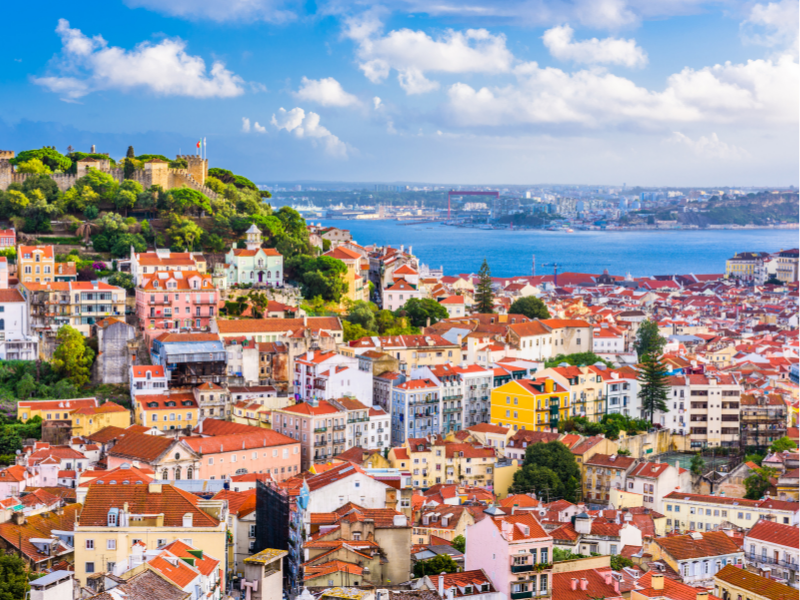
Lissabon is een stad van heuvels, licht op de rivier en oude trams, verspreid over de hellingen boven de brede monding van de Taag. Een groot deel van het centrum werd herbouwd na de grote aardbeving van 1755, waardoor de Baixa een van de vroegste geplande stadswijken van Europa is. Dit zijn de feiten en verhalen die de stad bijzonder maken.
10 leuke weetjes over Lissabon
- Een lift in plaats van een trap: de Elevador de Santa Justa, ontworpen door de in Porto geboren ingenieur Raoul Mesnier du Ponsard, brengt sinds 1902 passagiers van de Baixa omhoog richting Largo do Carmo.
- Een brug met twee namen: de lange rode hangbrug over de Taag ging in 1966 open als Salazarbrug. Na de Anjerrevolutie van 25 april 1974 kreeg hij de naam Ponte 25 de Abril.
- A king on a column: Rossio's official name is Praça D. Pedro IV, after the king whose statue has stood on the central column since 1870. An urban legend claims the statue was made for Emperor Maximilian of Mexico, but historians have shown the details, from the buttons to the charter in his hand, are Pedro's.
- Pavements as art: Lisbon's calçada portuguesa is laid by hand from small black and white stones. Rossio's dizzying wave pattern is the best known, and it is said to have inspired the famous promenade of Copacabana in Rio de Janeiro.
- Een recept van de monniken: bakkerij Pastéis de Belém verkoopt haar roomtaartjes sinds 1837, volgens een recept van de monniken van het nabijgelegen Jerónimosklooster.
- Two World Heritage monuments: the Jerónimos Monastery and the Belém Tower have been on UNESCO's World Heritage List together since 1983.
- A song of longing: fado, the melancholy music of Lisbon's old neighbourhoods, has been on UNESCO's list of intangible cultural heritage since 2011.
- A saint who was born here: Saint Anthony is known as 'of Padua', but he was born in Lisbon. On the night of 12 to 13 June the city celebrates him with street parties, grilled sardines and small pots of basil.
- Oude trams in steile straten: Lissabon rijdt nog met kleine gele trams naar een ontwerp uit de jaren dertig, omdat ze door de smalle, kronkelende straten passen. Lijn 28 is de bekendste en klimt door Graça, Alfama en Estrela.
- A theatre on the Inquisition's site: the National Theatre D. Maria II on the north side of Rossio stands where the Estaus Palace once housed the Portuguese Inquisition.
De aardbeving van 1755
On the morning of 1 November 1755, All Saints' Day, when many people were at Mass, a massive earthquake struck Lisbon. Within the hour a tsunami swept up the Tagus, and fires burned through the city for days. Tens of thousands of people died, and the royal palace on the riverfront, with its library and archives, was lost. The king's chief minister, later the Marquis of Pombal, took charge of the rebuilding. The Baixa was laid out again on a strict grid of wide, straight streets, with buildings framed by a flexible timber cage, the gaiola pombalina, designed to sway rather than collapse. Where the palace had stood, he created the vast Praça do Comércio.
Rossio en Restauradores uitgelegd
Rossio has been Lisbon's main square for centuries, a place of markets, celebrations and protests. Just to the north lies Praça dos Restauradores, with its obelisk recalling the restoration of Portuguese independence from Spain in 1640. On its west side stands the Foz Palace, begun in the 18th century and later named after the Marquis of Foz, who owned it in the late 19th century and gave it lavish interiors. Today it houses Lisbon's tourism offices.
Wat je moet eten in Lissabon
- Pastel de nata: het roomtaartje met knapperig deeg, het lekkerst lauw met kaneel en een koffie.
- Bacalhau: gedroogde, gezouten kabeljauw, het Portugese basisingrediënt. Probeer bacalhau à Brás, uitgeplozen met ei, ui en flinterdunne frietjes.
- Sardinhas assadas: gegrilde sardines, op hun best in juni tijdens de feesten voor Sint-Antonius.
- Bifana: een dun varkenslapje gemarineerd in knoflook en wijn, in een zacht broodje, vaak met mosterd.
- Ginjinha: een zure-kersenlikeur in kleine glaasjes. A Ginjinha, aan de Largo de São Domingos naast de Rossio, schenkt hem sinds 1840.
Goed om te weten voor je gaat
- Wear shoes with good grip: the polished stone pavements on Lisbon's hills are slippery, especially after rain.
- Veel musea en monumenten, waaronder het Jerónimosklooster, zijn op maandag gesloten, dus plan Belém op een andere dag.
- Trains to Sintra, with its palaces and gardens on UNESCO's World Heritage List, leave from Rossio station.
- Voor uitzicht klim je naar de miradouros: Senhora do Monte, Graça en São Pedro de Alcântara horen bij de mooiste, vooral bij zonsondergang.
Ontdek Lissabon met World City Trail
Onze schattenjacht in Lissabon maakt van deze plekken een spel op je telefoon. De route verbindt 10 stops en duurt ongeveer twee uur, met zo’n 49 minuten lopen, langs plekken als de Rossio en het Fozpaleis.
Bij elke stop los je een puzzel op en hoor je een kort verhaal, in je eigen tempo. Je kunt beginnen wanneer je wilt en spelen in het Nederlands, Engels, Duits, Frans, Italiaans, Spaans of Portugees.
Speel de schattenjacht in Lissabon →
Feiten gecontroleerd in oktober 2026.